
What the Gerund vs Participle Quiz measures
This quiz does not grade diagram tests, replace instructors, or certify syntax mastery from one session. It measures how much you agree with -ing role statements grouped four ways: gerund role labeling about activity subjects and objects; participle modifiers about describing nearby nouns; progressive helpers about is plus -ing ongoing action; and quiz not teacher substitute limits about unofficial framing and kind study groups. You rate 22 statements from strongly disagree to strongly agree, with reverse-worded traps so one lucky label guess cannot inflate every bar. Your answers also feed a second chart on closeness and trust habits, because syntax debates sometimes push writers toward harsh public dunking. The total becomes an index from 0 to 100 where higher means more reported role literacy on this screener, not proof you should skip textbooks.
Gerund role labeling
Activity subjects and objects.
Participle modifiers
Describe nearby nouns.
Progressive helpers
Be plus -ing action.
Quiz not teacher substitute
Mirror; teachers grade.
How it works
Answer 22 agreement items
Rate each statement from Strongly disagree to Strongly agree. Tap Next after each answer.
Answers sort into four domains
Each answer feeds one of four role study groups, and every item also feeds a closeness and trust layer.
See your index and charts
You get a 0 to 100 index, a band, four domain bars, and a second chart for intimacy habits.
Take the Gerund vs Participle Quiz
Answer 22 short statements to see your gerund versus participle role index, four domain bars, and a closeness and trust chart.
What your result means
Your index is the average of all 22 answers, scaled from 0 to 100, with reverse-worded items flipped first. Read quiz-not-teacher-substitute bars together with progressive helper habits before you treat a high score as classroom immunity. Cozy reflection supports kinder syntax nights; instructors still own graded proof.
| Band | Index range | Typical reading |
|---|---|---|
| Building role literacy | 0 to 35 | Fewer agreed habits on gerund roles, participle modifiers, progressive helpers, or unofficial limits. |
| Mixed role literacy | 36 to 65 | Solid modifier habits with myth slips about impossible gerund subjects or progressive confusion. |
| Strong role literacy | 66 to 100 | Frequent agreement with role labeling, modifiers, progressive helpers, and unofficial limits; still study play only. |
Tips at a glance
A quick takeaway graphic with topic tips (not your personal quiz scores). Start the quiz for your index, bands, and charts.
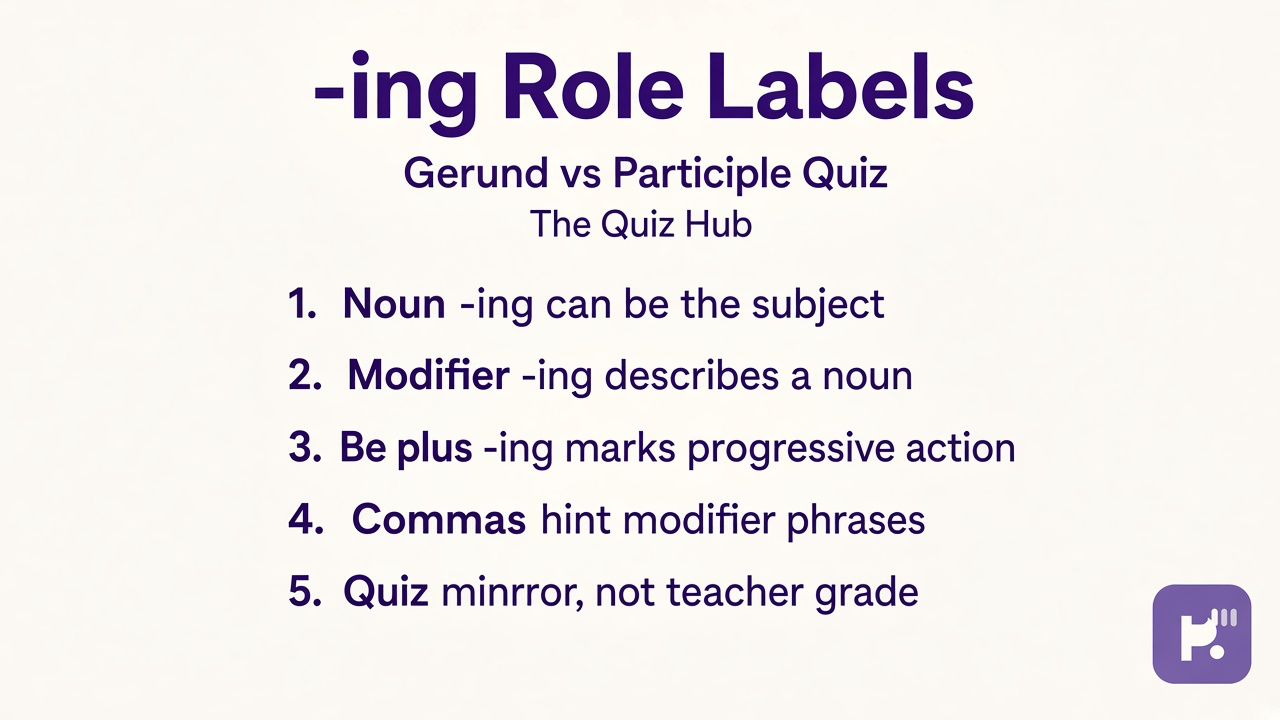
What this quiz can and cannot tell you
Can tell you
- Highlight gerund versus participle role habits worth revisiting before the next syntax unit
- Separate playful role reflection from teacher substitution or public dunk myths
- Encourage calm labeling in study groups without shame spirals
- Spark better questions about -ing jobs without claiming psychometric authority
Cannot tell you
- Replace teacher rubrics, diagram quizzes, or formal syntax exams
- Prove classroom rank or writing job clearance from one couch screener
- Give permission to mock classmates or spam syntax corrections from bar height
- Predict exact standardized diagram items from unofficial bars alone
Why gerund versus participle study needs roles, modifiers, progressives, and limits
Search traffic around gerund versus participle quizzes usually wants a mirror after a syntax diagram week, a college writing lab handout, or a study-group fight about whether swimming is a subject or a modifier, not a substitute teacher grade or dunk scoreboard. Those goals help when readers label activity nouns, spot participial modifiers, and separate progressive is plus -ing from gerund topics. They hurt when role bars become proof someone may correct every stranger, or when win jokes ignore consent because a couch screener looked tall.
Dr. James Whitfield reviews grammar screeners by pairing accurate role labeling with limits on teacher substitution myths. Gerund role labeling tracks activity subjects and objects. Participle modifiers tracks noun description. Progressive helpers tracks be-verb action frames. Quiz not teacher substitute keeps screeners separate from rubric dunking.
Real students mix bars. You might score high on participle modifiers while keeping progressive items moderate, which often describes careful readers who still argue tense labels under timer pressure. Reverse items catch impossible-gerund and no-participle-modifier myths; those shortcuts should not inflate bars meant to track layered study manners.
Pair results with siblings instead of forcing one -ing story. Our gerund quiz deepens noun roles and preposition objects without participle modifier stems here. Our gerund and infinitive quiz covers verb-pattern choice when enjoy versus want lists matter more than modifier jobs. Our gerunds participles and infinitives quiz offers combined verbal review when holistic charts fit better than role-only wording on this page. Browse the IQ and cognitive hub for more study play screeners.
Units rotate faster than meme threads clear. A participle bar might spike after one diagram sheet while progressive habits sleep until you retake calmly. Caption shares as unofficial role habits, credit teachers who assigned syntax charts, and skip ranking strangers who never asked for your label cosplay.
| Test | Focus |
|---|---|
| Gerund quiz | Preposition objects and gerund noun basics rather than participle modifier stems here |
| Gerund and infinitive quiz | Verb-pattern complements rather than modifier versus subject role labels here |
| Gerunds participles and infinitives quiz | Combined verbal overview rather than gerund-versus-participle-only lanes on this page |
Gerund vs Participle Quiz FAQ
What is the difference between a gerund and a participle?
On this screener, gerund items focus when -ing names an activity in subject or object slots. Participle items focus when -ing describes a nearby noun. Progressive items focus on is plus -ing action frames. Your teacher may use additional labels from your textbook.
What does the Gerund vs Participle Quiz measure?
It measures how much you agree with statements about gerund roles, participle modifiers, progressive helpers, and quiz-not-teacher-substitute limits. You get an index from 0 to 100 plus four bars. It reflects self-rated habits on this screener, not a classroom grade.
How is this different from the Gerund Quiz?
The gerund quiz centers noun roles and preposition objects. This quiz contrasts gerund subjects and objects with participial modifiers and progressive is plus -ing with separate stems.
Can a high score replace my syntax homework?
No. Limit items reject teacher substitution myths. High bars describe habits you endorsed here, not permission to skip instructor assignments.
Who reviewed this quiz?
Dr. James Whitfield reviewed the reflection framing, role not rubric separation, and result explanations. See our editorial policy for review standards.
Reviewed by
