
What the gas laws quiz measures
This quiz does not proctor AP Chemistry, grade lab practicals, or declare which classmate failed stoichiometry from bar height. It measures how much you agree with unofficial gas-law study statements grouped four ways: Boyle, Charles, and combined literacy about variable pairs and constants without law blur; unit and formula habits about Kelvin, pressure units, and PV=nRT assumptions without R cosplay; problem-solving humility about shown work and ideal gas limits without tutoring dunk threads; and quiz-not-AP-or-GCSE limits about unofficial warm-up separate from exam and lab safety cosplay. You rate 22 statements from strongly disagree to strongly agree, with reverse-worded items flipped first. Your answers also feed a second chart on closeness and trust habits. The total becomes an index from 0 to 100 where higher means more reported literacy habits on this screener.
Boyle, Charles, and combined literacy
Pressure, volume, and temperature relationships without law blur.
Unit and formula habits
Kelvin, atm, and PV=nRT with labeled variables.
Problem-solving humility
Shown work and assumptions without dunk threads.
Quiz not AP or GCSE gate
Warm-up reflection; not exam or lab proof.
How it works
Answer 22 agreement items
Rate each statement from Strongly disagree to Strongly agree. Tap Next after each answer.
Answers sort into four domains
Each answer feeds one of four gas law literacy groups, and every item also feeds a closeness and trust layer.
See your index and charts
You get a 0 to 100 index, a band, four domain bars, and a second chart for intimacy habits.
Take the Gas Laws Quiz
Answer 22 short statements to see your gas laws literacy index, four domain bars, and a closeness and trust chart.
What your result means
Your index is the average of all 22 answers, scaled from 0 to 100, with reverse-worded items flipped first. Read Boyle-Charles and unit bars together with exam-limit scores before you treat a high total as AP clearance.
| Band | Index range | Typical reading |
|---|---|---|
| Building gas laws literacy | 0 to 35 | Fewer agreed habits on Boyle-Charles recall, units, problem humility, or exam-limit items. |
| Mixed gas laws literacy | 36 to 65 | Solid recall in some domains with law-blur traps, unit slips, or exam cosplay. |
| Strong gas laws literacy | 66 to 100 | Frequent agreement with gas law, unit, and humility literacy plus unofficial exam limits. |
Tips at a glance
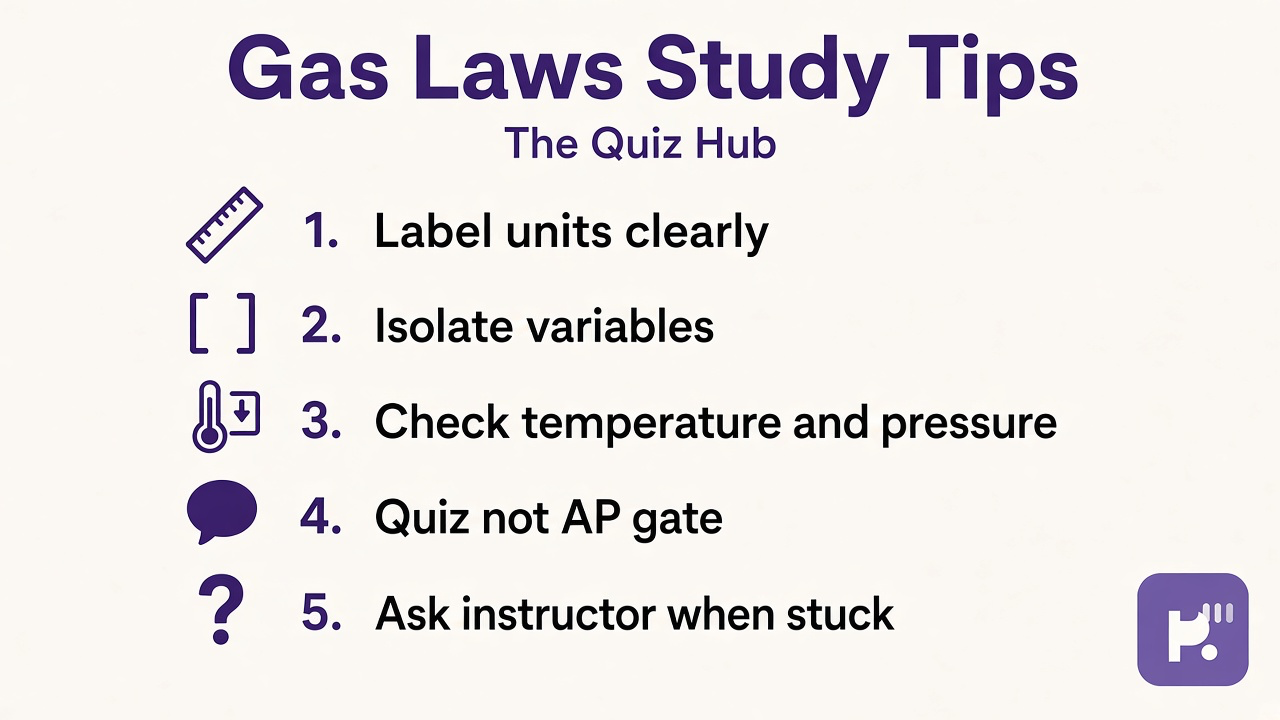
A quick takeaway graphic with topic tips (not your personal quiz scores). Start the quiz for your index, bands, and charts.
What this quiz can and cannot tell you
Can tell you
- Organize gas law homework habits in plain language before exams
- Separate gas law literacy from general chemistry siblings on this hub
- Notice law-blur cosplay without public tutoring dunk threads
- Spark better unit-check questions without claiming exam authority
Cannot tell you
- Replace AP or GCSE exams, instructor rubrics, or lab safety certification
- Prove course exemption or internship readiness from one couch screener
- Give permission to harass classmates over one unit typo online
- Substitute for instructor feedback on graded lab reports
Why gas law quizzes need constants, units, and exam separation
Search traffic around gas laws quizzes usually wants a mirror after one PV=nRT cram sheet, not AP clearance or tutoring dunk threads. Those goals help when readers label constants, convert to Kelvin, and show unit cancellations. They hurt when laws get swapped without conditions, or when agree bars get treated as lab safety waivers. Gas law literacy works best when it names unit habits and exam limits together while staying distinct from general chemistry trivia siblings.
Dr. James Whitfield reviews iq-cognitive science screeners with a simple split: reward honest law vocabulary and honest limits on exam substitution myths at the same time. Boyle, Charles, and combined literacy tracks variable pairs without law blur. Unit and formula habits tracks Kelvin, pressure consistency, and PV=nRT assumptions. Problem-solving humility tracks shown work and ideal gas limits without dunk culture. Quiz not AP or GCSE gate keeps screeners separate from timed finals and safety waiver fantasies.
Real students mix bars. You might score high on units while keeping combined law literacy moderate, which often describes careful lab partners who convert well yet still argue which variable is constant. Reverse items catch overconfidence: interchangeable law myths, meme key rights, instructor-question skips, or lab waiver claims should not inflate bars meant to track layered study manners.
Pair results with siblings on this hub instead of forcing one chemistry story. Our chemistry quiz explores broader reaction and symbol recall when your class moves beyond gas units. Our organic chemistry quiz stays on carbon chemistry lanes rather than ideal gas stems here. Our biochemistry quiz angles toward biomolecule themes rather than Boyle homework on this page. Browse the IQ and cognitive test hub for more study screeners. Caption shares as chemistry warm-up, show units, and skip grading strangers who never asked for a quiz.
Exam calendars rotate faster than meme threads clear. A unit bar might spike after one lab week while combined law recall sleeps until you retake calmly. When you share results, say unofficial study habits. Retake after one free-response practice set and watch whether exam-limit bars stay high even if formula vocabulary rises.
| Test | Focus |
|---|---|
| Chemistry quiz | General chemistry recall rather than gas law constant-variable habits on this page |
| Organic chemistry quiz | Organic reaction themes rather than Boyle and Charles literacy here |
| Biochemistry quiz | Biomolecule literacy rather than ideal gas unit habits on this screener |
Gas Laws Quiz FAQ
What does the Gas Laws Quiz measure?
It measures how much you agree with statements about Boyle, Charles, and combined literacy, unit and formula habits, problem-solving humility, and quiz-not-AP-or-GCSE limits. You get an index from 0 to 100 plus four bars. It reflects self-reported study habits, not exam scores.
Does this quiz solve PV=nRT homework for me?
No. It mirrors study attitudes and literacy habits. You still need shown work, instructor feedback, and exam practice for graded problems.
Why emphasize Kelvin conversions?
Gas law equations use absolute temperature. Celsius slips are a common source of wrong answers on labs and tests.
Can this replace AP Chemistry or GCSE exams?
No. Instructors and official exam boards own timed gates and lab safety rules. This page is unofficial warm-up reflection only.
Who reviewed this quiz?
Dr. James Whitfield reviewed the educational framing, exam separation, unit discipline language, and result explanations. See our editorial policy for review standards.
Reviewed by
