What the G Davis Creativity Questionnaire measures
This quiz does not administer Gary A. Davis mailed Creativity Assessment Packet materials, replace school psychologists, or certify hireability from one couch session. It measures how much you agree with creativity literacy statements grouped four ways: divergent play curiosity about what-if prompts, mixed metaphors, and improv loosening without IQ dunk culture; draft persistence habits about messy middles, revision returns, and crediting instructors; humble creative shares about opt-in feedback, bandwidth checks, and refusing soul ranking from one assignment; and quiz not Davis battery limits about unofficial reflection, refusing bar charts as hiring or moral rank, and keeping respect for quiet processors. You rate 22 statements from strongly disagree to strongly agree, with reverse-worded traps so one lucky guess cannot inflate every bar. Your answers also feed a second chart on closeness and trust habits, because critique circles sometimes spill into friendship stress when humility scores dip. The total becomes an index from 0 to 100 where higher means more reported creativity literacy humility on this screener, not validated Davis scores.
Divergent play curiosity
What-if prompts without IQ dunk culture.
Draft persistence habits
Messy middles and revision returns.
Humble creative shares
Opt-in feedback and bandwidth checks.
Quiz not Davis battery
Literacy mirror only; mailed CAP lives elsewhere.
How it works
Answer 22 agreement items
Rate each statement from Strongly disagree to Strongly agree. Tap Next after each answer.
Answers sort into four domains
Each answer feeds one of four creativity literacy groups, and every item also feeds a closeness and trust layer.
See your index and charts
You get a 0 to 100 index, a band, four domain bars, and a second chart for intimacy habits.
Take the G Davis Creativity Questionnaire
Answer 22 short statements to see your G Davis creativity literacy index, four domain bars, and a closeness and trust chart.
What your result means
Your index is the average of all 22 answers, scaled from 0 to 100, with reverse-worded items flipped first. Read quiz-not-Davis-battery bars together with humble creative shares before you treat a high score as genius proof. Cozy reflection supports kinder studios; mailed batteries and hiring panels still own official gates.
| Band | Index range | Typical reading |
|---|---|---|
| Quieter creativity literacy | 0 to 35 | Fewer agreed habits on divergent play, draft persistence, humble shares, or Davis-limit items. |
| Mixed creativity literacy | 36 to 65 | Solid divergent play with reserve slips, perfectionism, public ranking, or Davis hire myths. |
| Stronger creativity literacy | 66 to 100 | Frequent agreement with divergent play, persistence, humble shares, and Davis limits; still unofficial only. |
Tips at a glance
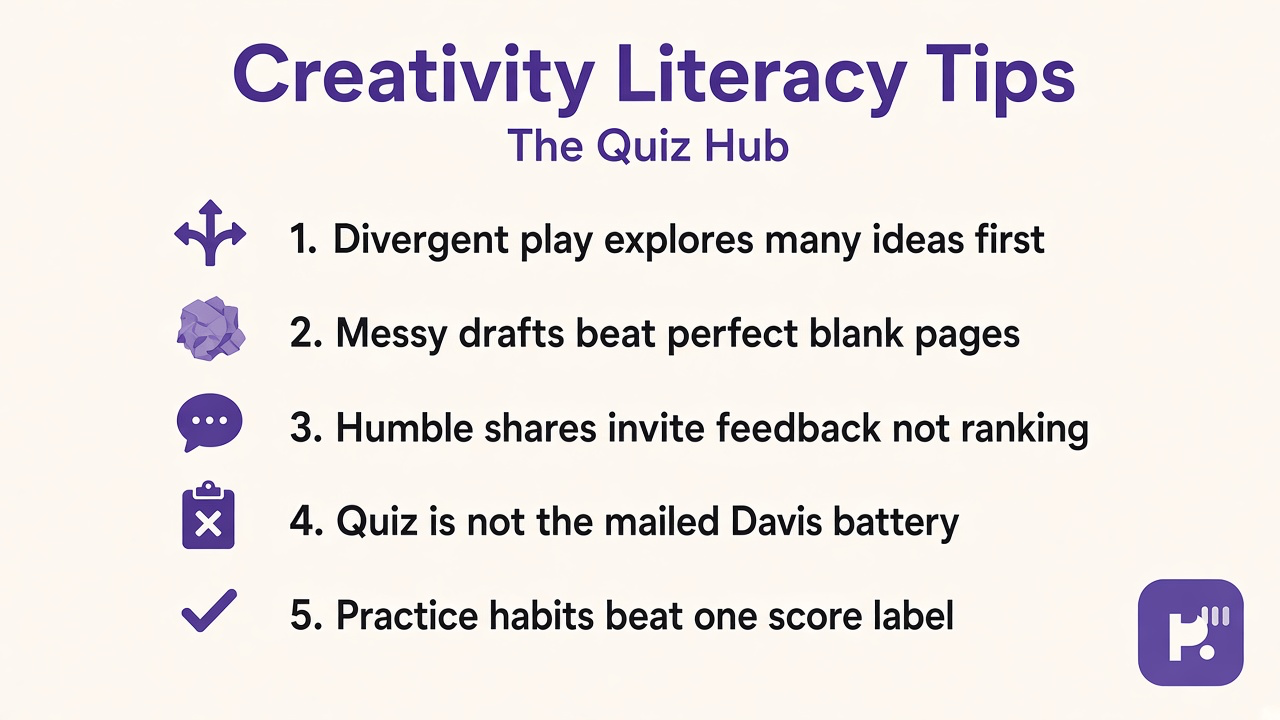
A quick takeaway graphic with topic tips (not your personal quiz scores). Start the quiz for your index, bands, and charts.
What this quiz can and cannot tell you
Can tell you
- Highlight divergent, persistence, and share habits worth revisiting before the next critique circle
- Separate unofficial literacy from mailed Davis battery and inclination questionnaire siblings
- Encourage opt-in feedback without public soul ranking
- Spark better class questions about creative process without claiming clinical authority
Cannot tell you
- Replace mailed Davis Creativity Assessment Packet administration or school psychological testing
- Prove creative genius, IQ, hireability, or portfolio grades from one couch screener
- Give permission to rank classmates, dump heavy material without consent, or skip assigned practice
- Diagnose clinical conditions or certify art school admission from trivia bars alone
G Davis creativity names, mailed batteries, and unofficial literacy limits
Search traffic around G Davis creativity questionnaires usually wants a verdict: am I imaginative enough, am I performing creativity wrong, or finally understood by a famous research name. Those questions help when they spark honesty about divergent play and sharing boundaries. They hurt when classroom warm-ups become excuses to skip syllabus work, or when quiet processors get read as uncreative in every culture. Reflection language works best when play and humility stay in the same sentence while staying distinct from the personality creativity inclination sibling.
Dr. Priya Sharma reviews personality psychology screeners with a simple split: reward honest divergent curiosity and honest limits on mailed battery substitution myths at the same time. Divergent play curiosity tracks what-if prompts without IQ dunk culture. Draft persistence habits tracks messy middles and revision returns. Humble creative shares tracks opt-in feedback and bandwidth checks. Quiz not Davis battery keeps screeners separate from CAP mail cosplay, genius hiring ads, and bar-height creativity verdicts.
Real students mix bars. You might score high on divergent play while strong on limits, which often describes experimental people who still refuse to diagnose strangers. You might score high on studio habits while low on humble shares, which is a cue for smaller drafts before public posts, not shame. Reverse items catch myths: no painting means no creativity, vulnerability only counts with strangers, skipping practice because quizzes certified you, or web scores type other people should not inflate bars meant to track habits.
Pair results with siblings on this hub instead of forcing one creativity story. Our personality creativity inclination questionnaire by g davis explores inclination stems with a separate item bank rather than divergent warm-up habits here. Our creative potential self assessment questionnaire angles toward risk-try and growth belief language when you want parallel reflection without Davis battery framing on this page. Browse the personality and psychology hub for more low-stakes screeners. Share scores as conversation starters, not as orders to perform in every critique circle.
Portfolio seasons and research name drops rotate faster than syllabus rubrics on classroom drives. A humble-share bar might dip after one public critique week while divergent play stays high until you retake calmly. When you share results, say unofficial creativity literacy habits. When you borrow tips, credit instructors who taught revision and classmates who asked for opt-in feedback. Retake after one studio unit and watch whether Davis-limit bars stay high even if divergent enthusiasm rises, which often means you separated cozy creative joy from battery substitution pressure.
| Test | Focus |
|---|---|
| Personality creativity inclination questionnaire by g davis | Inclination scale stems rather than divergent warm-up and draft persistence habits on this page |
| Creative potential self assessment questionnaire | Risk-try and growth belief cues rather than Davis battery literacy limits here |
| Emotional creativity questionnaire ECQ-1127 | Emotional creativity habit themes rather than G Davis classroom literacy framing here |
G Davis Creativity Questionnaire FAQ
What does the G Davis Creativity Questionnaire measure?
It measures how much you agree with statements about divergent play curiosity, draft persistence habits, humble creative shares, and quiz-not-Davis-battery limits. You get an index from 0 to 100 plus four bars. It reflects self-rated literacy habits on this screener, not mailed CAP scores.
Is this the official Davis Creativity Assessment Packet?
No. This page is unofficial literacy reflection only. Mailed Davis batteries and school psychologists use separate materials and procedures.
How is this different from the personality creativity inclination questionnaire by g davis?
This quiz centers divergent warm-ups, draft persistence, and humble shares with separate stems. The inclination sibling uses its own item bank focused on inclination scale themes.
Can a high score prove I am a creative genius or get me hired?
No. Quiz not Davis battery items reject genius and hiring myths. High bars describe habits you endorsed here, not employer decisions or validated test scores.
Who reviewed this quiz?
Dr. Priya Sharma reviewed the reflection framing, Davis battery separation, humble share norms, and result explanations. See our editorial policy for review standards.
Reviewed by