What the From Author Henri Tajfel quiz measures
This quiz does not administer published Social Identity Theory batteries, predict election outcomes from one session, or declare whether someone must join a pile-on from bar height. It measures how much you agree with unofficial Tajfel-literacy statements grouped four ways: social identity literacy about membership and self-concept without moral rank cosplay; minimal group literacy about arbitrary label bias as a warning not a cruelty cheat code; out-group fairness literacy about refusing dunk memes and dehumanizing joke formats; and unofficial Tajfel limits about Tajfel-inspired unofficial framing, refusal to treat agree bars as mailed SIT totals, consented sharing, and zero permission for in-group dunk threads. You rate 22 statements from strongly disagree to strongly agree, with reverse-worded items flipped first so agreeable mood cannot hide dunk or pile-on cosplay. Your answers also feed a second chart on closeness and trust habits, because clique pressure sometimes blocks honest dissent. The total becomes an index from 0 to 100 where higher means more reported literacy habits on this screener, not proof your communities are fair forever.
Social identity literacy
Membership language without moral rank cosplay.
Minimal group literacy
Random label bias warnings without cruelty excuses.
Out-group fairness literacy
Disagreement without dunk memes or dehumanizing jokes.
Unofficial Tajfel limits
Educational reflection; not published SIT scores.
How it works
Answer 22 agreement items
Rate each statement from Strongly disagree to Strongly agree. Tap Next after each answer.
Answers sort into four domains
Each answer feeds one of four Tajfel literacy groups, and every item also feeds a closeness and trust layer.
See your index and charts
You get a 0 to 100 index, a band, four domain bars, and a second chart for intimacy habits.
Take the From Author Henri Tajfel
Answer 22 short statements to see your Tajfel social identity literacy index, four domain bars, and a closeness and trust chart.
What your result means
Your index is the average of all 22 answers, scaled from 0 to 100, with reverse-worded items flipped first. Read social identity and minimal group bars together with fairness and unofficial limit scores before you treat a high total as proof your fandom is harmless. Educational reflection supports kinder group talk; mediators, anti-bullying policy, and clinicians still own responses when threats or harassment are active.
| Band | Index range | Typical reading |
|---|---|---|
| Building Tajfel literacy | 0 to 35 | Fewer agreed habits on social identity vocabulary, minimal group themes, out-group fairness literacy, or unofficial Tajfel humility on this screener. |
| Mixed Tajfel literacy | 36 to 65 | Solid vocabulary in some domains with dunk memes, hashtag pile-ons, SIT cosplay, or fandom verdict corners. |
| Strong Tajfel literacy | 66 to 100 | Frequent agreement with social identity, minimal group, and fairness literacy plus unofficial humility; still not SIT scores or moderator authority. |
Tips at a glance
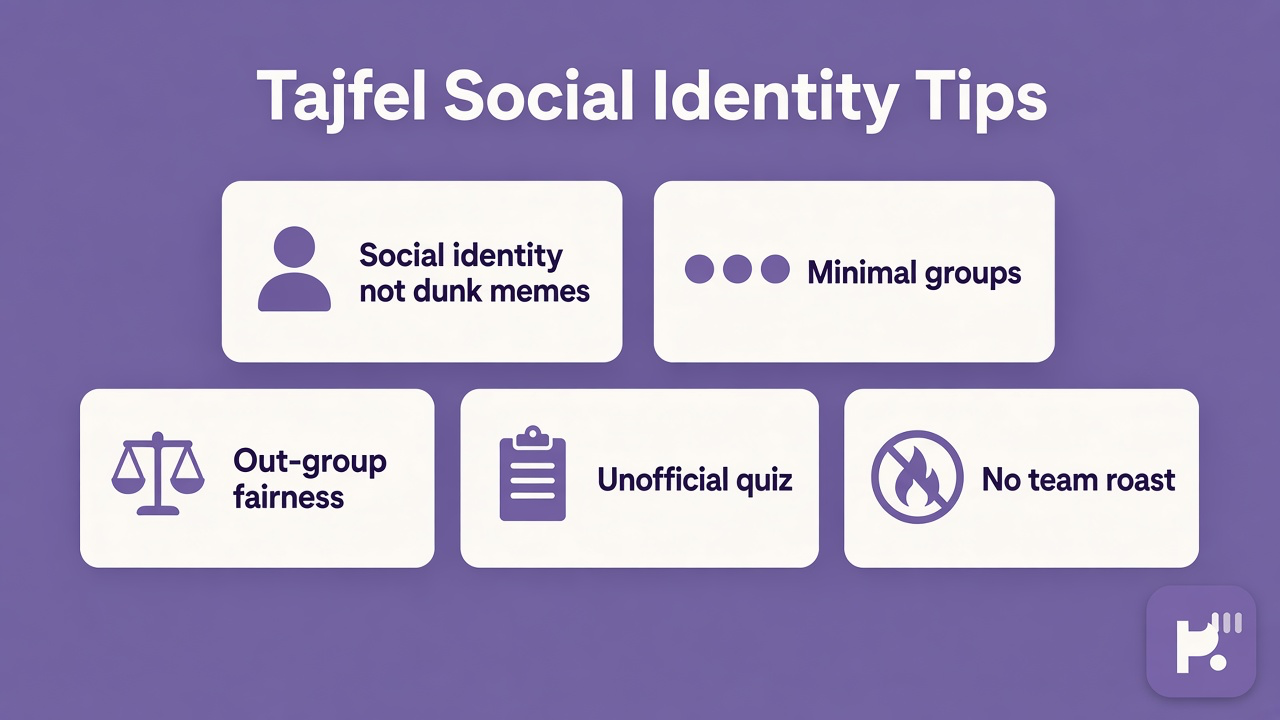
A quick takeaway graphic with topic tips (not your personal quiz scores). Start the quiz for your index, bands, and charts.
What this quiz can and cannot tell you
Can tell you
- Translate Tajfel social identity and minimal group language into one honest team or fandom conversation starter
- Separate author identity literacy from prosocial identity frequency siblings on this hub
- Notice in-group favoritism pulls without public pile-ons or dunk memes
- Spark better questions about social identity research without claiming licensed clinician credentials
Cannot tell you
- Replace anti-bullying policy, mediation, HR processes, or safety planning when threats appear
- Prove a rival fandom deserves harassment from one agree screener
- Publish official SIT scores or certify Tajfel clinic cutoffs
- Give permission to coordinate in-group dunk threads from bar height
Why Tajfel literacy needs minimal group warnings and anti dunk limits
Search traffic around Henri Tajfel often follows social psychology courses citing social identity and minimal groups while social feeds turn those ideas into in-group dunk memes and proof rivals deserve pile-ons. Those goals help when readers name membership pride, recall arbitrary label bias, and refuse dehumanizing joke formats. They hurt when literacy bars become proof someone may coordinate harassment hashtags, or when agree totals replace anti-bullying policy when threats are already present. Tajfel literacy works best when it pairs identity vocabulary with unofficial limits and stays distinct from prosocial identity frequency siblings on this hub.
Dr. Priya Sharma reviews personality screeners with a simple split: reward honest social identity and minimal group language and honest refusal of public dunk threads at the same time. Social identity literacy tracks membership without moral rank cosplay. Minimal group literacy tracks bias warnings without cruelty cheat codes. Out-group fairness literacy tracks disagreement without dehumanizing memes. Unofficial Tajfel limits track unofficial framing, consented sharing, and humility about mailed SIT batteries.
Real people mix bars. You might score high on social identity language while keeping fairness awareness moderate, which often describes fans who love a team yet still feel dunk urges under stress. You might score high literacy with softer limit items, which can mean you avoid public posts yet still treat quiz totals like fandom audit notes. Reverse items catch overconfidence: loyalty dunk posts, natural bias cruelty myths, win-at-all-costs fairness skips, or bar-height pile-on polls should not inflate scores meant to track layered habits.
Pair results with siblings on this hub instead of forcing one group story. Our content of prosocial identity GSA explores separate give-and-help frequency stems rather than Tajfel minimal group author framing on this page. Our from author Gordon W Allport sibling emphasizes prejudice and contact literacy with its own stems rather than unofficial Tajfel limits here. Our from author Hazel Rose Markus stays on independent and interdependent self-construal literacy rather than social identity dunk refusal on this screener. Browse the personality and psychology hub for more reflection screeners. Share scores as private conversation starters with consent, not as orders about who must join a pile-on.
Playoff season and algorithm feeds move faster than one calm fairness pause on a sticky note. A minimal group bar might dip after one random team assignment meme while social identity recall stays high until you retake gently. When you share results, say unofficial literacy habits. When you borrow tips, credit researchers who taught you Tajfel vocabulary and rivals who deserve dignity off-screen. Retake after one hard month and watch whether unofficial limit bars stay high even if social identity items rise, which often means you separated curious reading from in-group dunk pressure.
| Test | Focus |
|---|---|
| Content of prosocial identity GSA | Separate prosocial give-and-help frequency stems rather than Tajfel social identity author framing on this page |
| From author Gordon W Allport | Prejudice and contact author literacy rather than minimal group unofficial limits on this screener |
| From author Hazel Rose Markus | Independent and interdependent self-construal literacy rather than out-group fairness dunk refusal here |
From Author Henri Tajfel FAQ
What does the From Author Henri Tajfel quiz measure?
It measures how much you agree with statements about social identity literacy, minimal group literacy, out-group fairness literacy, and unofficial Tajfel limits. You get an index from 0 to 100 plus four bars. It reflects self-reported awareness habits on this screener, not published SIT scores.
Does social identity language mean my in-group may dunk out-groups online?
No. Fairness and limit items explicitly reject in-group dunk memes and harassment hashtags. Literacy bars describe vocabulary habits you endorsed here, not loyalty orders about rivals.
What do minimal group findings imply about real-world bias?
Minimal group items treat arbitrary labels as a warning that favoritism can appear quickly, not as a cheat code that cruelty is justified.
Is this the same as the content of prosocial identity GSA quiz?
No. The GSA sibling uses separate give-and-help frequency stems. This page focuses on Tajfel social identity and minimal group author literacy.
Who reviewed this quiz?
Dr. Priya Sharma reviewed the unofficial framing, social identity not dunk separation, limit tone, and result explanations. See our editorial policy for review standards.
Reviewed by