What the Freud S Stages Of Development Quiz measures
This quiz does not provide therapy, diagnose personality disorders, or administer licensed Freudian assessments. It measures how much you agree with statements in four groups: five stages order about naming and sequencing oral through genital themes at intro depth; psychosexual themes about feeding and dependency talk, anal control language, phallic identity conflict summaries, latency pause, and genital mature intimacy vocabulary teachers pair with stages; modern theory limits about teaching Freud as historical theory, feminist and cultural critique, individual variation, and refusing habit-to-stage fortune telling; and quiz not therapy diagnosis about study-only framing, clinician interviews you still need for clinical questions, and refusing to type people from social clips or treat web bars like therapy credentials. You rate 22 statements from strongly disagree to strongly agree, with reverse-worded items so autopilot meme answers cannot inflate every bar. Your answers also feed a second chart on closeness and trust habits, because psych searches sometimes overlap with parasocial certainty about strangers. The total becomes an index from 0 to 100 where higher means more endorsed Freud literacy on this screener, not proof you finished every psychosexual task on schedule.
Five stages order
Sequence from oral themes through genital language at textbook depth.
Psychosexual themes
Pleasure-zone vocabulary teachers link to each stage in survey courses.
Modern theory limits
Critique, culture, and variation beside century-old claims.
Quiz not therapy diagnosis
Classroom literacy; therapy and clinical assessment stay separate.
How it works
Answer 22 agreement items
Rate each statement from Strongly disagree to Strongly agree. Tap Next after each answer.
Answers sort into four domains
Each answer feeds one of four Freud literacy groups, and every item also feeds a closeness and trust layer.
See your index and charts
You get a 0 to 100 index, a band, and two bar charts you can compare before a personality psych unit test.
Take the Freud S Stages Of Development Quiz
Answer 22 short statements to see your Freud psychosexual stage literacy index, four domain bars, and a closeness and trust chart.
What your result means
Your index is the average of all 22 answers, scaled from 0 to 100, with reverse-worded myth items flipped first. Read quiz-not-therapy diagnosis with modern theory limits bars before you treat any total as therapy clearance or moral rank. Distress that disrupts safety deserves clinicians, not stage memes.
| Band | Index range | Typical reading |
|---|---|---|
| Building Freud literacy | 0 to 35 | Fewer agreed facts on stage order, themes, modern limits, or therapy boundaries on this screener. |
| Mixed Freud literacy | 36 to 65 | Solid facts in some domains with order slips, theme gaps, nail-biting myths, or typing traps on others. |
| Stronger Freud literacy | 66 to 100 | Frequent agreement on order, themes, modern limits, and therapy boundaries; still not clinical assessment. |
Tips at a glance
A quick takeaway graphic with topic tips (not your personal quiz scores). Start the quiz for your index, bands, and charts.
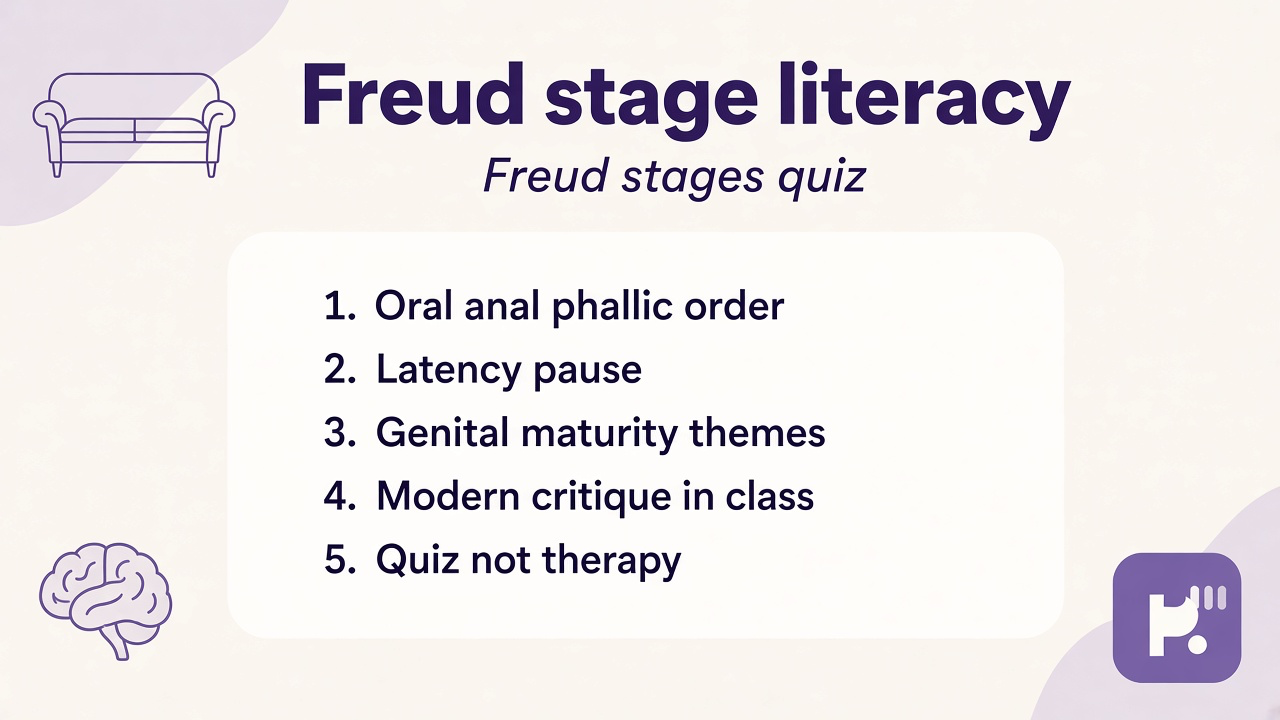
What this quiz can and cannot tell you
Can tell you
- Highlight stage order and theme vocabulary worth revisiting during personality psych study
- Separate unofficial literacy from therapy and licensed psychoanalytic assessment
- Encourage critique language without shaming individual timelines or parents
- Spark better syllabus questions without typing strangers online
Cannot tell you
- Replace therapy, psychiatry, or licensed psychoanalytic evaluations
- Diagnose fixation, trauma, or attachment injuries from one agree screener
- Prove you failed or passed a childhood stage on a fixed calendar
- Authorize labeling friends, partners, or children from one behavior video
Freud literacy needs modern critique beside stage names
Students search Freud quizzes when personality psych units start, parenting threads argue about oral memes, and influencers type strangers from one habit clip. Those goals help when readers treat bars as syllabus maps for order and theme language. They hurt when dated theory becomes moral rank, fixation talk shames adults, or unofficial pages pose as therapy replacements.
Dr. Priya Sharma reviews personality psychology literacy screeners with a simple split: reward honest agreement with widely taught stage facts and honest limits on clinical overreach at the same time. Five stages order keeps oral-through-genital sequencing visible beside swapped-stage myths. Psychosexual themes keeps feeding, control, identity conflict, latency pause, and mature intimacy pairing visible beside nail-biting doom stereotypes. Modern theory limits keeps critique, culture, and variation visible beside missed-milestone shame talk. Quiz not therapy diagnosis keeps study disclaimers visible beside typing strangers or treating web bars like licensure.
Real students mix bars. You might score high on theme names while moderate on order, which often describes meme exposure before the first chart sketch. You might score high on modern limits with strong therapy boundaries, which can mean solid humility without claiming therapist authority. Reverse items catch sloppy answers: latency before oral, habit jokes as fixed destiny, missed ages banning later growth, or web scores granting therapy licenses should not inflate bars meant to track layered study habits.
Pair results with siblings on this hub instead of forcing one developmental story. Our Erikson stages of development quiz explores psychosocial crises when lifespan units stack beside Freud week. Our Freud quiz stays on broader Freud trivia and defense habit lanes with stems separate from psychosexual order on this page. Browse the personality and psychology hub for more unofficial reflection screeners. Caption shares as study notes, not diagnosis badges.
Syllabus seasons move faster than one viral fixation quote. Internships, caregiving, and therapy journeys change which theme language feels alive. When you share results, say clinicians beat unofficial bars for clinical questions. When you borrow tips, credit professors who taught critique beside names. Retake after the unit final and notice whether therapy limit bars stay high even when order trivia spikes, which often marks healthier study habits than stage dunking on friends.
| Test | Focus |
|---|---|
| Erikson stages of development quiz | Psychosocial crisis literacy rather than Freud psychosexual stage order on this page |
| Freud quiz | Broader Freud trivia and defense themes rather than five-stage psychosexual sequencing here |
| Personality and psychology hub | More unofficial model screeners when you want reflection without clinical framing |
Freud S Stages Of Development Quiz FAQ
What does the Freud S Stages Of Development Quiz measure?
It measures how much you agree with statements about five stage order, psychosexual themes, modern theory limits, and quiz-not-therapy boundaries. You get an index from 0 to 100 plus four bars. It describes self-rated study literacy on this screener, not a clinical personality profile.
Is this quiz therapy or a licensed Freudian assessment?
No. This is unofficial classroom literacy trivia. Therapists and clinicians use interviews and protocols this page does not provide. Do not treat your index as diagnosis or treatment planning.
Does a habit joke mean I am stuck in one stage forever?
No. Intro stage language is simplified teaching vocabulary with heavy critique in modern courses. Habits, culture, and trauma context matter. This screener does not score your worth from one behavior.
Why include modern limit items beside stage facts?
Freud searches often skip therapy boundaries and historical critique. Limit bars keep study reflection separate from typing strangers or treating web scores like clinician credentials.
Who reviewed this quiz?
Dr. Priya Sharma reviewed the educational framing, therapy separation, modern critique language, and result explanations. See our editorial policy for review standards.
Reviewed by