What Frankfurt Self Concept Scales FSKN measures
This quiz does not administer the licensed Frankfurt Self-Concept Scales (FSKN), diagnose depression or personality disorders, or replace counseling when self-worth thoughts turn unsafe. It measures how much you agree with self-concept habit statements grouped four ways: competence self-concept habits about skill practice, help-seeking, and mistake-as-data framing without global stupidity labels; social acceptance reflection about reciprocal belonging, awkward-moment perspective, and refusing applause-only crowds; self-worth reflection habits about steady respect on off days, challenging perfection scripts, and separating personhood from grades or likes; and quiz not clinical diagnosis about unofficial framing, kindness captions, and refusing viral worth rankings from bar height. You rate 22 statements from strongly disagree to strongly agree, with reverse-worded traps so one lucky guess cannot inflate every bar. Your answers also feed a second chart on closeness and trust habits, because shame about competence sometimes blocks asking for support. The total becomes an index from 0 to 100 where higher means more reported self-concept literacy on this screener, not proof you hold clinical authority over anyone else worth.
Competence self-concept habits
Skills as practice, help-seeking, mistakes as data.
Social acceptance reflection
Reciprocal belonging without popularity court drama.
Self-worth reflection habits
Steady respect beyond grades, likes, or perfection.
Quiz not clinical diagnosis
Reflection only; licensed tools belong with clinicians.
How it works
Answer 22 agreement items
Rate each statement from Strongly disagree to Strongly agree. Tap Next after each answer.
Answers sort into four domains
Each answer feeds one of four self-concept groups, and every item also feeds a closeness and trust layer.
See your index and charts
You get a 0 to 100 index, a band, four domain bars, and a second chart for intimacy habits.
Take the Frankfurt Self Concept Scales FSKN
Answer 22 short statements to see your Frankfurt self-concept reflection index, four domain bars, and a closeness and trust chart.
What your result means
Your index is the average of all 22 answers, scaled from 0 to 100, with reverse-worded items flipped first. Read quiz-not-clinical bars together with self-worth reflection before you treat a high score as therapy proof. Playful reflection supports kinder conversations; licensed clinicians still own validated self-concept assessment when daily life shrinks.
| Band | Index range | Typical reading |
|---|---|---|
| Quieter self-concept literacy | 0 to 35 | Fewer agreed items on competence, social acceptance, self-worth, or quiz-not-clinical limits on this screener. |
| Mixed self-concept literacy | 36 to 65 | Solid competence or worth habits with social comparison slips, perfection myths, diagnostic cosplay, or viral ranking traps. |
| Strong self-concept literacy | 66 to 100 | Frequent agreement with competence, acceptance, self-worth, and unofficial limits; still reflection only. |
Tips at a glance
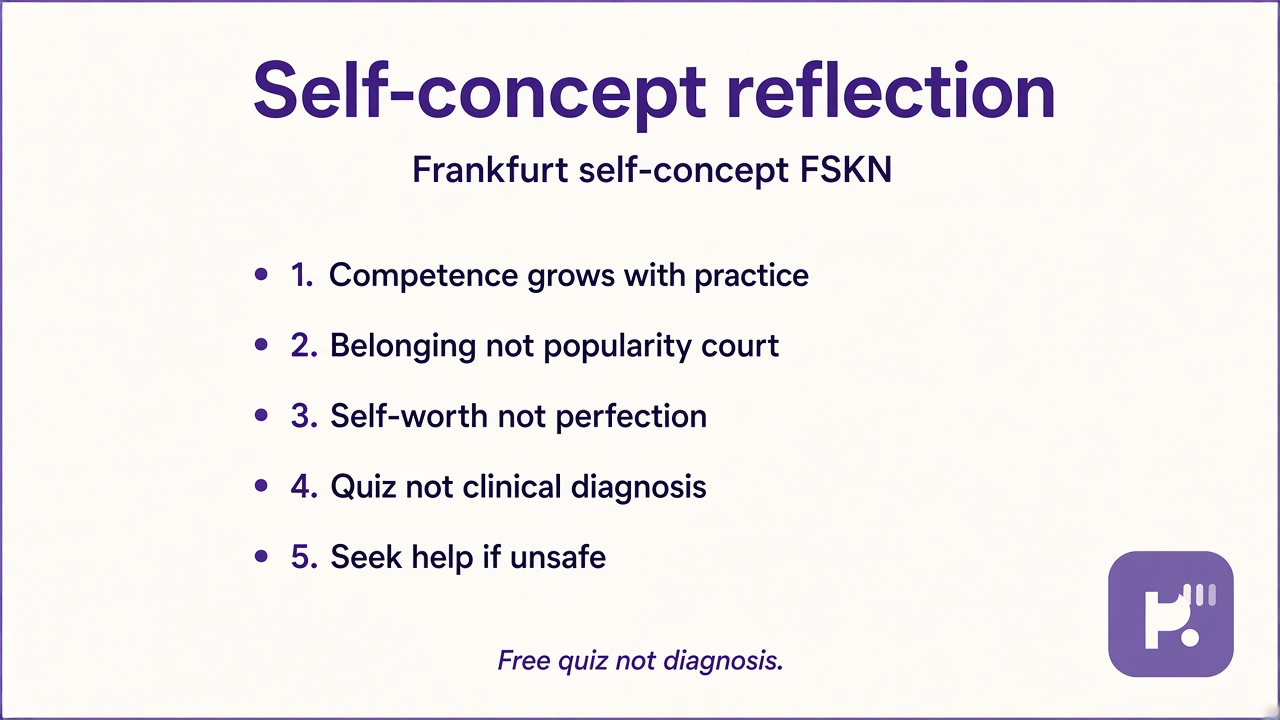
A quick takeaway graphic with topic tips (not your personal quiz scores). Start the quiz for your index, bands, and charts.
What this quiz can and cannot tell you
Can tell you
- Highlight competence, belonging, and self-worth habits worth revisiting before the next comparison spiral
- Separate unofficial reflection from licensed FSKN scoring or viral esteem dunking
- Encourage professional help prompts when shame or mood limits roles for weeks
- Spark better self-talk conversations without claiming diagnostic authority
Cannot tell you
- Replace licensed FSKN administration, clinical interviews, or validated self-esteem batteries
- Diagnose depression, anxiety, or personality disorders from one couch screener
- Prove moral worth, hiring fitness, or relationship rank from bar height
- Give permission to label strangers as low self-esteem because your bars look higher
Why Frankfurt-themed self-concept mirrors need competence, belonging, and unofficial framing
Search traffic around Frankfurt self-concept language usually wants two things: vocabulary for competence and belonging dips, and guardrails when meme culture treats self-esteem like a public scoreboard. Those goals help when readers name skill practice honestly, check reciprocal friendships, and hold worth steady on off days. They hurt when mirror bars become FSKN cosplay, or when comparison threads dunk strangers. Self-concept literacy works best when it names competence, acceptance, worth, and unofficial limits together.
Dr. Priya Sharma reviews personality psychology self-concept screeners with a simple split: reward honest competence habits and honest limits on clinical pretense at the same time. Competence self-concept habits tracks help-seeking and mistake-as-data without stupidity myths. Social acceptance reflection tracks belonging without hourly text panic or applause-only crowds. Self-worth reflection tracks steady respect without outperform-everyone scripts. Quiz not clinical diagnosis keeps screeners separate from licensed FSKN reports and viral ranking games.
Real players mix bars. You might score high on competence while keeping social acceptance moderate, which often describes capable people who still need friend reciprocity checks after lonely seasons. You might score high self-worth with softer limit items, which can mean strong inner talk yet occasional mirror posts like diagnostic proof. Reverse items catch overconfidence: stupidity labels for help-seekers, gifted-no-feedback myths, text-back panic, applause-only belonging, outperform-everyone worth, or perfect scores licensing low-esteem labels on strangers should not inflate bars meant to track kind self-concept habits.
Pair results with siblings on this hub instead of forcing one worth story. Our self esteem test explores broader esteem habits with stems separate from Frankfurt-themed competence language here. Our basic foundations of self esteem CSW sibling angles toward foundational worth reflection rather than social acceptance reciprocity items on this page. Our self worth quiz stays on intrinsic value language when job-title math needs a lighter lane. Browse the personality and psychology hub for more low-stakes screeners. Caption shares as fun reflection and skip sentencing strangers who never asked for a worth label.
Seasons and stressors rotate faster than group chat polls. A social acceptance bar might dip after one reunion weekend while competence bars stay steady until you retake calmly. When you share results, say unofficial self-concept mirror. When you borrow tips, credit friends who modeled help-seeking and clinicians who taught validated assessment without shame. Retake after one high-stress month and watch whether quiz-not-clinical bars stay high even if competence vocabulary rises, which often means you separated cozy reflection from actual FSKN certification pressure.
| Test | Focus |
|---|---|
| Self esteem test | General esteem habits rather than Frankfurt-themed competence and acceptance stems on this page |
| Basic foundations of self esteem CSW | Foundational worth reflection rather than social reciprocity and competence practice items here |
| Self worth quiz | Intrinsic value framing rather than Frankfurt self-concept literacy and clinical limits on this screener |
Frankfurt Self Concept Scales FSKN FAQ
What does Frankfurt Self Concept Scales FSKN measure?
It measures how much you agree with statements about competence self-concept habits, social acceptance reflection, self-worth reflection, and quiz-not-clinical-diagnosis limits. You get an index from 0 to 100 plus four bars. It describes self-reported habits on this screener, not licensed FSKN clinical scores.
Is this the official Frankfurt FSKN instrument?
No. Quiz-not-clinical items keep the page unofficial. Licensed clinicians and researchers own validated FSKN administration; this screener is couch reflection and habit prompts only.
Does a low self-worth bar mean I am broken?
No. Limit items reject permanent-broken myths. Low bars can mean timing, grief, or burnout on the day you answered. Seek licensed care when shame or mood limits daily life for weeks.
Can I use this to diagnose friends?
No. Sharing bars without consent or labeling strangers from bar height violates quiz-not-clinical habits. Reflection stays personal unless someone opts into a kind conversation.
Who reviewed this quiz?
Dr. Priya Sharma reviewed the soft YMYL framing, unofficial FSKN boundaries, and result explanations. See our editorial policy for review standards.
Reviewed by