What the Fragment Run On Quiz measures
This quiz does not certify copyediting jobs, rank intelligence, or replace teachers and style guides. It measures how much you agree with run-on and fragment literacy grouped four ways: run-on and fused spotting about multiple independent clauses without proper breaks, counting main clauses, and rejecting punctuation-free clarity myths; fragment boundary cues about missing subjects or verbs, dependent clause tails, and intentional fragments in notes versus essays; revision read-aloud habits about hearing stop points, line-by-line fixes, and partner listen checks; and practice not grammar shame about retakes, rewrite loops, anti-mockery limits, and refusing bar-height hiring fantasies. You rate 22 statements from strongly disagree to strongly agree, with reverse-worded traps so one lucky guess cannot inflate every bar. Your answers also feed a second chart on closeness and trust habits, because grammar policing sometimes chases correctness performance over kind learning. The total becomes an index from 0 to 100 where higher means more reported boundary literacy on this screener, not proof you should harass dialect speakers online. Stems stay unique from the fragment run on comma splice quiz sibling, which focuses on comma-only joins rather than fused chains and fragment tails.
Run-on and fused spotting
Multiple complete thoughts chained without proper stops.
Fragment boundary cues
Missing subject or verb, dependent tails, essay versus note rules.
Revision read-aloud habits
Hear stops, fix one fused pair at a time, partner listens.
Practice not grammar shame
Worksheets and retakes without IQ bragging or dunk threads.
How it works
Answer 22 agreement items
Rate each statement from Strongly disagree to Strongly agree. Tap Next after each answer.
Answers sort into four domains
Each answer feeds one of four boundary literacy groups, and every item also feeds a closeness and trust layer.
See your index and charts
You get a 0 to 100 index, a band, four domain bars, and a second chart for intimacy habits.
Take the Fragment Run On Quiz
Answer 22 short statements to see your run-on and fragment literacy index, four domain bars, and a closeness and trust chart.
What your result means
Your index is the average of all 22 answers, scaled from 0 to 100, with reverse-worded items flipped first. Read practice-not-grammar-shame bars together with read-aloud habits before you treat a high score as license to correct strangers. Cozy reflection supports kinder revision; instructors still own graded rubrics.
| Band | Index range | Typical reading |
|---|---|---|
| Building boundary habits | 0 to 35 | Fewer agreed habits on run-on spotting, fragment cues, read-aloud revision, or anti-shame limits on this screener. |
| Mixed boundary habits | 36 to 65 | Solid spotting in one domain with fused-sentence myths, fragment slips, or shame-myth items in others. |
| Strong boundary habits | 66 to 100 | Frequent agreement with run-on and fragment spotting, read-aloud revision, and anti-shame limits; still study only. |
Tips at a glance
A quick takeaway graphic with topic tips (not your personal quiz scores). Start the quiz for your index, bands, and charts.
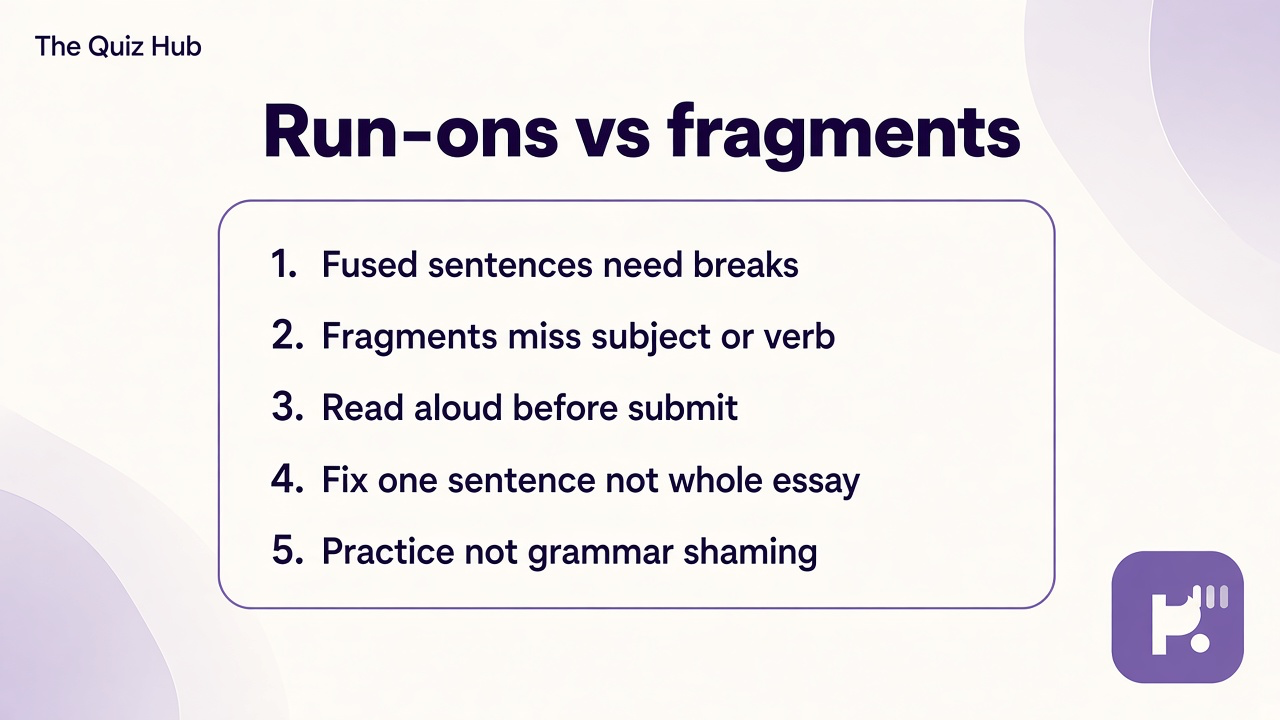
What this quiz can and cannot tell you
Can tell you
- Highlight run-on and fragment spotting habits worth revisiting before the next essay draft
- Separate unofficial boundary reflection from IQ rank or copyeditor hiring fantasies
- Encourage read-aloud revision and rewrite loops without public shame spirals
- Spark better study questions about fused sentences and fragments without claiming editor credentials
Cannot tell you
- Replace teachers, tutors, style manuals, or timed grammar exams on long papers
- Prove intelligence rank, gifted placement, or professional editing hire from one online screener
- Give permission to mock dialects, multilingual writers, or strangers over boundary typos
- Cover comma-splice-only repair patterns reserved for the fragment run on comma splice quiz sibling
Why run-on and fragment quizzes need distinct stems from comma splice siblings
Search traffic around run-on and fragment quizzes usually wants boundary rules after a writing unit, not IQ flexing or grammar shame pile-ons. Those goals help when readers count main clauses, hear draft stops aloud, and keep practice scores away from hiring myths. They hurt when every long sentence gets called a run-on, or when fragment tips from one page get copy-pasted onto comma-splice homework with different fixes. Boundary literacy works best when run-on, fragment, and comma-splice screeners use unique stems so learners know which repair toolkit fits.
Dr. James Whitfield reviews iq cognitive writing screeners with a simple split: reward honest fused-sentence spotting and honest anti-shame limits at the same time. Run-on and fused spotting tracks chained independent clauses, main-clause counting, and rejecting punctuation-free clarity myths. Fragment boundary cues tracks missing subjects or verbs, dependent tails, and note-style fragments versus essay rules. Revision read-aloud habits tracks hearing stops, line-by-line repair, and partner listen checks. Practice not grammar shame keeps retake loops and anti-mockery stances visible beside scores that were never copyeditor job offers.
Real learners mix bars. You might score high on fragments while keeping run-on spotting moderate, which often describes careful clause attachers who still draft breathless paragraphs under timers. You might score high literacy with softer anti-shame items, which can mean you avoid public dunking yet still treat quiz totals like intelligence proof. Reverse items catch overconfidence: punctuation-free clarity myths, every-line-is-a-sentence traps, silent-skimming shortcuts, or editor hiring fantasies should not inflate charts meant to track layered boundary knowledge.
Pair results with siblings on this hub instead of forcing one grammar story. Our fragment run on comma splice quiz sibling centers comma-only joins between independent clauses with repair stems that do not repeat here. Our run on sentence quiz offers another recall angle on fused sentences when you want extra practice. Our sentence fragment quiz leans incomplete-thought drills beside this agree screener. Browse the IQ and cognitive test hub for more literacy screeners. Caption shares as practice trivia and skip dunk threads on friends who draft on phones.
Deadlines and texting seasons refresh faster than peer-review comments. A run-on bar might dip after one timed freewrite while fragment cues stay high until you retake calmly. When you share results, say unofficial boundary habits. When you borrow tips, credit teachers who teach kindly and respect writers who learn English alongside other languages. Retake after one heated edit war and watch whether anti-shame bars stay high even when fused-sentence spotting rises, which often means you separated book rules from table manners online.
| Test | Focus |
|---|---|
| Fragment run on comma splice quiz | Comma splice spotting and FANBOYS repair rather than fused run-on and fragment stems on this page |
| Run on sentence quiz | Alternate fused-sentence recall practice rather than this agree screener boundary domains |
| Sentence fragment quiz | Fragment spotting drills rather than run-on chain diagnosis emphasis here |
Fragment Run On Quiz FAQ
What does the Fragment Run On Quiz measure?
It measures how much you agree with statements about run-on and fused spotting, fragment boundary cues, revision read-aloud habits, and practice-not-grammar-shame limits. You get an index from 0 to 100 plus four bars. It reflects self-reported boundary habits on this screener, not IQ rank or copyeditor certification.
How is this different from the fragment run on comma splice quiz?
This quiz focuses on fused run-ons and incomplete fragments with unique stems. The comma splice sibling focuses on two independent clauses joined by comma only and repair with periods, semicolons, or FANBOYS.
Is this an IQ test or editor hiring exam?
No. This is an unofficial educational screener about sentence boundaries for learners. It does not contact publishers, grant editing licenses, or replace instructor feedback on graded work.
Does a high score mean I should correct everyone online?
No. Practice-not-grammar-shame items explicitly reject dunk threads. High bars mean you related to literacy statements here, not that you should mock typos in public pile-ons.
Who reviewed this quiz?
Dr. James Whitfield reviewed the educational framing, anti-shame limits, sibling stem separation, and result explanations. See our editorial policy for review standards.
Reviewed by