What the Fixing Your Credit Math Quiz measures
This quiz does not certify CFP credentials, run credit pulls, or sell repair services. It measures how much you agree with unofficial credit math literacy grouped four ways: APR and interest literacy about periodic charges, grace-period pay-in-full stories, promo rate expiration, and comparing cards with honest carry assumptions; minimum payment math about issuer minimums leaving principal, extra principal dollars, long timelines on high APR balances, and due-date hygiene without minimum-equals-best-strategy myths; utilization and statement basics about reported balances, closing versus due dates, Schumer box reading, legitimate disputes versus shady erase ads, and refusing score-guarantee cosplay; and study not repair scam about self-study framing, skepticism toward upfront-fee miracle marketers, licensed and nonprofit professionals owning serious plans, and refusing bar-height franchise fantasies. You rate 22 statements from strongly disagree to strongly agree, with reverse-worded items so optimism bias cannot inflate every line. Your answers also feed a second chart on closeness and trust habits, because money shame sometimes chases dunking rights instead of amortization support. The total becomes an index from 0 to 100 where higher means more reported credit math literacy and humble limits on this screener, not proof a repair shop should hire you.
APR and interest literacy
Periodic charges, pay-in-full grace stories, promo resets, and honest APR comparisons.
Minimum payment math
Minimum traps, extra principal dollars, timelines, and statement due dates.
Utilization and statements
Reported balances, closing versus due dates, Schumer boxes, legit disputes.
Study not repair scam
No miracle erase ads, licensed advice limits, no FTC franchise from bars.
How it works
Answer 22 agreement items
Rate each statement from Strongly disagree to Strongly agree. Tap Next after each answer.
Answers sort into four domains
Each answer feeds one of four credit math groups, and every item also feeds a closeness and trust layer.
See your index and charts
You get a 0 to 100 index, a band, four domain bars, and a second chart for intimacy habits.
Take the Fixing Your Credit Math Quiz
Answer 22 short statements to see your credit math literacy index, four domain bars, and a closeness and trust chart.
What your result means
Your index is the average of all 22 answers, scaled from 0 to 100, with reverse-worded items flipped first. Higher means more reported APR, minimum payment, utilization, and repair-scam-limit agreement on this screener. Read APR and study-not-repair bars together before you treat the total as CFP certification.
| Band | Index range | Typical reading |
|---|---|---|
| Building credit math habits | 0 to 35 | Fewer agreed APR, minimum payment, utilization, or study-not-repair-scam items on this screener. |
| Mixed credit math literacy | 36 to 65 | Some APR and minimum facts mixed with utilization guesses or repair-scam slips. |
| Source-aware credit math | 66 to 100 | Frequent APR, minimum, utilization, and study-not-repair-scam agreement with kind sharing habits. |
Tips at a glance
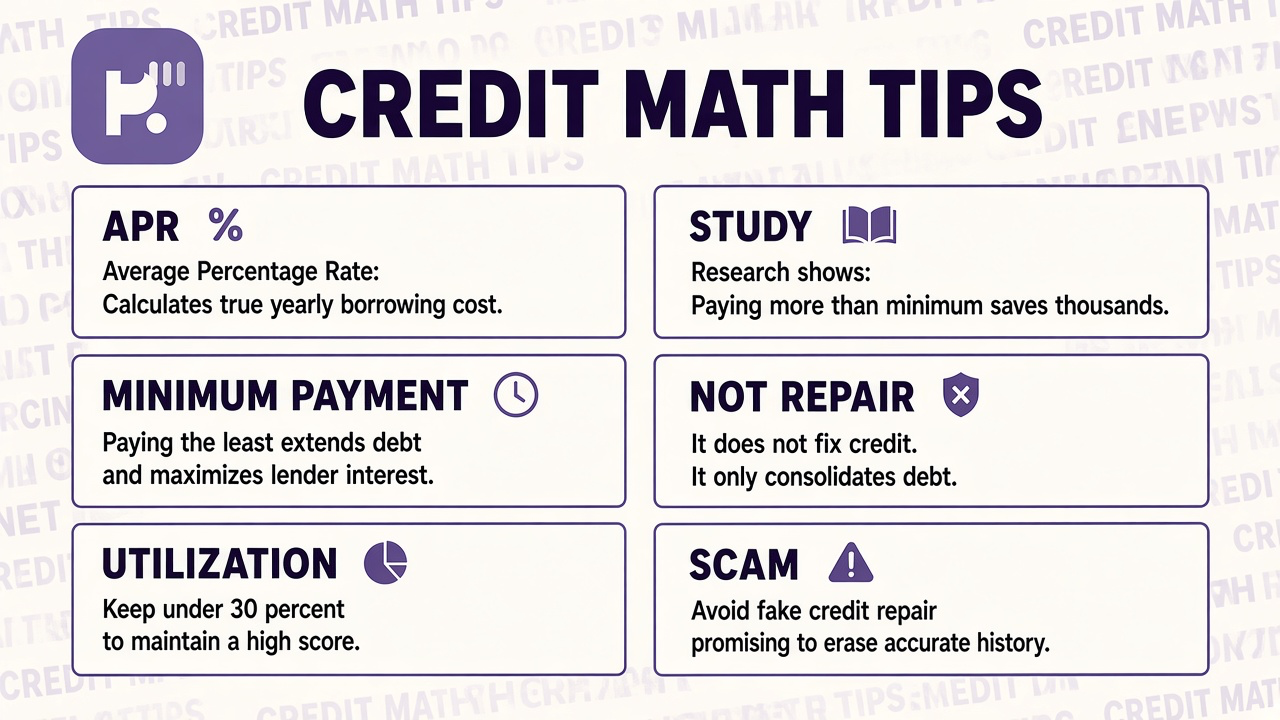
A quick takeaway graphic with topic tips (not your personal quiz scores). Start the quiz for your index, bands, and charts.
What this quiz can and cannot tell you
Can tell you
- Spot whether you confuse promo rates with permanent zero interest or minimums with fast payoff
- Encourage statement reading and calendar due dates without public shaming
- Separate self-study math from credit repair scam marketing and credentialed advice
- Give a playful baseline to retake after one nonprofit money coaching session
Cannot tell you
- Prove CFP marks, pull credit reports, or guarantee specific score outcomes
- Replace fiduciaries, bankruptcy attorneys, or individualized dispute strategy
- Certify affiliation with any bureau, bank, or repair marketing program
- Tell someone which cards or payoff order they must choose for their household
Credit math literacy without repair-scam cosplay
People land on fixing your credit math quizzes because minimum payments feel manageable while APR footnotes stay unread. Annual percentage rate is the yearly price tag lenders disclose; carrying balances turns that rate into real dollars on statements. Pay-in-full habits when grace rules apply beat assuming interest is optional forever. Promo zero-percent windows ending is a trap this screener flags so readers calendar reset dates instead of influencer denial.
Minimum payment math is amortization plus shame management. Issuer minimums keep accounts current but often leave principal on high-APR cards for years. Extra dollars toward principal change timelines when budgets allow. Treating minimum as best strategy because the box says so is a reverse item worth unlearning. Opening one statement to name balance, APR, minimum, and due date is literacy that still stops short of licensed payoff engineering.
Utilization and statement basics keep bureau conversations honest without cosplay. Reported balances relate to limits in consumer education even for pay-in-full households. Closing dates differ from due dates; autopay surprises hurt when calendars blur. Legitimate disputes you file yourself differ from upfront-fee erase-everything ads. Schumer boxes beat banner approvals that hide APR tables.
Study limits keep the page honest. This screener is math reflection, not CFP exam prep or repair franchise training. Miracle marketers deserve skepticism in protection summaries. Planners, fiduciaries, and nonprofit counselors own personalized advice; online bars do not replace them or justify promising strangers fifty-point jumps.
Use your index as a nudge toward one support conversation, not a credential. Pair this with our credit card quiz when you want separate stems on card product trivia rather than APR amortization here, the credit score quiz for score factor study habits with its own item bank, the financial health quiz for cushion and insurance humility with distinct wording, or the IQ and cognitive test hub for more low-stakes screeners. Retake after you can explain one promo expiration line in plain words without mixing in repair-scam guarantees; literacy grows when sources stay labeled, not when you win the group chat.
| Test | Focus |
|---|---|
| Credit card quiz | Card product and perks trivia rather than APR minimum payment math stems here |
| Credit score quiz | Score factor study habits rather than statement amortization items here |
Fixing Your Credit Math Quiz FAQ
What does the Fixing Your Credit Math Quiz measure?
It measures how much you agree with credit math literacy across APR and interest, minimum payments, utilization and statements, and study-not-repair-scam limits. You get an index from 0 to 100 and four bars. It reflects self-reported habits on this screener, not credit scores or bureau files.
Will this quiz fix my credit or boost my score?
No. It is study reflection only. Legitimate improvement takes payment behavior, time, and sometimes professional or nonprofit help. No online screener guarantees score jumps or erases accurate negative history.
How is this different from credit repair companies?
Repair marketers often promise fast erase-everything outcomes for upfront fees. This page teaches APR, minimum, and statement math skepticism and points serious cases toward licensed advisors and official dispute channels you control.
Why are some items worded negatively?
Reverse-worded statements balance optimism. Agreeing that promos never expire, that minimum payments are always the best strategy, that quiz bars guarantee stranger score jumps, or that perfect scores mail repair franchises should not inflate literacy.
Who reviewed this quiz?
Dr. James Whitfield reviewed the educational framing, study-not-repair-scam limits, and result explanations. See our editorial policy for review standards.
Reviewed by