What the First 20 Elements Quiz measures
This quiz does not award a chemistry degree, certify analytical lab work, or rank intelligence from one screener. It measures how much you agree with introductory periodic table literacy grouped four ways: element order and atomic numbers about hydrogen through calcium as elements 1 through 20; symbols and names about H, He, Na, Mg, Al, Si, Cl, K, Ca, and common swapped-letter traps; periods and group basics about period 1 through 4 placement, noble gases, halogens, alkali and alkaline earth families, and metal versus nonmetal language at intro depth; and study not chem degree limits about flashcard retakes, textbook citations, and refusing to treat trivia bars as licensing or lab safety waivers. You answer 22 statements from strongly disagree to strongly agree, with reverse-worded myths so shortcut agreements cannot inflate every bar. Your answers also feed a second chart on closeness and trust habits, because academic comparison sometimes pushes harsh self-rankings over honest study maps. The total becomes an index from 0 to 100 where higher means more reported first-twenty-element literacy on this screener, not proof you should skip instructors when exams or labs move beyond calcium.
Element order and atomic numbers
Hydrogen at 1 through calcium at 20, proton count language, and increasing order across modern tables.
Symbols and names
Distinct pairs from H and He through Cl, Ar, K, and Ca without Na-N or Au-in-twenty traps.
Periods and group basics
Period 1 through 4 rows, noble gases, halogens, alkali and alkaline earth spots before element twenty.
Study not chem degree
Blank-table prep, syllabus humility, no degree or lab credentialing, and instructor-owned graded work.
How it works
Answer 22 agreement items
Rate each statement from Strongly disagree to Strongly agree. Tap Next after each answer.
Answers sort into four domains
Each answer feeds one of four first-twenty-element groups, and every item also feeds a closeness and trust layer.
See your index and charts
You get a 0 to 100 index, a band, four domain bars, and a second chart for intimacy habits.
Take the First 20 Elements Quiz
Answer 22 short statements to see your first twenty elements literacy index, four domain bars, and a closeness and trust chart.
What your result means
Your index is the average of all 22 answers, scaled from 0 to 100, with reverse-worded items flipped first. Higher means more reported H-through-Ca literacy on this screener. Read study-not-degree and symbol bars together before you treat the total as exam immunity.
| Band | Index range | Typical reading |
|---|---|---|
| Building first twenty elements literacy | 0 to 35 | Fewer agreed facts on atomic order, symbol pairs, period placement, or study-not-degree limits on this screener. |
| Mixed first twenty elements literacy | 36 to 65 | Solid order or symbol facts with myths about shared atomic numbers, Au in the first twenty, all-metal rows, or trivia replacing lab safety. |
| Strong first twenty elements literacy | 66 to 100 | Frequent agreement with accurate H-through-Ca order, symbols, period families, and healthy study limits. |
Tips at a glance
A quick takeaway graphic with topic tips (not your personal quiz scores). Start the quiz for your index, bands, and charts.
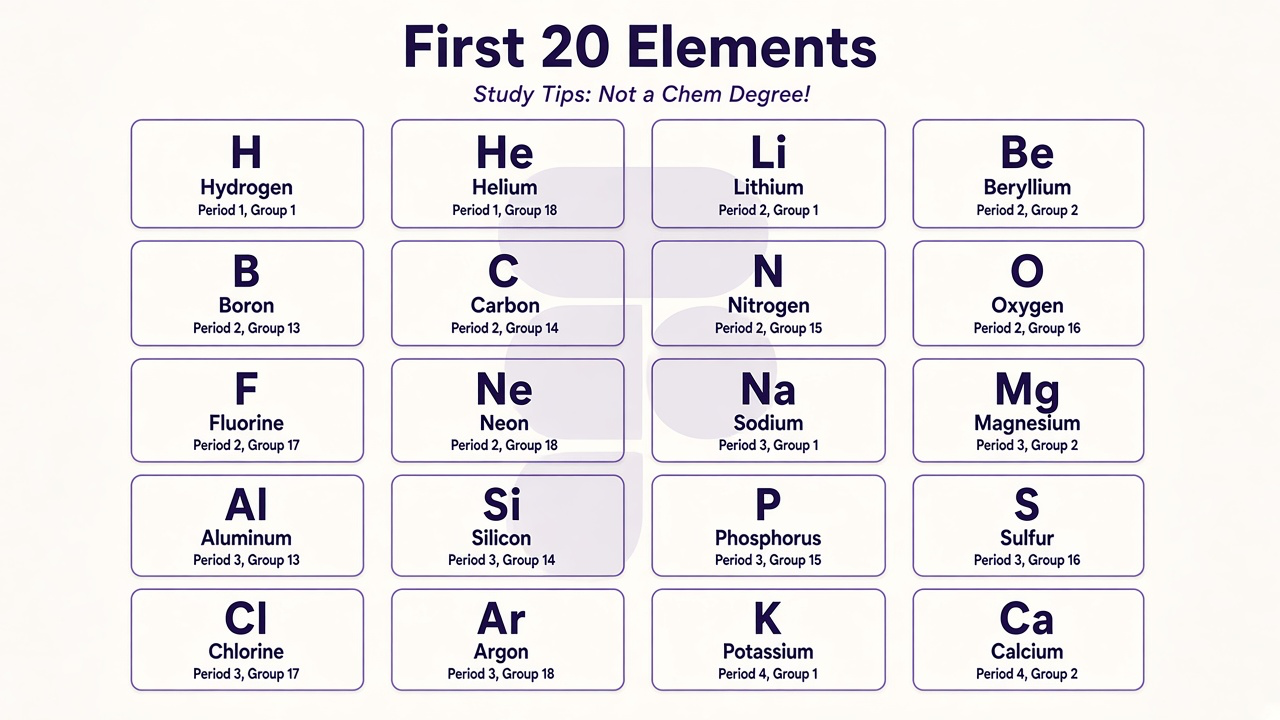
What this quiz can and cannot tell you
Can tell you
- Clarify atomic number order and symbol-name pairs for elements 1 through 20
- Highlight common Na-N, Au-in-twenty, and all-metal-row myths worth unlearning
- Encourage blank-table and flashcard retakes without shame
- Spark better questions during intro chemistry or general science units
Cannot tell you
- Award a chemistry degree, professional license, or lab instrument sign-off from trivia answers
- Replace instructors, textbooks, or graded exams on content after calcium
- Prove intelligence rank or predict career success from one screener
- Justify skipping lab safety gear because element-order bars look high
H through Ca literacy before the full table marathon
Students search first twenty elements when a general science or intro chemistry unit hands them a blank grid and every symbol looks equally plausible. Hydrogen opens the table at atomic number 1; helium follows at 2; the sequence runs through calcium at 20 before transition-metal chapters usually take over. Mixing alphabetical name order with atomic number order is the trap this screener flags on purpose.
Symbol literacy keeps homework honest. Sodium is Na, not N for nitrogen; magnesium is Mg, not Mn for manganese later in the table; chlorine is Cl and calcium is Ca so two-letter pairs stay distinct on keys. Gold is Au and sits far beyond the first twenty study set, so agreeing that Au belongs beside aluminum because both start with A is a myth worth rejecting before you retake.
Period and group language partitions the first twenty into rows students can trace aloud. Period 1 holds hydrogen and helium only; period 2 runs from lithium through neon; period 3 adds sodium through argon; calcium anchors period 4 as an alkaline earth metal in intro maps. Noble gases helium, neon, and argon sit in teaching stories about stable outer shells; fluorine and chlorine are halogens; lithium, sodium, and potassium are alkali metals. Calling every slot from hydrogen through calcium a metal ignores carbon, nitrogen, oxygen, and the noble gases that share the same study set.
Atomic number facts tie names to structure in plain intro language. Proton count defines element identity on standard charts; argon at 18 sits before potassium at 19, so alphabet or rhyme shortcuts that place K before Ar break the increasing-number story instructors expect on early exams. Neon at 10 is not the same element as sodium at 11 even when both appear in period 2 vocabulary drills.
Study limits are the fourth domain because table scores tempt overconfidence. Flashcards, blank-table retakes, and agree screeners are normal class prep; they do not mean you finished a chemistry degree or earned lab credentialing. Agreeing that perfect H-through-Ca trivia replaces goggles or instructor briefings is another myth worth rejecting. Use this screener as a warm-up, not a verdict. Pair it with our periodic table quiz when you want broader full-table recall, our electron configuration quiz when Aufbau work follows the first twenty, or our Dr. Doe chemical quiz for playful formula literacy at meme depth. Browse the IQ and cognitive test hub for more low-stakes study games. Retake after you can write symbols 1 through 20 from memory without peeking; literacy grows when order, symbols, and periods stay in sequence, not when you memorize that calcium starts with C and hope chlorine never appears on the quiz.
| Test | Focus |
|---|---|
| Periodic table quiz | Broader full-table recall rather than hydrogen-through-calcium order drill on one page |
| Electron configuration quiz | Orbital filling and Aufbau depth after you know element order through calcium |
| Dr. Doe chemical quiz | Playful reaction and meme chemistry trivia, not H-through-Ca symbol flashcard depth |
First 20 Elements Quiz FAQ
What does the First 20 Elements Quiz measure?
It measures how much you agree with introductory periodic table literacy for elements 1 through 20 across atomic order, symbols and names, period and group basics, and study limits. You get an index from 0 to 100 and four bars. It reflects self-reported study habits on this screener, not a proctored exam or chemistry degree audit.
Does this quiz cover the whole periodic table?
No. This screener stays on the hydrogen-through-calcium study set: twenty elements, four intro domains, and humility about content after calcium. Full-table recall and transition-metal depth belong in your course and siblings like the periodic table quiz.
Why are some statements worded as myths?
Reverse-worded myths catch overconfidence. Agreeing that neon and sodium share atomic number 10, that potassium comes before argon by proton count, that gold belongs in the first twenty, that every element through calcium is a metal, or that trivia replaces lab goggles should not inflate your literacy index.
Will a high score earn me a chemistry degree or lab certification?
No. It is study trivia and table literacy. Degrees, licensing, instrument training, and instructor sign-off stay separate from any online agree screener, no matter how high your bars look.
Who reviewed this quiz?
Dr. James Whitfield, PhD reviewed the educational framing, first-twenty-element limits, and result explanations. See our editorial policy for review standards.
Reviewed by