What the Find My Signature Scent Quiz measures
This quiz does not diagnose fragrance allergy, contact dermatitis, migraine triggers, or chemical sensitivity, and it cannot replace allergist patch tests or physician guidance from bar height. It measures how much you agree with unofficial signature-scent literacy statements grouped four ways: note family curiosity about citrus, floral, woody, musk, and vanilla vocabulary without taste gatekeeping; mood season pairing about matching intensity to weather, events, and scent-free workplaces instead of one loud bottle everywhere; sample patch habits about decants, blotters, skin tests, and stopping when formulas sting or itch; and unofficial scent limits about playful captions, clinician lookup prompts when reactions are severe, and refusing smell-shaming from totals. You rate 22 statements from strongly disagree to strongly agree, with reverse-worded traps so one lucky guess cannot inflate every bar. Your answers also feed a second chart on closeness and trust habits, because scent identity sometimes chases dunking rights instead of curious sampling. The total becomes an index from 0 to 100 where higher means more reported signature-scent literacy on this screener, not proof you hold clinical authority over anyone else skin or airways.
Note family curiosity
Scent vocabulary without ranking strangers as cheap.
Mood season pairing
Match intensity to context, weather, and your energy.
Sample patch habits
Try before full bottles; stop when skin protests.
Unofficial scent limits
Reflection only; allergies belong with clinicians.
How it works
Answer 22 agreement items
Rate each statement from Strongly disagree to Strongly agree. Tap Next after each answer.
Answers sort into four domains
Each answer feeds one of four scent literacy groups, and every item also feeds a closeness and trust layer.
See your index and charts
You get a 0 to 100 index, a band, four domain bars, and a second chart for intimacy habits.
Take the Find My Signature Scent Quiz
Answer 22 short statements to see your signature scent literacy index, four domain bars, and a closeness and trust chart.
What your result means
Your index is the average of all 22 answers, scaled from 0 to 100, with reverse-worded items flipped first. Higher means more reported note curiosity, mood pairing, sample habits, and humble limits on this screener. Read unofficial scent limits with sample patch habits before you treat a high score as allergy expertise. Playful reflection supports kinder shopping; licensed clinicians still own patch testing when exposure limits daily life.
| Band | Index range | Typical reading |
|---|---|---|
| Quieter signature scent habits | 0 to 35 | Fewer agreed items on note curiosity, mood pairing, sample habits, or unofficial limits on this screener. |
| Mixed signature scent habits | 36 to 65 | Solid note curiosity mixed with one-bottle-everywhere myths, skipped patch tests, influencer cosplay, or public smell ranking traps. |
| Strong signature scent habits | 66 to 100 | Frequent agreement with note curiosity, mood pairing, sample habits, and unofficial limits; still reflection only. |
Tips at a glance
A quick takeaway graphic with topic tips (not your personal quiz scores). Start the quiz for your index, bands, and charts.
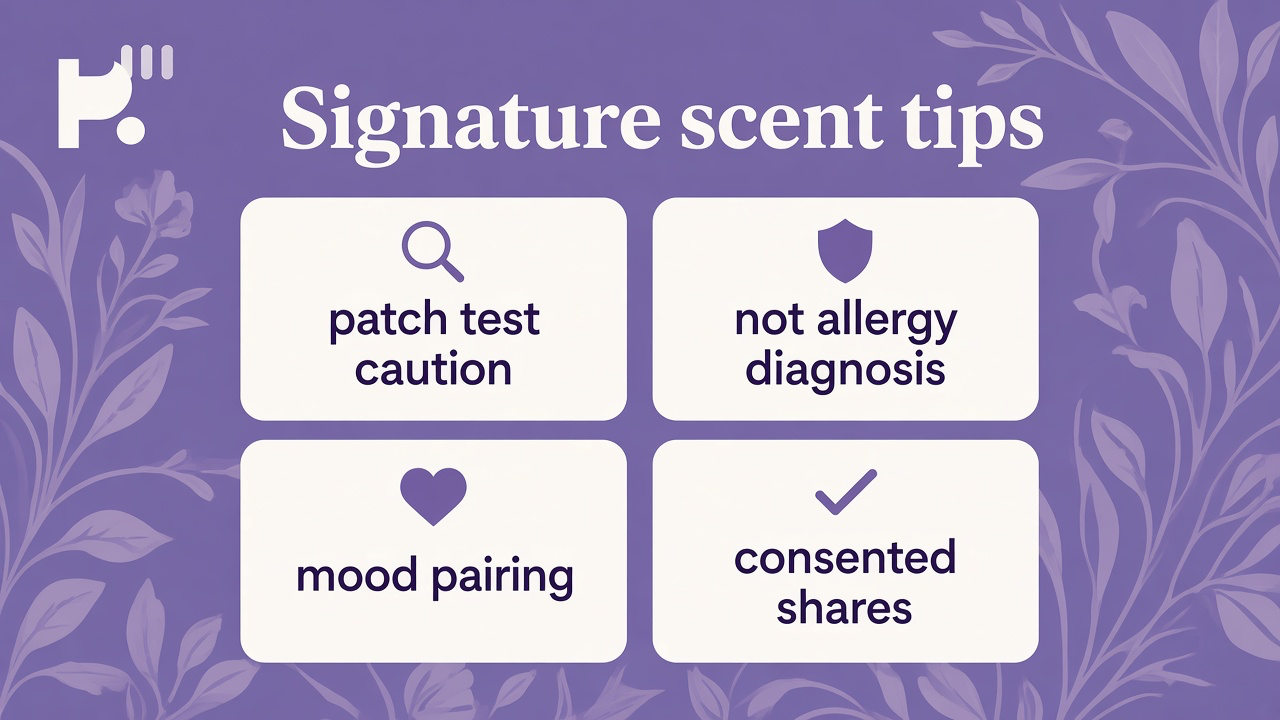
What this quiz can and cannot tell you
Can tell you
- Spot whether you buy full bottles before blotter or skin tests
- Encourage context-aware wearing without spoiling unscented workplace norms
- Separate hobby reflection from medical allergy or migraine evaluation
- Give a playful baseline to retake after one sample-decant experiment
Cannot tell you
- Prove patch-test results or IgE panels from one score
- Tell you to ignore wheezing, hives, or anaphylaxis after fragrance exposure
- Replace allergist, dermatologist, or neurologist guidance for scent triggers
- Certify that you found a legally safe signature scent for every shared space
Note families, mood pairing, and quiz-not-allergy limits
People land on signature scent quizzes because one viral bottle promises instant main-character energy. Fragrance language starts with broad families: citrus and shower-fresh notes for bright days, florals for soft romance, vanilla and amber for cozy warmth, woods and musks for depth. That vocabulary helps you describe preferences; it does not rank who smells expensive enough for your group chat.
Mood and season pairing matters as much as the pyramid. Heat and crowded rooms often call for lighter sprays or unscented days. Richer formulas can feel right on cool evenings when context allows. Scent-free clinics, classrooms, and offices deserve respect even when your favorite vanilla still has hours of sillage on a card.
Sample and patch habits protect wallets and skin. Decants and blotters let you test how a formula evolves on your chemistry before a full-bottle commitment. Stinging, itching, or headache patterns are data, not loyalty tests. Influencer dupe lists skip that step; this screener rewards trying small before buying big.
Medical fragrance sensitivity is real and separate from hobby taste. Patch tests and physician history-taking own diagnosis; couch bars do not. Gatekeeping strangers as cheap or classy from quiz height harms the same self-image play these pages claim to support.
Pair results with siblings on this hub instead of forcing one scent story. Our aesthetic quiz widens to overall visual style when you want identity language beyond note pyramids on this page. Our beauty quiz covers general grooming habits rather than fragrance-specific pairing here. Our color analysis quiz explores palette fit when you want appearance context separate from sillage talk. Browse the self image and appearance hub for more low-stakes screeners. Retake after one week of intentional samples when safe and compare bars, not only the total.
| Test | Focus |
|---|---|
| Aesthetic quiz | Overall visual aesthetic mapping rather than fragrance note literacy on this quiz |
| Beauty quiz | General grooming and product habits rather than signature-scent pairing here |
| Color analysis quiz | Palette and season color fit rather than mood-and-season scent context on this page |
Find My Signature Scent Quiz FAQ
What does the Find My Signature Scent Quiz measure?
It measures how much you agree with unofficial note family curiosity, mood season pairing, sample patch habits, and scent limit statements. You get an index from 0 to 100 and four bars. It reflects self-reported fragrance curiosity habits, not allergist patch-test results.
Can this quiz tell me if I am allergic to perfume?
No. Allergy and sensitivity evaluation needs clinician history and often patch testing. This page is reflection only. Stop using formulas that sting or trigger breathing symptoms and seek medical care.
Why are some items worded negatively?
Reverse-worded statements balance optimism. Agreeing that drugstore wearers deserve public rankings, that stinging skin proves toughness, or that bar height licenses allergy labels on strangers should not inflate literacy scores.
How is this different from beauty or aesthetic quizzes on this site?
Beauty and aesthetic siblings cover wider grooming and visual style habits with separate stems. This quiz focuses on fragrance vocabulary, context pairing, and sample safety language. Use each screener for its own lane.
Who reviewed this quiz?
Dr. Rachel Kim reviewed the unofficial fragrance framing, self-image limits, and result explanations. See our editorial policy for review standards.
Reviewed by