What the Filipino Quiz measures
This quiz does not score visa eligibility, certify language teachers, or rank who is Filipino enough. It measures how much you agree with unofficial Philippines literacy grouped four ways: archipelago geography about Southeast Asia island nation context, capital literacy, and Luzon Visayas Mindanao groupings in common summaries; language respect basics about beginner Tagalog phrases, regional language humility, and refusing accent mockery; culture food festivals about bayanihan spirit summaries, festival and food examples without stereotype punchlines; and unofficial trivia limits about couch trivia framing, diaspora respect, and refusing citizenship cosplay or public authenticity trials from bar height. You rate 22 statements from strongly disagree to strongly agree, with reverse-worded items so meme confidence cannot inflate every line. Your answers also feed a second chart on closeness and trust habits, because identity trivia sometimes chases dunking rights instead of curiosity. The total becomes an index from 0 to 100 where higher means more reported respectful Philippines literacy on this screener, not proof you passed a government exam.
Archipelago geography
Island nation context, capital literacy, major groupings on classroom maps.
Language respect basics
Beginner phrases, regional humility, no accent police.
Culture food festivals
Bayanihan, festival names, food beats without stereotype jokes.
Unofficial trivia limits
Fun shares, diaspora respect, no citizenship gatekeeping.
How it works
Answer 22 agreement items
Rate each statement from Strongly disagree to Strongly agree. Tap Next after each answer.
Answers sort into four domains
Each answer feeds one of four Philippines literacy groups, and every item also feeds a closeness and trust layer.
See your index and charts
You get a 0 to 100 index, a band, four domain bars, and a second chart for intimacy habits.
Take the Filipino Quiz
Answer 22 short statements to see your Philippines culture literacy index, four domain bars, and a closeness and trust chart.
What your result means
Your index is the average of all 22 answers, scaled from 0 to 100, with reverse-worded items flipped first. Higher means more reported respectful Philippines trivia habits on this screener. Read language respect and unofficial limit bars together before you treat the total as citizenship proof.
| Band | Index range | Typical reading |
|---|---|---|
| Building Philippines literacy | 0 to 35 | Fewer agreed geography, language respect, culture food, or unofficial limit items on this screener. |
| Mixed Philippines literacy | 36 to 65 | Solid map or food facts mixed with accent mockery myths, diaspora gatekeeping, or citizenship cosplay. |
| Source-aware Philippines habits | 66 to 100 | Frequent geography literacy, language respect, culture humility, and unofficial limits. |
Tips at a glance
A quick takeaway graphic with topic tips (not your personal quiz scores). Start the quiz for your index, bands, and charts.
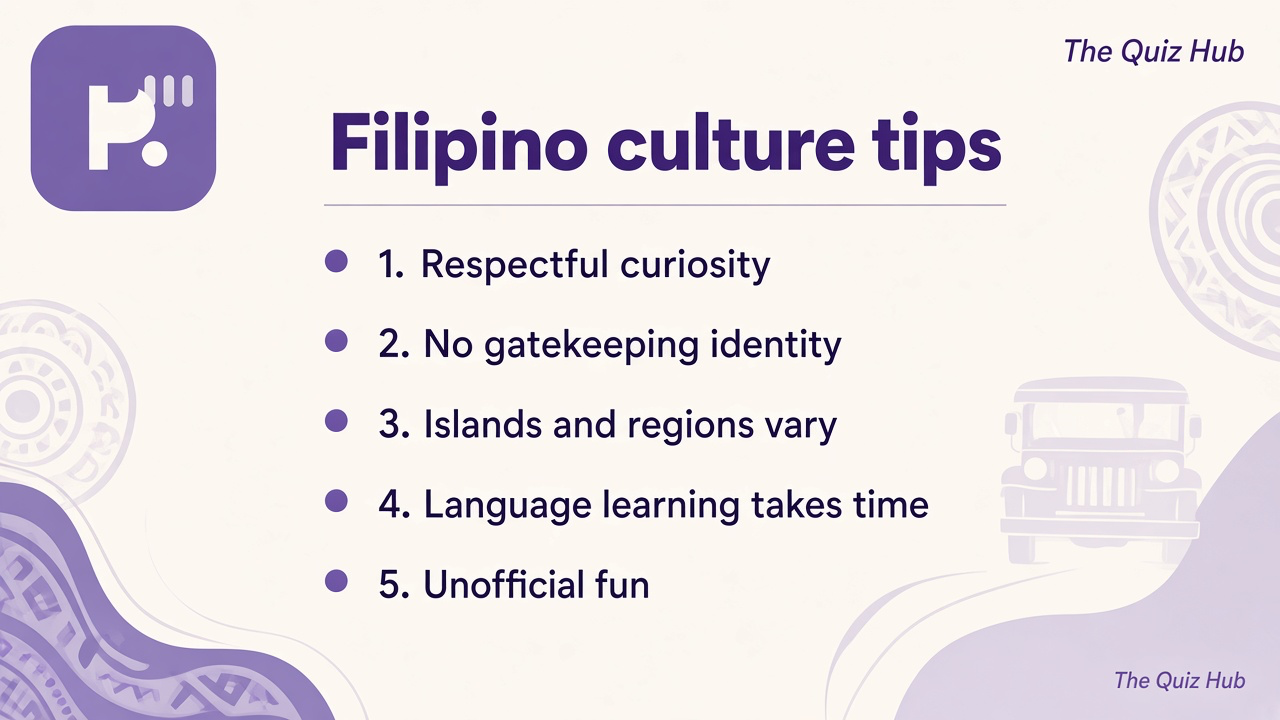
What this quiz can and cannot tell you
Can tell you
- Spot whether you mix meme food facts with archipelago geography context
- Encourage respectful phrase learning without accent mockery
- Separate culture trivia from immigration or citizenship decisions
- Give a playful baseline to retake after one respectful primer chapter
Cannot tell you
- Prove government language exam scores or visa outcomes
- Tell you who is authentic enough to call themselves Filipino
- Replace Filipino teachers, elders, or embassy official guidance
- Certify travel safety, legal status, or employment abroad from couch bars
Filipino trivia without citizenship gatekeeping
People land on Filipino quizzes because festival colors, family recipes, and archipelago maps collide in one algorithm feed. The Philippines in common geography summaries is a Southeast Asian archipelago with thousands of islands and Manila widely taught as the capital. Luzon, Visayas, and Mindanao show up as major groupings on classroom maps. That is literacy, not a checklist for demanding passports at lunch.
Language stories need humility. Beginner Tagalog greetings like salamat appear in visitor phrase books, yet the country holds many regional languages beyond Manila Tagalog. Code-switching between Filipino languages and English is everyday for millions; trivia should not treat that as fake speech. Respect markers like po and opo show up in many family speech examples. Imitating accents for punchlines is the opposite of the respect this screener rewards.
Culture beats deserve context. Bayanihan summaries describe neighbors helping one another through moves and crises. Festival names such as Sinulog or Ati-Atihan and dishes such as adobo, lumpia, or halo-halo appear in primers as entry points, not as proof every region cooks the same. Reducing people to costume jokes or ranking diaspora holidays as less authentic ruins the hobby faster than one wrong capital guess.
Real communities include overseas workers, mixed heritage families, and learners still building vocabulary. Trivia bars do not certify consulate officers or immigration lawyers. Gatekeeping who counts as Filipino enough from couch scores harms the same communities these pages claim to celebrate.
Use your index as a nudge toward one respectful chapter, not a credential. Pair this with our Asian culture quiz when you want broader regional trivia separate from Philippines-specific stems here, the Asia map quiz for silhouette practice, or the geography quiz for wider map habits. Browse the fun and novelty hub for more low-stakes screeners. Retake after you can name archipelago context and one festival in plain words without accent bits; literacy grows when sources stay labeled and people stay kind.
| Test | Focus |
|---|---|
| Asian culture quiz | Broader Asian culture trivia rather than Philippines-specific respect stems on this page |
| Asia map quiz | Regional map silhouette habits rather than Filipino language humility here |
| Geography quiz | General geography literacy rather than bayanihan and festival context on this screener |
Filipino Quiz FAQ
What does the Filipino Quiz measure?
It measures how much you agree with unofficial Philippines literacy across geography summaries, language respect, culture and food beats, and kind unofficial limits. You get an index from 0 to 100 and four bars. It reflects self-reported trivia habits, not government exam scores.
Will this quiz help me pass a citizenship or language exam?
No. Couch trivia does not replace official study guides, teachers, or embassy processes. Use government sources for legal and citizenship questions.
Why include language respect items?
Many learners enjoy basic phrases while diaspora communities speak diverse mixes. Respect items discourage accent mockery and fake-authenticity gatekeeping.
Why are some items worded negatively?
Reverse-worded statements balance optimism. Agreeing that Europe landlock myths are true, that accent bits are fair comedy, or that bars justify passport demands should not inflate literacy scores.
Who reviewed this quiz?
Dr. Rachel Kim reviewed the unofficial trivia framing, diaspora respect limits, and result explanations. See our editorial policy for review standards.
Reviewed by