What Familiar Commands In Spanish Quiz measures
This quiz does not certify DELE or SIELE levels, rank intelligence, or replace Spanish teachers and classroom oral rubrics. It measures how much you agree with classroom command study habits grouped four ways: command meanings about siéntense, escuchen, abran el libro, levántense, silencio, and presten atención tied to real directions; listen and repeat about escuchen dos veces, repitan chorally, gesture cues, aloud practice, and asking kind glosses when you miss a line; teacher register about ustedes classroom forms, rubric politeness, and refusing meme or street slang as graded substitutes; and quiz not DELE about unofficial warm-ups, pairing drills with teacher tasks, and captioning shares as practice not credential drops. You rate 22 statements from strongly disagree to strongly agree, with reverse-worded traps so one lucky guess cannot inflate every bar. Your answers also feed a second chart on closeness and trust habits, because language stress sometimes pushes people toward harsh perfectionism instead of calm aloud practice. The total becomes an index from 0 to 100 where higher means more reported command literacy on this screener, not proof you should skip classes when you need DELE prep.
Command meanings
Siéntense, escuchen, open book, stand, and quiet cues tied to actions.
Listen and repeat
Escuchen twice, repitan rhythm, gestures, and kind gloss requests.
Teacher register
Ustedes classroom forms versus slang and meme shortcuts.
Quiz not DELE
Study warm-ups only; exams and teachers own credentials.
How it works
Answer 22 agreement items
Rate each statement from Strongly disagree to Strongly agree. Tap Next after each answer.
Answers sort into four domains
Each answer feeds one of four classroom command literacy groups, and every item also feeds a closeness and trust layer.
See your index and charts
You get a 0 to 100 index, a band, four domain bars, and a second chart for intimacy habits.
Take the Familiar Commands In Spanish Quiz
Answer 22 short statements to see your Spanish classroom command literacy index, four domain bars, and a closeness and trust chart.
What your result means
Your index is the average of all 22 answers, scaled from 0 to 100, with reverse-worded items flipped first. Read quiz-not-DELE bars together with listen-repeat habits before you treat a high score as oral exam readiness. Command literacy supports kinder study talk; teachers still matter for rubrics.
| Band | Index range | Typical reading |
|---|---|---|
| Building command literacy | 0 to 35 | Fewer agreed habits on command meanings, listen-repeat drills, teacher register, or quiz-not-DELE limits on this screener. |
| Mixed command literacy | 36 to 65 | Solid habits in some domains with TikTok-once myths, slang-as-answers traps, or DELE substitution slips in others. |
| Strong command literacy | 66 to 100 | Frequent agreement with command meanings, listen-repeat habits, teacher register, and quiz-not-DELE limits; still study only. |
Tips at a glance
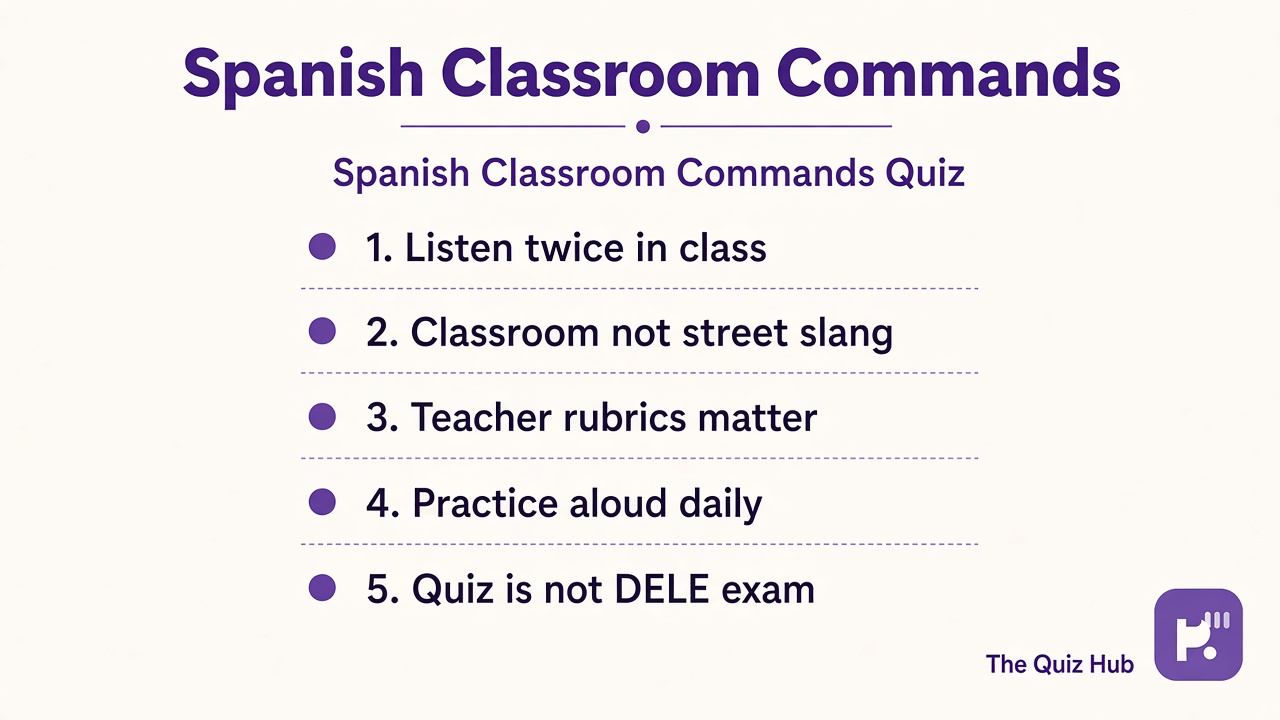
A quick takeaway graphic with topic tips (not your personal quiz scores). Start the quiz for your index, bands, and charts.
What this quiz can and cannot tell you
Can tell you
- Highlight command, listen-repeat, and register habits worth revisiting before the next Spanish I unit
- Separate unofficial command trivia from DELE cosplay or IQ fantasies
- Encourage escuchen-twice and repitan questions before blurting in class
- Spark honest talk with friends about warm-up captions on shares
Cannot tell you
- Replace DELE, SIELE, school courses, or employer language assessments
- Prove spoken fluency or immigration language rank from one agree screener
- Diagnose language disorders or certify job readiness alone
- Turn command scores into harassment, classmate pile-ons, or accent mockery
Classroom Spanish commands before DELE confusion
Search traffic around Spanish command quizzes usually wants two things: quick recall for siéntense and escuchen on day one, and relief from threads that treat every chorale repeat like a DELE audition. Those goals help when learners connect imperatives to actions, listen twice, and match teacher register to graded sheets. They hurt when command bars become fluency cosplay, or when pile-ons mock classmates while claiming perfect scores. Command language works best when it names classroom habits and kindness limits together.
Dr. James Whitfield reviews iq-cognitive Spanish screeners with a simple split: reward honest command habits and honest limits on DELE fantasy at the same time. Command meanings track sit, listen, open, stand, and quiet cues without ranking slow listeners as lazy forever. Listen and repeat tracks escuchen dos veces and repitan rhythm without calling every accent error a failure. Teacher register tracks ustedes politeness without meme Spanish as homework substitutes. Quiz not DELE keeps screeners, teachers, and exam teams separate from bar height.
Real learners mix bars. You might score high on siéntense recall while keeping listen-repeat moderate, which often describes strong chart memory who still blurts before the teacher finishes. You might score high register awareness with softer limit items, which can mean good rubric questions plus occasional screenshot certification slips. Reverse items catch sloppy answers: every -en verb meaning eat lunch, one TikTok replacing classroom listening, street insults as answers, profanity as participation, or immigration certification from bars should not inflate charts meant to track layered command knowledge.
Pair results with siblings on this hub instead of forcing one verb story. Our classroom objects in Spanish quiz stays on desk and board vocab with stems separate from imperative directions on this page. Our Spanish grammar quiz covers broader grammar themes when command units sit beside conjugation homework. Our Spanish quiz offers general study reflection when you want parallel habit domains from another angle. Browse the IQ and cognitive hub for more study screeners. Caption shares as warm-up, repeat commands kindly, and skip bait threads on friends who never opted in.
Sub days and assembly weeks refresh faster than forum arguments. When you share results, say evidence and humility beat scoreboard. When you borrow tips, credit teachers who model escuchen-twice and classmates who disagree without lying labels. Retake after one command block and watch whether quiz-not-DELE bars stay high even if meaning recall rises, which often means you separated book rules from actual table manners in class.
| Test | Focus |
|---|---|
| Classroom objects in Spanish quiz | Desk and board noun vocab rather than imperative command directions on this page |
| Spanish grammar quiz | Broader grammar study themes rather than classroom command listen-repeat drills here |
| Spanish quiz | General Spanish study reflection rather than siéntense escuchen command literacy only |
Familiar Commands In Spanish Quiz FAQ
What does Familiar Commands In Spanish Quiz measure?
It measures how much you agree with statements about classroom command meanings, listen-and-repeat habits, teacher register, and quiz-not-DELE limits. You get an index from 0 to 100 plus four bars. It describes self-reported command study habits on this screener, not DELE level or teacher oral grades.
What is teacher register on this quiz?
Register means matching polite classroom commands and ustedes forms to teacher rubrics instead of treating street slang, memes, or insults as graded participation.
Does a high score mean I am fluent in Spanish?
No. High bars mean you related to command habit statements here, not that you hold DELE certification or should skip speaking assignments.
Why include listen-and-repeat items with vocabulary checks?
Teachers give directions aloud before students write. Listen-twice and repitan habits keep blurting separate from real recall so results stay honest about which habits you endorse.
Who reviewed this quiz?
Dr. James Whitfield reviewed the educational framing, anti-mockery limits, and separation from DELE or SIELE credential claims. See our editorial policy for review standards.
Reviewed by