What this Fahrenheit 451 Sieve and Sand quiz measures
This page does not grade classroom essays, certify Bradbury expertise, or prove you should spoil Faber lectures for strangers from one agree screener. It measures how much you agree with statements in four groups: Faber lesson teaching about applied books, leisure to digest, quality information, cowardice after academies thinned, and rejecting no-free-time reading myths; sieve and hourglass imagery about childhood sieve sand, leaking attention on commutes, hourglass lines escaping, and rejecting permanent-full-memory and part-one-only traps; subway Bible reading about scripture on noisy trains, ads breaking focus, failed first-ride mastery myths, and keeping subway strain in this unit not part three flight; and distracted reading and limits about parlor-wall shallow habits, unofficial warm-up framing, comparing part-two siblings, and rejecting skip-chapter licenses tied to high bars. You rate 22 statements from strongly disagree to strongly agree, with reverse-worded myths so autopilot responding cannot inflate every bar. Your answers also feed a second chart on closeness and trust habits, because performative spoiler drops sometimes chase belonging over honest reading. The total becomes an index from 0 to 100 where higher means more endorsed sieve-unit literacy on this screener, not exam scores or harassment license.
Faber lesson teaching
Applied books, leisure to digest, quality information, and mentor cowardice context.
Sieve and hourglass imagery
Childhood sieve sand, leaking memory, and hourglass attention on commutes.
Subway Bible reading
Scripture on noisy transit, ads, and Faber whisper guidance under strain.
Distracted reading and limits
Parlor shallow habits, part-two compare, page quotes, and opt-in shares.
How it works
Answer 22 agreement items
Rate each statement from Strongly disagree to Strongly agree. Tap Next after each answer.
Answers sort into four domains
Each answer feeds one of four Sieve and Sand literacy groups, and every item also feeds a closeness and trust layer.
See your index and charts
You get a 0 to 100 index, a band, and two bar charts you can compare after one instructor-led reread week.
Take the Fahrenheit 451 Sieve and Sand Quiz
Answer 22 short statements to see your Fahrenheit 451 Sieve and Sand literacy index, four domain bars, and a closeness and trust chart.
What your result means
Your index is the average of all 22 answers, scaled from 0 to 100, with reverse-worded myth items flipped first. Read distracted-reading limit bars with Faber lesson bars before you treat any total as cliff-note proof or Faber spoiler license. Persistent shame about literature class deserves instructor help, not only meme reframes.
| Band | Index range | Typical reading |
|---|---|---|
| Building Sieve and Sand literacy | 0 to 35 | Fewer agreed facts on Faber lesson, sieve imagery, subway Bible, or distraction-limit statements on this screener. |
| Mixed Sieve and Sand literacy | 36 to 65 | Solid habits in some domains with no-leisure traps, instant-Bible myths, or skip-reading slips snagging a bar. |
| Stronger Sieve and Sand literacy | 66 to 100 | Frequent agreement on Faber lesson, sieve imagery, subway Bible, and quiz limits; still not graded exam certification. |
Tips at a glance
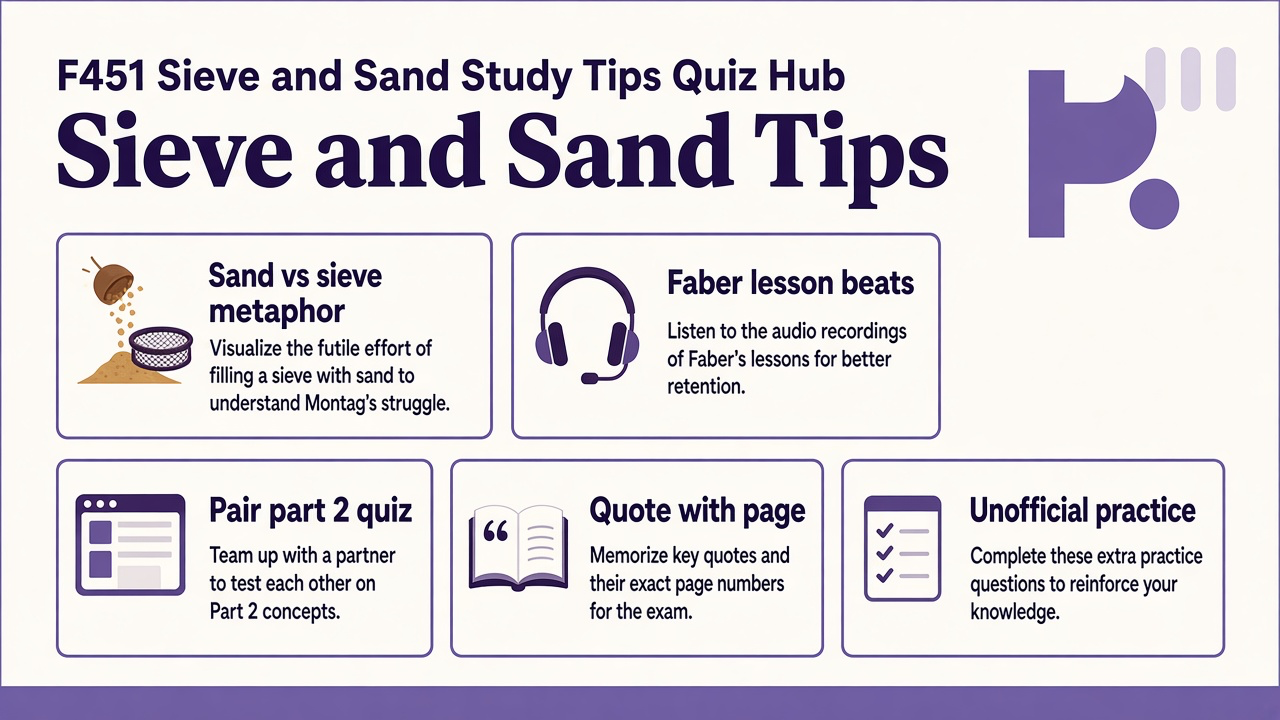
A quick takeaway graphic with topic tips (not your personal quiz scores). Start the quiz for your index, bands, and charts.
What this quiz can and cannot tell you
Can tell you
- Highlight Faber, sieve, and subway reading habits worth trying before the next Bradbury discussion
- Separate unofficial sieve-unit literacy from graded essays and instructor page keys
- Encourage spoiler-aware sharing and kind close reading without Faber bait threads
- Spark better seminar questions without web score hiring or shame claims
Cannot tell you
- Replace school essays, proctored exams, annotated editions, or instructor grading
- Prove Bradbury mastery or publishing skill from sieve-unit agree bars alone
- Excuse untagged Faber dumps or classmate bait threads because subway bars scored high once
- Substitute for therapy when online rank arguments disrupt sleep and friendships
Faber lessons, sieve sand, and unofficial share limits
Students search Fahrenheit 451 sieve and sand quizzes before syllabus middle units, compare-to-part-two charts, and group chats that treat recall like cliff-note immunity. Those goals help when bars stay reflection notes for Faber teaching, sieve imagery, and subway Bible strain. They hurt when people paste untagged Faber lectures or claim agree totals replaced quoted page work.
Dr. James Whitfield reviews iq-cognitive novel screeners with a simple split: reward honest sieve-unit agreement and honest limits on spoiler bait at the same time. Faber lesson teaching keeps applied books, leisure to digest, and quality information visible beside no-free-time traps. Sieve and hourglass imagery keeps childhood sieve sand and leaking attention visible beside permanent-full-memory and part-one-only myths. Subway Bible reading keeps noisy transit strain visible beside flawless first-ride traps. Distracted reading and limits keeps parlor shallow habits, part-two siblings, page quotes, and opt-in shares honest so readers know instructors own graded writing.
Real readers mix bars. You might score high on sieve imagery while Faber lesson bars wobble, which often describes sand memory without applied-book rereads. You might score high on subway strain with moderate limits, which can mean solid transit detail yet little experience captioning unofficial shares. Reverse items catch sloppy answers: reading needing no leisure, Montag mastering scripture instantly, sieve imagery never in this section, or high bars as skip-chapter licenses should not inflate charts meant to track layered literacy habits.
Pair results with siblings on this hub instead of forcing one Bradbury bank everywhere. Our Fahrenheit 451 part 2 quiz stays on Montag shift and fire-station symbol recall with stems separate from this Faber and sieve unit page. Our Fahrenheit 451 quiz covers broader censorship recall when whole-novel habits need a different stem lane. Browse the IQ and cognitive test hub for more study screeners that skip credential posing. Caption shares as reading warm-up, quote with page when syllabi require it, and skip bait threads on classmates who have not reached The Sieve and the Sand.
Semesters move faster than recap threads. The sieve unit arrives after hearth chapters, but Faber rereads stay useful all year. When you share results, say Faber spoilers need opt-in tags. When you borrow tips, credit partners who lent annotated editions. Retake after one cited paragraph lands in your notes and watch whether limit bars stay high even when sieve bars rise, which often means you separated performative rank from actual close-reading habits.
| Test | Focus |
|---|---|
| Fahrenheit 451 part 2 quiz | Montag shift and fire-captain symbol recall rather than Faber lesson and sieve-unit stems on this page |
| Fahrenheit 451 quiz | Whole-novel censorship recall breadth rather than Sieve and the Sand Faber and subway literacy bars |
Fahrenheit 451 Sieve and Sand Quiz FAQ
What does this Fahrenheit 451 Sieve and Sand quiz measure?
It measures how much you agree with statements about Faber lesson teaching, sieve and hourglass imagery, subway Bible reading, and distracted reading with quiz limits. You get an index from 0 to 100 plus four bars. It describes self-rated sieve-unit literacy on this screener, not instructor exam scores.
How is this different from the part 2 quiz?
The part 2 quiz focuses on Montag shift and fire-station symbol recall with its own stem bank. This page covers Faber applied-book lectures, sieve sand memory, and subway scripture strain without repeating those Montag-shift and Beatty plot stems.
Does this cover part 3 river and book people scenes?
No. Items stay inside The Sieve and the Sand unit habits and limits. River flight and memorizer community stems live on the part 3 quiz with a separate bank.
Should I cite page numbers from my edition?
Yes when your syllabus requires quoted proof. Agree bars here are unofficial reflection only and cannot replace instructor page keys or annotated editions.
Who reviewed this quiz?
Dr. James Whitfield, PhD reviewed the educational framing, anti-spoiler limits, and result explanations. See our editorial policy for review standards.
Reviewed by