
What this Fagerstrom nicotine habit screener measures
This page does not administer the licensed Fagerstrom Test for Nicotine Dependence from research clinics, and it cannot diagnose nicotine use disorder or prescribe treatment from one score. It measures how often you noticed habits quit coaches and clinicians often discuss when nicotine strains daily life, organized four ways: morning nicotine cue when the first hit landed soon after waking, felt hardest at breakfast, or dominated early hours; cravings and daily strain when smoke-free zones, irritability, chain use, or early pack opens outran plans; use pattern and health honesty when nicotine continued while sick, amounts hid from people who care, quit attempts restarted without structure, or vaping myths replaced honest logs; and quiz not FTND limits when unofficial screeners replaced quit lines or doctors, skipped pediatric boundaries, or ignored clinician-guided replacement plans. You answer 22 how-often statements about the past month, with reverse-worded items so one morning delay, craving plan, quit-line call, or honest doctor visit cannot hide frequent morning cues or hidden use on other days. Your responses also feed a second chart on closeness and trust habits, because shame about nicotine sometimes blocks asking for help. The total becomes an index from 0 to 100 where higher means more frequent reported nicotine habit strain on this screener. Your responses suggest intensity to discuss with support; they do not prove you failed at quitting forever.
Morning nicotine cue
How often first-after-waking nicotine, breakfast-before-smoke slips, or morning-heavy use showed up.
Cravings and daily strain
How often urges in no-smoke zones, irritability when delayed, or stress chain use outran plans.
Use pattern and health honesty
How often sick-day use, hidden amounts, failed quit restarts, or vaping zero-risk myths appeared.
Quiz not FTND limits
How often quit-line planning, doctor patch plans, adult-only framing, and licensed-form humility showed up.
How it works
Answer 22 frequency items
Rate each statement from Never to Very often for the past month. Tap Next after each answer.
Answers sort into four domains
Each answer feeds one of four nicotine strain groups, and every item also feeds a closeness and trust layer.
See your index and charts
You get a 0 to 100 index, a band, and two bar charts you can bring to a doctor or quit-line coach.
Take the Fagerstrom Nicotine Dependence Test FTND
Answer 22 short statements to see your nicotine habit strain index, four domain bars, and a closeness and trust chart.
What your result means
Your index is the average of all 22 answers, scaled from 0 to 100, with reverse-worded items flipped first. Higher means more frequent reported morning cues, craving strain, or hidden use on this screener. Read quiz-not-FTND limits with morning bars before you treat any total as licensed FTND proof. Persistent hopelessness or safety worries deserve crisis support, not only delay tactics.
| Band | Index range | Typical reading |
|---|---|---|
| Lower reported nicotine habit strain | 0 to 35 | Fewer frequent morning-cigarette cues, craving spikes, hidden-use habits, or quiz-as-FTND myths in the past month. |
| Mixed reported nicotine habit strain | 36 to 65 | Some smoke-free stretches alongside morning cues, craving spikes, hidden use, or limit myths on other days. |
| Higher reported nicotine habit strain | 66 to 100 | Frequent morning cues, craving strain, or hidden use; quit-line, clinician, and crisis support may help more than another solo retake. |
Tips at a glance
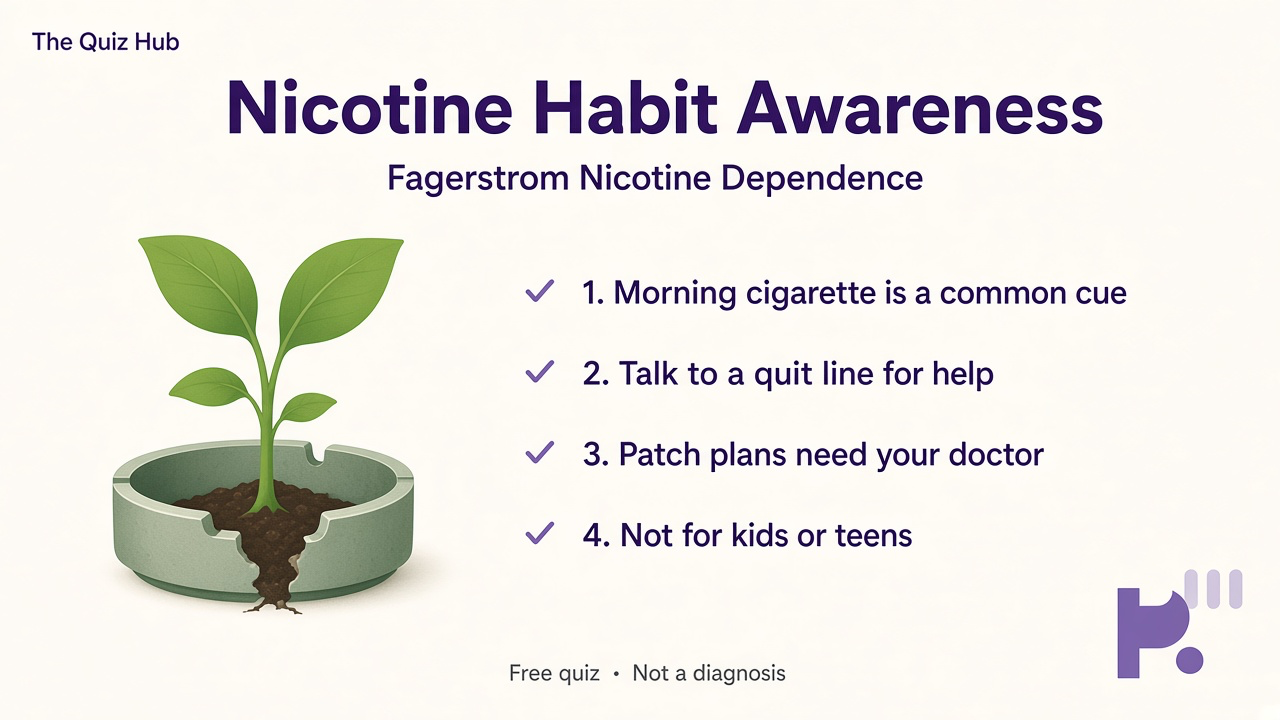
A quick takeaway graphic with topic tips (not your personal quiz scores). Start the quiz for your index, bands, and charts.
What this quiz can and cannot tell you
Can tell you
- Name morning nicotine, craving, and hidden-use habits in plain language for doctor or quit-line intake
- Highlight when delay tactics, quit-line outreach, or clinician planning habits are missing
- Support honest overlap conversations with clinicians without forcing one online label
- Offer a baseline if you retake after one week of honest logging and morning delay practice
Cannot tell you
- Diagnose nicotine use disorder or lung disease from one score
- Replace licensed FTND scoring, quit-line coaching, or medication prescribing
- Choose patch, gum, or vial doses without a clinician or pharmacist
- Substitute for crisis care when hopelessness or safety fears feel urgent
Morning nicotine cues, quit lines, and quiz-not-FTND limits
People search Fagerstrom nicotine dependence test pages when the first cigarette or vape hit runs the morning, when cravings win in smoke-free buildings, or when quit attempts restart without a plan. Clinicians and quit lines discuss nicotine dependence as patterns that persist despite health goals, often with morning cue strength, withdrawal irritability, and hidden use during stress. This online screener uses that reflection lens unofficially; it cannot replace interview-based assessment or tell you which medication dose fits without your history and local guidance.
Morning nicotine cue covers waking use within thirty minutes, nicotine before coffee or a shower, morning hits feeling hardest to skip, and heavier use in early hours. Delaying first use, naming one trigger, and trying a supported delay tactic are protective signals worth tracking even when bars run high. Cravings and daily strain covers no-smoke-zone slips, irritability when delayed, chain use under stress, and opening packs early. Brief craving plans and honest conversations with someone you trust are not moral trophies; they are often how strain loosens when support exists.
Use pattern and health honesty covers nicotine while sick, hiding amounts, restarting after quit day without structure, and treating vaping or pouches as risk-free while daily schedules still revolve around nicotine. Honest logs, pharmacist questions, and quit-line calls belong in the same story as strain bars. Quiz not FTND limits covers refusing licensed-form myths, remembering screeners are adult reflection tools, and planning clinician-guided patch or gum plans instead of screenshot dosing.
Pair results with siblings on this hub instead of forcing one label story. Our smoking quiz sibling tracks general smoking literacy with its own stem bank, not past-month dependence frequency here. Our on topic smoking page frames situational smoking choices with separate wording. Our type of smoking behavior sibling emphasizes behavior-style reflection rather than morning-cue frequency on this page. Browse the mental health and clinical test hub for more YMYL screeners with study-not-diagnosis framing.
Higher scores mean more frequent self-reported nicotine strain on this tool, not proof you must shame yourself alone. Bring domain bars to intake so sessions start with examples, not guilt. If hopelessness spikes, skip online debate and prioritize 988 or a clinician. Retake after one week of honest logging and one quit-line or doctor conversation when safe and compare bars, not only the total.
| Test | Focus |
|---|---|
| Smoking quiz | General smoking literacy and recall with a separate stem bank; zero shared sentences with this FTND-theme frequency page |
| On topic smoking | Situational smoking choice themes with its own wording, not morning nicotine cue frequency here |
| Type of smoking behavior | Behavior-style smoking reflection rather than past-month craving and morning-cue strain on this screener |
Fagerstrom Nicotine Dependence Test FTND FAQ
What does this Fagerstrom nicotine dependence test measure?
It measures how often you noticed morning nicotine cues, cravings and daily strain, use pattern and health honesty habits, and quiz-not-FTND limit habits during the past month. You get an index from 0 to 100 plus four domain bars. Your responses suggest self-reported frequency for adult reflection, not a clinical diagnosis.
Is this the licensed Fagerstrom Test for Nicotine Dependence (FTND)?
No. Published FTND forms use validated item banks and trained scoring in research and clinic settings. This page is an unofficial screener inspired by common FTND themes with its own stems for reflection only, not a licensed FTND license, and not a substitute for quit-line or medical care.
Why focus on the morning cigarette cue?
Intent brief readers asked for FTND-theme literacy without copying licensed items. Morning-first nicotine is a familiar dependence signal quit coaches discuss; delay tactics and clinician plans still matter when morning bars run high.
Can children or teens take this screener?
No. Nicotine dependence screeners on this page are framed for adults reflecting on tobacco or nicotine products. Minors need pediatric or family clinicians, not unofficial web bars, for substance questions.
What should I do if my score is high or I want to quit?
Contact a national quit line for free coaching, schedule a clinician visit to discuss patches, gum, or medication when appropriate, and call or text 988 (US) if hopelessness or safety worries feel urgent. Prioritize support over retakes when strain spikes.
Who reviewed this screener?
Dr. Sarah Chen, PhD reviewed the YMYL framing, crisis resources, quiz-not-FTND limits, adult-only boundaries, smoking-quiz sibling separation, and result explanations. See our editorial policy for review standards.
Reviewed by
