
What this quiz measures
This quiz does not measure spoken fluency for immigration or hiring, certify DELF or DALF scores, or replace classroom French courses. It measures how much you agree with -er conjugation study habits grouped four ways: singular endings about je, tu, and il elle on present patterns after dropping -er; plural endings about nous -ons, vous -ez, and ils elles -ent with silent final consonants; accents and stem about preferer-style accent shifts, -ger and -cer spelling before vowels, conjugation tables, and listening-to-writing links; and French quiz limits about practice reflection, pairing drills with teacher speaking tasks, refusing online fluency certification myths, and knowing irregular verbs still matter beyond -er families. You answer 22 statements from strongly disagree to strongly agree, with reverse-worded myths so agreeing with every shortcut cannot inflate every bar. Your answers also feed a second chart on closeness and trust habits, because language stress sometimes pushes people toward harsh perfectionism instead of calm aloud practice. The total becomes an index from 0 to 100 where higher means more reported conjugation literacy on this screener, not proof you should skip classes when you need DELF prep.
Singular endings
Stem from infinitive, je tu il on -e patterns, accent awareness.
Plural endings
Nous -ons, vous -ez, ils elles -ent, and silent finals.
Accents and stem
Accent shifts, -ger and -cer spelling, tables, and listening links.
French quiz limits
Practice not DELF oral; bars not fluency credentials.
How it works
Answer 22 agreement items
Rate each statement from Strongly disagree to Strongly agree. Tap Next after each answer.
Answers sort into four domains
Each answer feeds one of four conjugation literacy groups, and every item also feeds a closeness and trust layer.
See your index and charts
You get a 0 to 100 index, a band, and two bar charts you can compare after a verb drill week.
Take the Er Verb Quiz
Answer 22 short statements to see your French -er conjugation literacy index, four domain bars, and a closeness and trust chart.
What your result means
Your index is the average of all 22 answers, scaled from 0 to 100, with reverse-worded items flipped first. Higher means more reported conjugation literacy on this screener. Read French quiz limit bars together with plural endings before you treat the total as DELF readiness.
| Band | Index range | Typical reading |
|---|---|---|
| Building -er conjugation literacy | 0 to 35 | Fewer agreed facts on singular, plural, accent, or French limit items on this screener. |
| Mixed -er conjugation literacy | 36 to 65 | Solid habits in some domains with myths about no accents, one plural ending, or bars replacing DELF. |
| Strong -er conjugation literacy | 66 to 100 | Frequent agreement with accurate -er conjugation habits and healthy quiz limits. |
Tips at a glance
A quick takeaway graphic with topic tips (not your personal quiz scores). Start the quiz for your index, bands, and charts.
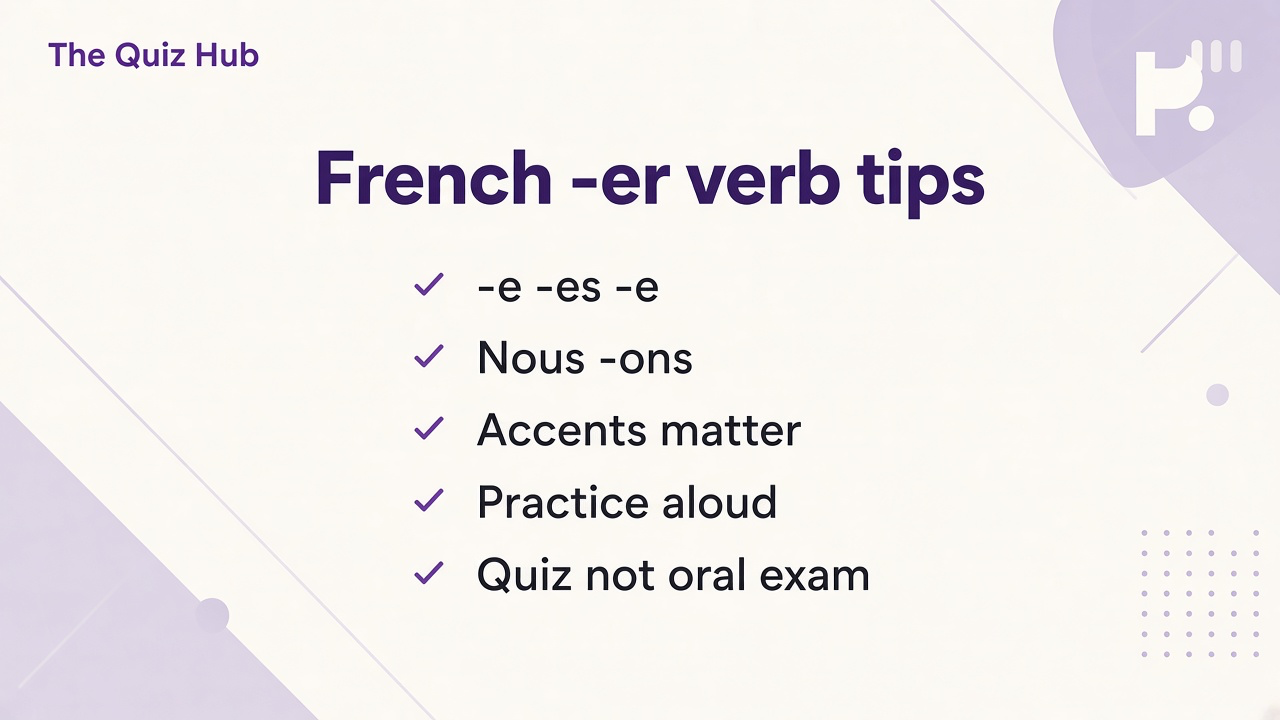
What this quiz can and cannot tell you
Can tell you
- Highlight singular, plural, and accent habits worth practicing in daily French study
- Separate self-study reflection from formal DELF prep in plain language
- Encourage aloud drills without public grammar shaming
- Spark better questions for tutors, teachers, or conversation partners
Cannot tell you
- Replace DELF, DALF, school courses, or employer language assessments
- Prove spoken fluency or immigration language rank from one agree screener
- Diagnose language disorders or certify job readiness alone
- Justify skipping irregular verb study because -er bars look high
French -er conjugation habits without credential confusion
Search traffic around French verb quizzes often mixes chart memorization with credential hunger. Dropping -er to find the stem before adding endings beats copying parler once without pattern sense. Je tu il -e rhythms and tu -es forms show up across huge verb families, which is why teachers drill them early.
Plural endings need separate attention because nous -ons and vous -ez look nothing like ils -ent on paper yet share one family logic. Reading aloud connects silent finals to listening homework. Claiming all plural subjects share only -ent is a myth screeners flag so learners notice nous and vous forms again.
Accents and stem tweaks are still learnable rules. Preferer-style shifts and -ger spelling before vowels trip many students, which is why conjugation tables and listening drills stay paired in class. Ignoring accents is another myth that should not inflate bars meant to track careful spelling habits.
Quiz limits keep this page honest. It is practice reflection, not DELF oral proof. Pair results with the French quiz when broader vocabulary units overlap, or browse the IQ and cognitive test hub for more study screeners. Retake after a month of aloud drills; habits move slowly and that is normal.
| Test | Focus |
|---|---|
| French quiz | Broader French study themes rather than -er conjugation ending depth |
| IQ and cognitive hub | More study screeners rather than French verb ending literacy only |
Er Verb Quiz FAQ
What does this quiz measure?
It measures how much you agree with French regular -er conjugation habits across singular endings, plural endings, accents and stem patterns, and quiz limits. You get an index from 0 to 100 and four bars. It reflects self-reported study literacy on this screener, not a DELF score.
Can I use this quiz instead of DELF or DALF prep?
No. Formal exams, courses, and tutors own credentials. This screener is habit reflection only and cannot certify spoken fluency for school, immigration, or hiring.
Does a high score mean I am fluent in French?
No. High scores mean you agreed with many conjugation habit statements here. Listening, speaking, and irregular verbs still need classroom and real-world practice.
Why are some statements worded as myths?
Reverse items catch overconfidence. Agreeing that accents never matter, that all plurals share only -ent, or that online bars replace DELF should not inflate bars meant to track layered study habits.
Who reviewed this quiz?
Dr. James Whitfield, PhD reviewed the educational framing, conjugation habit limits, and result explanations. See our editorial policy for review standards.
Reviewed by
