
What this quiz measures
This quiz does not measure IQ, certify you as a historian, or give immigration or legal advice. It measures how much you agree with introductory English monarchs history literacy grouped four ways: succession basics about heirs, houses, regents, landmark reigns, and messy abdication episodes; crown and Parliament about modern constitutional roles, Royal Assent convention, prime ministers, and stories that limited crown power; sources not memes about approximate dates, archives, primary source caution, meme skepticism, and documentary fact-checking; and study not historian about living royal privacy, gossip limits, unofficial warm-up framing, and refusing trivia professorship fantasies. You answer 22 statements from strongly disagree to strongly agree, with reverse-worded myths so agreeing with every shortcut cannot inflate every bar. Your answers also feed a second chart on closeness and trust habits, because political fandom sometimes chases certainty and loyalty performance over careful sources. The total becomes an index from 0 to 100 where higher means more reported monarchy history literacy on this screener, not proof you should spread unverified royal gossip online.
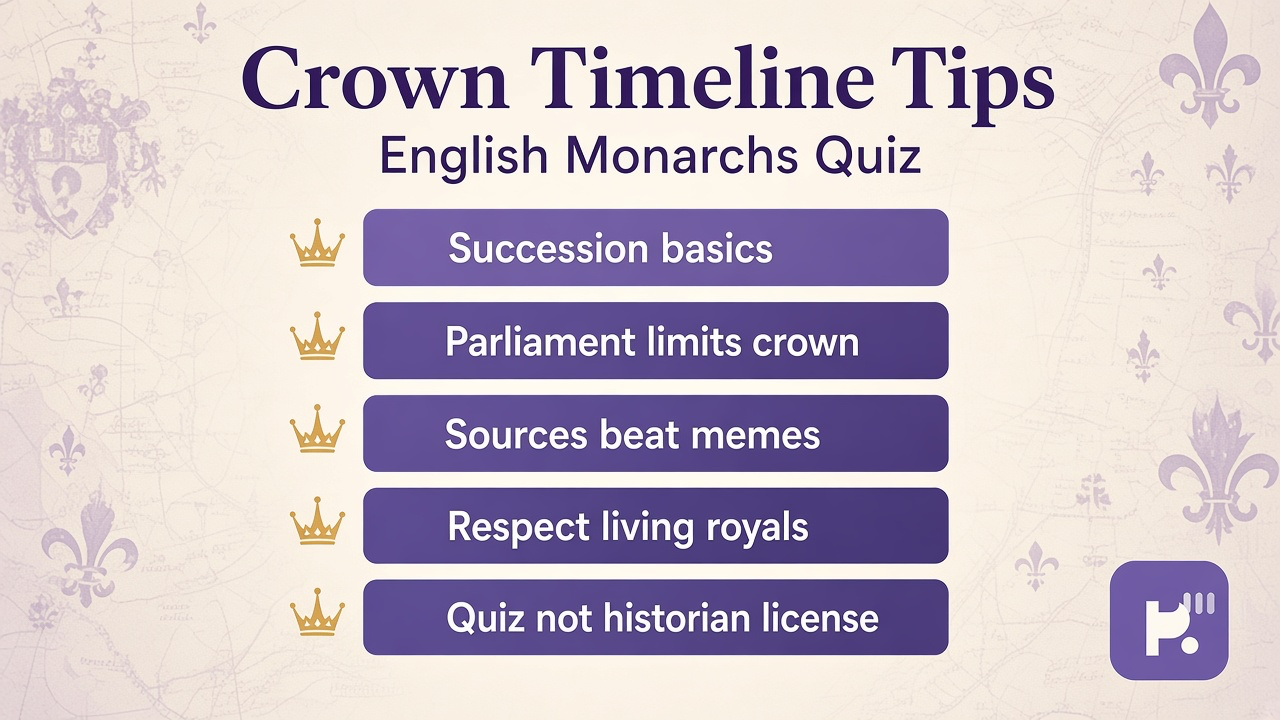
Succession basics
Heirs, houses, regents, landmark reigns, abdication messiness, and timeline flashcards.
Crown and Parliament
Modern constitutional roles, Royal Assent, prime ministers, and limits on personal decree myths.
Sources not memes
Museum and syllabus checking, approximate dates, primary source caution, and meme skepticism.
Study not historian
Living royal privacy, anti-gossip norms, and online warm-ups not replacing historians or legal advice.
How it works
Answer 22 agreement items
Rate each statement from Strongly disagree to Strongly agree. Tap Next after each answer.
Answers sort into four domains
Each answer feeds one of four monarchy history groups, and every item also feeds a closeness and trust layer.
See your index and charts
You get a 0 to 100 index, a band, and two bar charts you can use before a history unit test.
Take the English Monarchs Quiz
Answer 22 short statements to see your English monarchs history literacy index, four domain bars, and a closeness and trust chart.
What your result means
Your index is the average of all 22 answers, scaled from 0 to 100, with reverse-worded items flipped first. Higher means more reported monarchy history literacy on this screener. Read study-not-historian bars together with sources not memes before you treat the total as expert certification.
| Band | Index range | Typical reading |
|---|---|---|
| Building monarchs history literacy | 0 to 35 | Fewer agreed facts on succession, crown limits, source habits, or study humility on this screener. |
| Mixed monarchs history literacy | 36 to 65 | Solid facts in some domains with myths about tavern succession, personal decree lawmaking, or meme archives. |
| Strong monarchs history literacy | 66 to 100 | Frequent agreement with accurate monarchy history trivia and healthy source and privacy limits. |
Tips at a glance
A quick takeaway graphic with topic tips (not your personal quiz scores). Start the quiz for your index, bands, and charts.
What this quiz can and cannot tell you
Can tell you
- Clarify succession, house timelines, and crown versus Parliament roles in plain language
- Highlight common meme myths worth unlearning before history essays
- Encourage museum, syllabus, and archive checking without shame
- Spark better questions during history class or museum visits
Cannot tell you
- Replace historians, archivists, citizenship lawyers, or immigration advisers
- Prove intelligence rank or predict academic careers from one screener
- License harassment, stalking, or gossip about living royals or their families
- Justify spreading viral claims because trivia bars look high
English monarchs study beyond meme timelines and gossip threads
Students search English monarchs quizzes when Tudor and Stuart names blur and every viral post claims a new abdication date. Succession follows published heir rules even when wars, abdications, and regents make stories messy. Houses like Tudor or Stuart group reigns so religion, marriage, and civil war arcs fit on one timeline. Claiming a random tavern knight inherits whenever a king sneezes is a trap screeners flag on purpose.
Modern UK governance splits roles. The monarch serves as head of state with ceremonial duties while elected Parliament passes laws executed by ministers. Royal Assent remains part of legislation even though convention limits how monarchs use that power. Claiming the current monarch personally writes every statute without Parliament is another myth worth rejecting before civics essays.
Sources beat memes. Approximate reign dates on flashcards sort centuries when exams allow rounding. Primary sources need context because old language misleads fast. Museum and syllabus sentences should check spicy social posts before you repost. TikTok captions with crown emojis do not replace archive visits historians expect.
Study limits are the fourth domain because royal topics attract gossip. Living royals deserve privacy; stalking homes or schools is not history homework. This screener is warm-up, not historian licensing or visa advice. Pair it with our British citizenship quiz for modern civic framing, or the England quiz for geography and nations context. Browse the IQ and cognitive test hub for more study games. Retake after one museum page verifies a meme you almost shared; literacy grows when succession, Parliament limits, and source habits stay in order.
| Test | Focus |
|---|---|
| British citizenship quiz | Modern civic and citizenship recall rather than deep royal timeline study habits |
| England quiz | England geography and nations context rather than monarchy succession depth |
English Monarchs Quiz FAQ
What does this quiz measure?
It measures how much you agree with introductory English monarchs history literacy across succession, crown and Parliament roles, source habits, and study limits. You get an index from 0 to 100 and four bars. It reflects self-reported study habits on this screener, not a history degree or IQ score.
Does a high score mean I can give immigration or legal advice about the UK?
No. It is study trivia only. Citizenship, immigration, and legal questions belong to qualified advisers and official government sources, not an online agree screener.
Why are some statements worded as myths?
Reverse-worded myths catch overconfidence. Agreeing that tavern knights inherit randomly, that monarchs write every law alone, that TikTok replaces archives, or that trivia grants professorships should not inflate the literacy index.
Are reign dates in this quiz exact for every exam board?
This screener uses approximate timeline language suited to intro study. Exam boards may require precise dates; follow your syllabus and instructor for graded work.
Who reviewed this quiz?
Dr. James Whitfield reviewed the educational framing, constitutional and privacy limits, and result explanations. See our editorial policy for review standards.
Reviewed by
