What this quiz measures
This quiz does not measure IQ, grade your child for school, or replace teacher rubrics. It measures how much you agree with introductory class five English grammar study literacy grouped four ways: nouns and naming about people, places, things, ideas, and proper noun capitals; verbs and action about action and linking verbs, subject-verb agreement in simple present tense, and helping verbs; sentences and read-aloud about capitals, end punctuation, question starters, short paragraphs, and hearing broken grammar aloud; and practice not report card about mistake-friendly coaching, parent helper framing, and leaving formal grades to teachers. You answer 22 statements from strongly disagree to strongly agree, with reverse-worded myths so agreeing with every shortcut cannot inflate every bar. Your answers also feed a second chart on closeness and trust habits, because homework stress sometimes pushes families toward harsh labels instead of calm practice. The total becomes an index from 0 to 100 where higher means more reported grammar study literacy on this screener, not proof you should skip class when the next unit covers adjectives.
Nouns and naming
People, places, things, ideas, proper nouns, and spotting naming words in short sentences.
Verbs and action
Action and linking verbs, he-she-it s endings, helping verbs, and finding verbs when reading aloud.
Sentences and read-aloud
Capitals, periods and question marks, daily reading aloud, and short clear paragraphs.
Practice not report card
Mistakes as practice, kind parent coaching, and online bars not replacing teacher grades.
How it works
Answer 22 agreement items
Rate each statement from Strongly disagree to Strongly agree. Tap Next after each answer.
Answers sort into four domains
Each answer feeds one of four grammar study groups, and every item also feeds a closeness and trust layer.
See your index and charts
You get a 0 to 100 index, a band, and two bar charts you can use before a class five grammar unit test.
Take the English Grammar Quiz For Class 5
Answer 22 short statements to see your class 5 grammar study literacy index, four domain bars, and a closeness and trust chart.
What your result means
Your index is the average of all 22 answers, scaled from 0 to 100, with reverse-worded items flipped first. Higher means more reported grammar study literacy on this screener. Read practice-not-report-card bars together with read-aloud habits before you treat the total as school immunity.
| Band | Index range | Typical reading |
|---|---|---|
| Building class 5 grammar literacy | 0 to 35 | Fewer agreed facts on nouns, verbs, sentence habits, or practice humility on this screener. |
| Mixed class 5 grammar literacy | 36 to 65 | Solid facts in some domains with myths about every word being a noun, optional punctuation, or online bars replacing grades. |
| Strong class 5 grammar literacy | 66 to 100 | Frequent agreement with accurate class five grammar study trivia and healthy practice limits. |
Tips at a glance
A quick takeaway graphic with topic tips (not your personal quiz scores). Start the quiz for your index, bands, and charts.
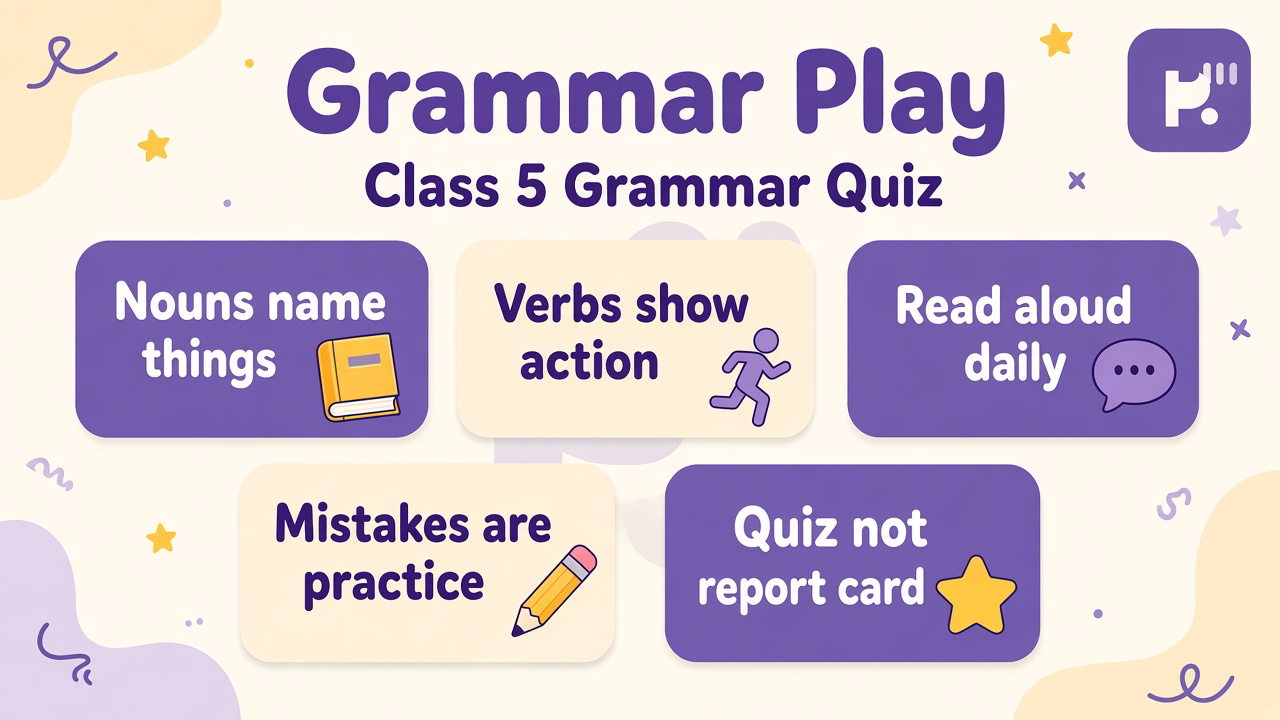
What this quiz can and cannot tell you
Can tell you
- Clarify noun, verb, and sentence basics in plain language for class five learners
- Highlight common grammar myths worth unlearning without shaming children
- Encourage read-aloud and retake habits at home without comparing siblings
- Spark better questions during parent-teacher conferences or homework time
Cannot tell you
- Replace teachers, school rubrics, formal assessments, or individualized education plans
- Prove intelligence rank or predict long-term academic success from one screener
- Diagnose learning disabilities or language disorders from online agree items
- Justify skipping classroom instruction because trivia bars look high
Class five grammar study without kitchen-table shame
Parents search class five grammar quizzes when homework mixes up nouns and verbs and every correction turns into tears. Nouns name people, places, things, and sometimes abstract ideas like freedom in stories teachers assign. Proper nouns like India or Tuesday take capital letters. Treating every word as a noun is a trap screeners flag on purpose so kids learn verbs and adjectives still exist.
Verbs carry the action or state of being. Simple present tense often adds s when the subject is he, she, or it: she runs, they run. Helping verbs like is, are, and has show up in sentences teachers mark before kids meet heavier tense charts in later grades. Claiming verbs never change form is another myth worth rejecting aloud during read-aloud time.
Sentences need capitals and sensible end marks. Question words who, what, where, when, why, and how often signal question marks. Reading homework aloud catches broken grammar faster than silent rushing because the ear hears what the eye skips. Commas and periods are not optional decorations once rubrics expect them; they are part of clear writing even in class five.
Practice limits are the fourth domain because online scores tempt overconfidence or shame. Mistakes are data for the next worksheet, not proof a child failed English forever. This screener helps parents coach kindly; it does not replace report cards or teacher grades. Pair it with our grammar quiz when adults want broader recall, or the IQ and cognitive test hub for more low-stakes study games. Retake after one unit on parts of speech; literacy grows when naming, action, and read-aloud habits stay in order.
| Test | Focus |
|---|---|
| Grammar quiz | Broader grammar recall for older learners rather than class five noun-verb basics |
| IQ and cognitive hub | More study games when you want grammar warm-ups beside other cognitive screeners |
English Grammar Quiz For Class 5 FAQ
What does this quiz measure?
It measures how much you agree with introductory class five grammar study literacy across nouns, verbs, sentences, and practice limits. You get an index from 0 to 100 and four bars. It reflects self-reported study habits on this screener, not a school report card or IQ score.
Does a high score mean my child will ace every grammar test?
No. It is study trivia and home practice framing. Teacher rubrics, classroom quizzes, and formal assessments stay separate from any online screener, no matter how high the bars look.
Why are some statements worded as myths?
Reverse-worded myths catch overconfidence. Agreeing that every word is a noun, that verbs never change, that punctuation is optional, or that online bars replace school grades should not inflate the literacy index.
Is this quiz only for students in class five?
It targets early upper-primary grammar habits common around class five age. Younger or older learners may still use it as a low-stakes warm-up, but teachers remain the authority on grade-level expectations.
Who reviewed this quiz?
Dr. James Whitfield reviewed the educational framing, parent helper limits, and result explanations. See our editorial policy for review standards.
Reviewed by