What the Engine Parts Quiz measures
This quiz does not issue ASE credentials, certify shop safety officers, or authorize customer vehicle repairs. It measures how much you agree with introductory engine parts study literacy grouped four ways: systems before parts about intake, combustion, and exhaust flow, piston and crank roles, valve timing context, and labeled block versus head reading; diagram literacy about exploded views, layout awareness, similar-part caution, sketch redraw habits, and refusing blurry-photo-only study; fluids and torque basics about oil versus coolant roles, cap labels, manual torque specs, drain procedures, and overheating stories beyond memes; and quiz not ASE about screeners versus certification exams, employer training, lift and jack stand rules, and refusing perfect-index shop waivers. You rate 22 statements from strongly disagree to strongly agree, with reverse-worded myths so one cram night cannot inflate every bar. Your answers also feed a second chart on closeness and trust habits, because study stress sometimes chases scores over honest lab partners. The total becomes an index from 0 to 100 where higher means more reported study literacy on this screener, not proof you may skip shop safety or ASE pathways.
Systems before parts
Intake, combustion, exhaust flow, and labeled block context at intro depth.
Diagram literacy
Exploded views, layouts, callouts, and sketches instead of photo guessing.
Fluids and torque basics
Oil versus coolant, caps, manuals, and drain procedures.
Quiz not ASE
Study screeners separate from exams, lifts, and employer training.
How it works
Answer 22 agreement items
Rate each statement from Strongly disagree to Strongly agree. Tap Next after each answer.
Answers sort into four domains
Each answer feeds one of four engine study groups, and every item also feeds a closeness and trust layer.
See your index and charts
You get a 0 to 100 index, a band, and two bar charts you can compare before an auto unit quiz.
Take the Engine Parts Quiz
Answer 22 short statements to see your engine parts study literacy index, four domain bars, and a closeness and trust chart.
What your result means
Your index is the average of all 22 answers, scaled from 0 to 100, with reverse-worded items flipped first. Read quiz-not-ASE with fluids bars before you treat a high systems score as shop permission. Literacy supports better questions in class; real bays deserve trained mechanics and instructors more than scoreboard wins.
| Band | Index range | Typical reading |
|---|---|---|
| Building engine parts study literacy | 0 to 35 | Fewer agreed facts on systems, diagrams, fluids, or ASE limit items on this screener. |
| Mixed engine parts study literacy | 36 to 65 | Solid recall in some domains with myths or guess habits in others. |
| Strong engine parts study literacy | 66 to 100 | Frequent agreement with accurate study and shop-limit habits. |
Tips at a glance
A quick takeaway graphic with topic tips (not your personal quiz scores). Start the quiz for your index, bands, and charts.
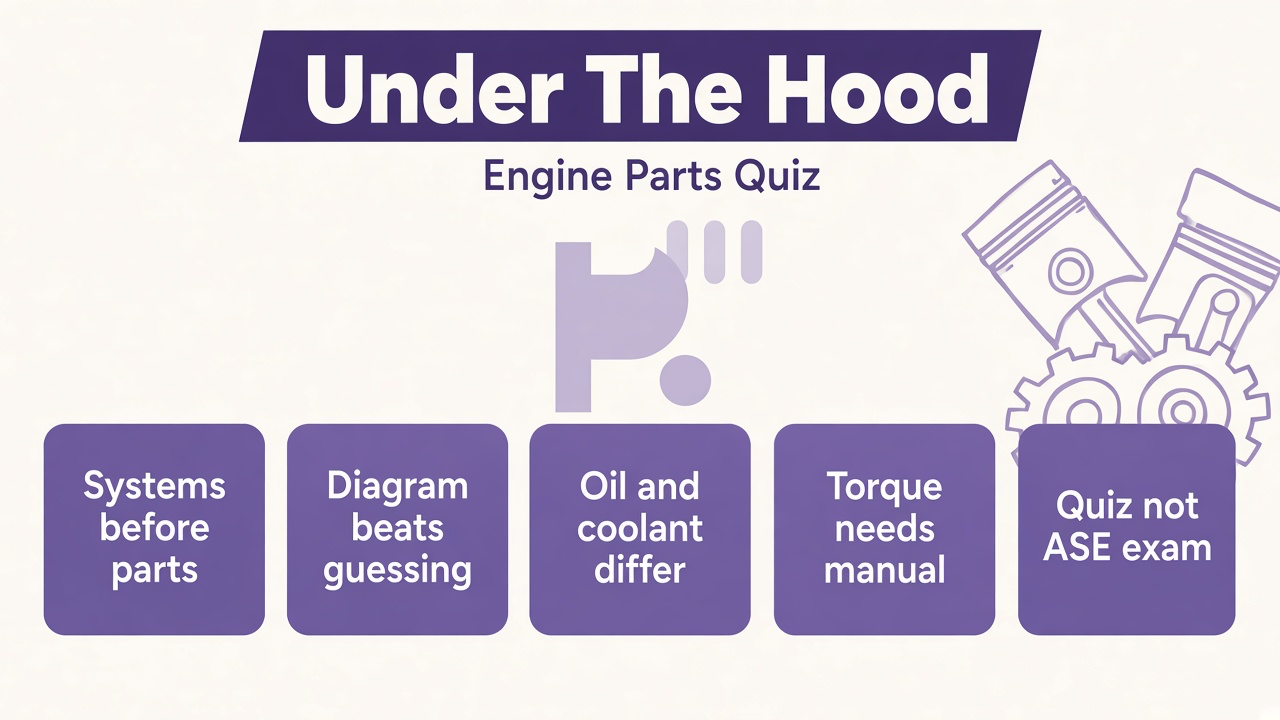
What this quiz can and cannot tell you
Can tell you
- Highlight systems, diagram, and fluid habits worth revisiting before engine unit tests
- Separate classroom labeling from ASE certification and shop safety fantasies
- Encourage manual callouts when you share scores in study group chats
- Spark better talk about torque specs and fluid roles without mechanic dunking
Cannot tell you
- Issue ASE certifications or employer mechanic licenses from one online screener
- Authorize unsupervised lift work or customer repair sign-off
- Replace auto instructors, shop manuals, or lab safety orientations
- Turn study scores into unsafe wrench bravado or fake training waivers online
Systems and diagrams before mechanic fantasies
Students search engine parts quizzes when piston labels blur, valve timing diagrams look alike, and social posts claim oil and coolant are interchangeable. Those goals help when readers treat bars as a study map for systems, manuals, and fluid roles, not as ASE passes or lift permissions. They hurt when people skip torque specs, ignore cap labels, or cite web scores in shop safety arguments.
Dr. James Whitfield reviews iq cognitive study screeners with a simple split: reward honest agreement with widely taught naming and diagram facts and honest limits on certification hype at the same time. Systems before parts keeps intake, combustion, and exhaust flow visible before isolated bolt trivia. Diagram literacy keeps exploded views, layouts, and sketch habits visible beside blurry-photo guessing traps. Fluids and torque basics keeps oil versus coolant roles, manual specs, and drain procedures visible beside interchangeable-fluid myths. Quiz not ASE keeps screeners, employer training, and lift rules visible beside perfect-index waiver jokes.
Real students mix bars. You might score high on systems while moderate on fluids, which often describes vocabulary before cap-label labs land. You might score high on diagrams with moderate quiz-not-ASE items, which can mean solid manuals yet little humility on shop floors. Reverse items catch sloppy answers: systemless engines, photo-only study, interchangeable fluids, or web scores waiving shop orientation should not inflate bars meant to track layered study habits.
Pair results with siblings on this hub instead of forcing one car story. Our car parts quiz spreads broader vehicle component recall when your class moves past engine bays. The automobile quiz sibling angles toward general auto literacy when you want stems beyond engine diagrams here. Browse the IQ and cognitive test hub for more low stakes study screeners. Caption shares as class practice and skip mechanic dunking on friends who never asked for a bay job.
Lab units move faster than one diagram photo. Safety briefings, torque sheets, and instructor demos shift while old bar charts still sit in camera rolls. When you share results, say labeled manuals beat scoreboard. When you borrow study tips, credit faculty who enforce lift rules. Retake after one engine cycle and watch whether fluids bars rise even if naming trivia lags, which often means you separated performative scoring from actual manual habits.
| Test | Focus |
|---|---|
| Car parts quiz | Broader vehicle component recall rather than dedicated engine systems and diagram depth here |
| Automobile quiz | General auto literacy rather than under-hood naming and torque spec habits on this page |
Engine Parts Quiz FAQ
What does this quiz measure?
It measures how much you agree with introductory engine parts study literacy across systems, diagrams, fluids and torque, and quiz-not-ASE limits. You get an index from 0 to 100 and four bars. It reflects self-reported knowledge on this screener, not an ASE exam score.
Does this replace ASE certification study?
No. ASE exams, employer training, and shop experience stay separate from any web screener. Use this for vocabulary reflection, not credential prep alone.
Does a high score mean I can work alone in a shop bay?
No. It is class trivia and study habits. Lift safety, instructor supervision, and manuals govern real equipment.
Why are some statements worded as myths?
Reverse-worded myths catch overconfidence. Agreeing that engines lack systems, that blurry photos beat manuals, that oil equals coolant, or that web scores waive shop training should not inflate your literacy index.
Who reviewed this quiz?
Dr. James Whitfield, PhD reviewed the educational framing, engine study literacy limits, and result explanations. See our editorial policy for review standards.
Reviewed by