What the Energy Transformation Quiz measures
This quiz does not license professional engineers, certify lab safety officers, or rank your intelligence. It measures how much you agree with introductory energy transformation study literacy grouped four ways: naming energy forms about kinetic, gravitational potential, thermal, chemical, electrical, sound, and light examples at homework depth without nuclear-everything shortcuts; conservation principles about form changes in closed teaching models, friction as thermal transfer, open versus closed system labels, and rejecting frictionless forever myths; units before numbers about joules, SI consistency, unit checks before arithmetic, reasonable magnitude estimates, and calorie-joule conversions from textbooks; and class not engineer license about screeners versus accredited degrees, refusing turbine sign-off fantasies, following powered-equipment lab rules, and treating class prep as separate from community infrastructure freelancing. You rate 22 statements from strongly disagree to strongly agree, with reverse-worded myths so one cram night cannot inflate every bar. Your answers also feed a second chart on closeness and trust habits, because exam stress sometimes chases scores over honest study partners. The total becomes an index from 0 to 100 where higher means more reported study literacy on this screener, not proof you may skip engineering ethics courses or safety training.
Naming energy forms
Kinetic, potential, thermal, chemical, electrical, sound, and light at intro problem depth.
Conservation principles
Form changes, friction to heat, and system boundaries in classroom models.
Units before numbers
Joules, SI consistency, checks, and conversions before arithmetic.
Class not engineer license
Exam prep, lab deferral, and refusal to treat screeners like PE credentials.
How it works
Answer 22 agreement items
Rate each statement from Strongly disagree to Strongly agree. Tap Next after each answer.
Answers sort into four domains
Each answer feeds one of four energy study groups, and every item also feeds a closeness and trust layer.
See your index and charts
You get a 0 to 100 index, a band, and two bar charts you can compare before a physics unit test.
Take the Energy Transformation Quiz
Answer 22 short statements to see your energy transformation study literacy index, four domain bars, and a closeness and trust chart.
What your result means
Your index is the average of all 22 answers, scaled from 0 to 100, with reverse-worded items flipped first. Read class-not-engineer with units bars before you treat a high conservation score as permission to skip lab safety. Literacy supports better questions in lecture; real machines deserve trained engineers and instructors more than scoreboard wins.
| Band | Index range | Typical reading |
|---|---|---|
| Building energy study literacy | 0 to 35 | Fewer agreed facts on energy forms, conservation models, unit habits, or engineering limit items on this screener. |
| Mixed energy study literacy | 36 to 65 | Solid habits in some domains with conservation traps, unit myths, or licensure fantasies in others. |
| Strong energy study literacy | 66 to 100 | Frequent agreement with form naming, conservation, units, and class limits; still not professional licensing. |
Tips at a glance
A quick takeaway graphic with topic tips (not your personal quiz scores). Start the quiz for your index, bands, and charts.
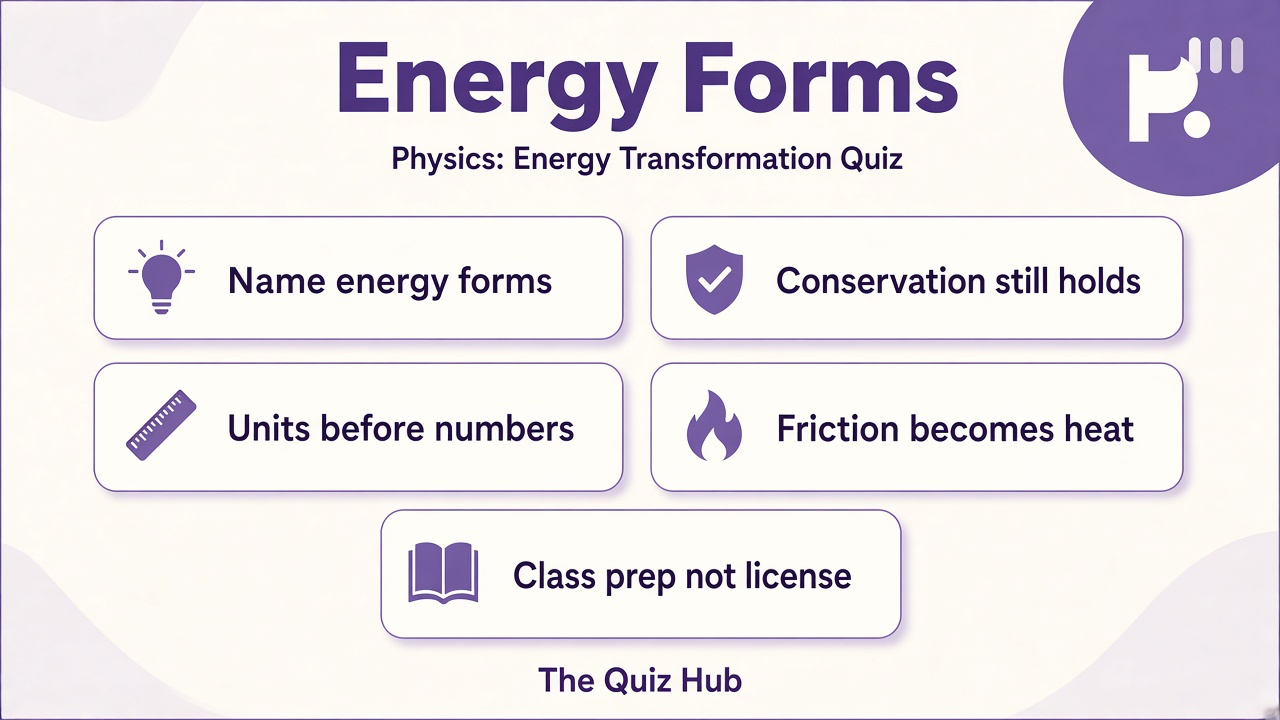
What this quiz can and cannot tell you
Can tell you
- Highlight energy form, conservation, and unit habits worth revisiting before unit exams
- Separate classroom models from professional engineering licensing fantasies
- Encourage bar charts and labeled joules before arithmetic bragging in group chats
- Spark better study talk about friction-to-heat and system boundaries
Cannot tell you
- Issue professional engineering licenses or PE credentials from one online screener
- Authorize unsupervised work on industrial turbines, panels, or structural sign-off
- Replace physics instructors, textbooks, or graded free-response rubrics
- Turn study scores into unsafe machinery bravado or fake OSHA waivers online
Energy forms and conservation before engineer fantasies
Students search energy transformation quizzes when kinetic versus potential labels blur, friction homework insists energy becomes heat, and social posts claim conservation means nothing ever slows down. Those goals help when readers treat bars as a study map for forms, boundaries, and units, not as engineering licenses or lab sign-off. They hurt when people skip joules because arithmetic felt fast, ignore open versus closed setups, or cite web scores in safety arguments on powered equipment.
Dr. James Whitfield reviews iq cognitive study screeners with a simple split: reward honest agreement with widely taught form and conservation facts and honest limits on licensure hype at the same time. Naming energy forms keeps kinetic, gravitational potential, thermal, chemical, and electrical examples visible without nuclear-everything shortcuts. Conservation principles keep defined-system bookkeeping, friction-to-heat stories, and open versus closed labels visible beside frictionless forever myths. Units before numbers keep joules, SI consistency, and conversion habits visible beside unit-free answer traps. Class not engineer license keeps screeners, accredited pathways, lab manuals, and safety deferral visible beside OSHA waiver jokes.
Real students mix bars. You might score high on form naming while keeping units moderate, which often describes vocabulary before labeled arithmetic lands. You might score high on conservation with moderate class-limit items, which can mean solid charts yet little humility on real machinery. Reverse items catch sloppy answers: nuclear labels everywhere, frictionless coasters forever, bare numbers beating labeled work, or perfect indices waiving workplace training should not inflate bars meant to track layered study habits.
Pair results with siblings on this hub instead of forcing one physics story. Our physics quiz spans broader mechanics recall when your course moves past energy units. The work and energy quiz sibling angles toward work-energy theorem language when your syllabus emphasizes joule paths through forces. Browse the IQ and cognitive test hub for more low stakes study screeners. Caption shares as class practice and skip engineer dunking on friends who never asked for a PE stamp.
Units move faster than one worksheet photo. New lab gear, safety briefings, and free-response rubrics shift while old bar charts still sit in camera rolls. When you share results, say labeled joules and instructor questions beat scoreboard. When you borrow study tips, credit faculty who enforce powered-equipment rules. Retake after one exam cycle and watch whether unit bars rise even if form trivia lags, which often means you separated performative scoring from actual problem setup.
| Test | Focus |
|---|---|
| Physics quiz | Broader mechanics recall rather than dedicated transformation form and unit habits on this page |
| Work and energy quiz | Work-energy theorem emphasis rather than multi-form transformation naming depth here |
Energy Transformation Quiz FAQ
What does this quiz measure?
It measures how much you agree with introductory energy transformation study literacy across naming forms, conservation in defined systems, units, and class-not-engineer limits. You get an index from 0 to 100 and four bars. It reflects self-reported knowledge on this screener, not a professional engineering exam.
Does conservation mean real machines never lose speed?
Intro models track form changes in defined systems. Real devices dissipate energy as heat and sound; brakes exist. Classroom conservation stories are bookkeeping tools, not claims that friction disappears.
Does a high score mean I am licensed to engineer bridges?
No. It is class trivia and study habits. Accredited degrees, exams, workplace training, and safety programs stay separate from any online screener.
Why are some statements worded as myths?
Reverse-worded myths catch overconfidence. Agreeing that every moving object is nuclear energy, that roller coasters never need brakes, that unit-free answers always win, or that web scores waive OSHA training should not inflate your literacy index.
Who reviewed this quiz?
Dr. James Whitfield, PhD reviewed the educational framing, energy study literacy limits, and result explanations. See our editorial policy for review standards.
Reviewed by