What the Endangered Species Quiz measures
This quiz does not measure IQ, certify you for wildlife biology licensing, or grade your worth as a student. It measures how much you agree with introductory conservation literacy grouped four ways: habitat loss and threats about fragmentation, invasive species, pollution, overharvesting, and climate-linked pressures without claiming one weather day erases decades of loss; IUCN status basics about vulnerable through critically endangered tiers, extinct in the wild, recovery programs, and refusing to use conservation labels as insults; local action habits about regional species learning, waste reduction, accredited zoo and aquarium support, wildlife distance ethics, and skeptical merch claims; and literacy not field guide about study prep, agency monitoring, no DIY wild animal handling, and biologist-owned recovery policy. You answer 22 statements from strongly disagree to strongly agree, with reverse-worded myths so agreeing with every shortcut cannot inflate every bar. Your answers also feed a second chart on closeness and trust habits, because academic and online culture sometimes pushes people toward harsh dunking over curious study. The total becomes an index from 0 to 100 where higher means more reported conservation literacy on this screener, not proof you should harass strangers or skip expert guidance in the field.
Habitat loss and threats
Fragmentation, invasives, pollution, overharvest, and climate pressures on populations.
IUCN status basics
Red List tiers, extinct in the wild, recovery programs, and labels are not insults.
Local action habits
Regional species, waste cuts, accredited programs, and respectful wildlife distance.
Literacy not field guide
Study screener, agency science, no wild nest selfies, experts own permits.
How it works
Answer 22 agreement items
Rate each statement from Strongly disagree to Strongly agree. Tap Next after each answer.
Answers sort into four domains
Each answer feeds one of four conservation literacy groups, and every item also feeds a closeness and trust layer.
See your index and charts
You get a 0 to 100 index, a band, and two bar charts you can use before a biology or environmental science unit.
Take the Endangered Species Quiz
Answer 22 short statements to see your conservation literacy index, four domain bars, and a closeness and trust chart.
What your result means
Your index is the average of all 22 answers, scaled from 0 to 100, with reverse-worded items flipped first. Higher means more reported conservation literacy on this screener. Read literacy-not-field-guide bars together with local action habits before you treat the total as expert immunity.
| Band | Index range | Typical reading |
|---|---|---|
| Building conservation literacy | 0 to 35 | Fewer agreed facts on habitat threats, status tiers, local habits, or study humility on this screener. |
| Mixed conservation literacy | 36 to 65 | Solid facts in some domains with myths about weather erasing habitat, insult labels, or dunking replacing study. |
| Strong conservation literacy | 66 to 100 | Frequent agreement with accurate conservation trivia and healthy study and field limits. |
Tips at a glance
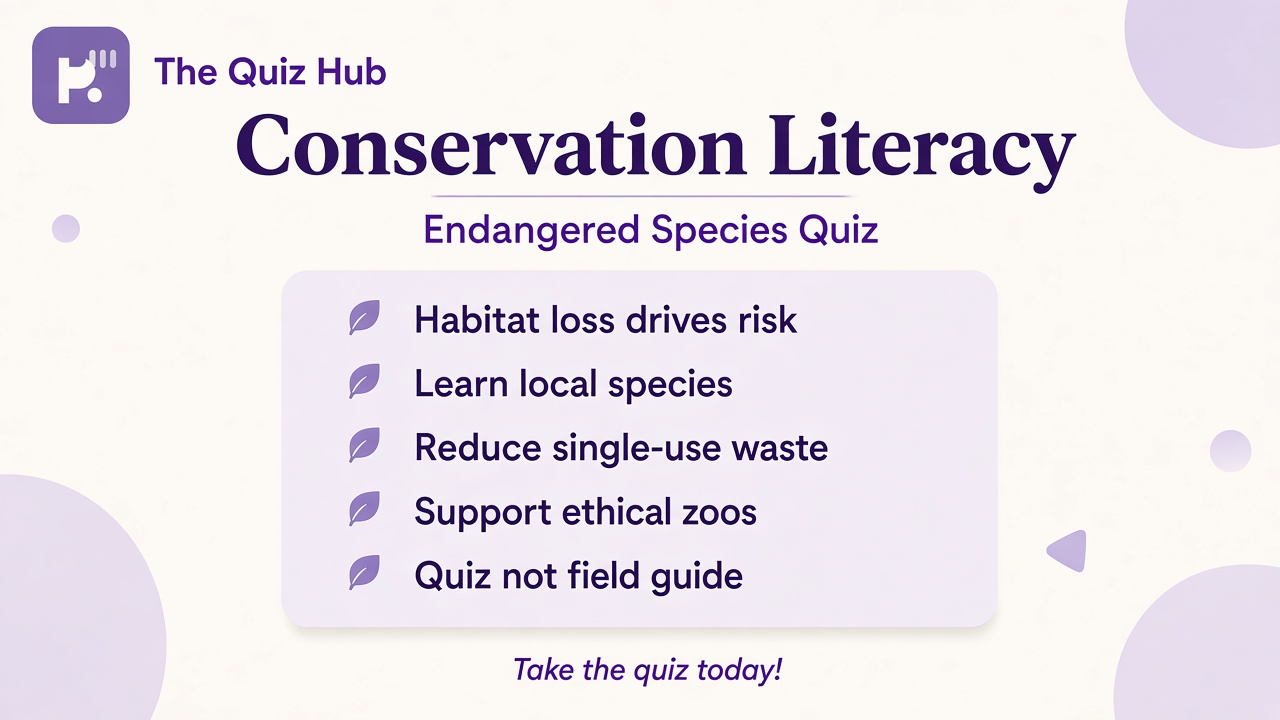
A quick takeaway graphic with topic tips (not your personal quiz scores). Start the quiz for your index, bands, and charts.
What this quiz can and cannot tell you
Can tell you
- Clarify habitat threat and Red List vocabulary in plain language
- Highlight common conservation myths worth unlearning before class discussions
- Encourage local species learning and waste habits without shame
- Spark better questions during biology units or nature center visits
Cannot tell you
- Certify you for wildlife handling, permitting, or recovery plan authorship
- Replace field guides, rangers, biologists, or agency monitoring data
- Prove intelligence rank or predict career success from one screener
- Justify harassing people who misname species because trivia bars look high
Conservation literacy beyond endangered animal clickbait
Students search endangered species quizzes when a biology unit hands them Red List headlines and every threat driver blurs together. Habitat loss and fragmentation remove food, shelter, and migration corridors faster than casual memes suggest. Invasive species, pollution, and overharvest add pressure on top of climate-linked range shifts that agencies track with long monitoring series. Treating one rainy afternoon as enough to erase decades of habitat work is a trap screeners flag on purpose.
IUCN Red List categories summarize science-reviewed extinction risk with labels like vulnerable, endangered, critically endangered, and extinct in the wild. Recovery can improve when protected areas, breeding programs, anti-poaching enforcement, and community stewardship align over years. Using endangered as a playground insult or assuming every sharp-toothed animal is critically rare confuses policy language with dunk culture.
Local action turns literacy into habits. Learning species near home makes watershed and park changes visible. Cutting single-use waste lowers pollution loads on rivers and coasts. Accredited zoos and aquariums with real conservation missions fund research and breeding beyond selfie cages, while unverified merch claims deserve skepticism. Mean comments on wildlife photos rarely teach what one regional field guide chapter does.
Study limits are the fourth domain because trivia scores tempt overconfidence. Memorizing famous mammals is class prep; it does not authorize touching wild pups or signing recovery plans. Agencies and field biologists use surveys, genetics, and permit law this screener cannot replace. Pair it with our biology quiz when you want broader life-science recall, or the climate change quiz when you want policy and evidence context beside habitat talk. Browse the IQ and cognitive test hub for more low-stakes study games. Retake after you can name one local species and one threat it faces without peeking; literacy grows when habitat, status, and action bars stay in order.
Conservation culture online moves faster than field seasons. A status bar might spike after a documentary while local action sleeps until you visit a nature center program. Retake after a unit test and notice whether literacy-not-field-guide bars stay high even when habitat recall rises, which often marks healthy study ethics. Trivia is a warm-up mirror, not a biologist license or a dunk pass.
| Test | Focus |
|---|---|
| Biology quiz | Broad life-science recall rather than dedicated endangered species and Red List literacy |
| Climate change quiz | Climate evidence and policy lanes rather than species status and local wildlife habits |
Endangered Species Quiz FAQ
What does this quiz measure?
It measures how much you agree with introductory conservation literacy across habitat threats, IUCN-style status basics, local action habits, and study humility. You get an index from 0 to 100 and four bars. It reflects self-reported knowledge on this screener, not a field biologist exam or IQ score.
Does a high score make me a wildlife expert?
No. It is study trivia and classroom literacy. Permits, handling rules, and recovery policy stay with trained biologists and agencies, no matter how high your bars look.
Why are some statements worded as myths?
Reverse-worded myths catch overconfidence. Agreeing that one rainy day erases habitat loss, that endangered is a fine insult, that dunk comments replace field guides, or that trivia replaces wolf pup permits should not inflate your literacy index.
How is this different from a field guide?
Field guides and apps identify species with photos, range maps, and expert updates. This screener checks habits and concepts at quiz length. Bring a guide or ranger on real hikes.
Who reviewed this quiz?
Dr. James Whitfield reviewed the study-not-field-guide framing, habitat and Red List literacy, anti-dunking limits, and educational tone. See our editorial policy for review standards.
Reviewed by