What this quiz measures
This quiz does not administer copyrighted clinical batteries, measure IQ, or grade your worth as a student or employee. It measures how much you agree with introductory psychometrics literacy grouped four ways: behavior sampling about items that target defined constructs, pilot trimming, retest learning effects, and limits of one short screener; norms and groups about reference samples, standard scores, cultural and era context, and refusing context-free genius labels; validity humility about face validity limits, structured versus projective contrast, reliability evidence, and rejecting perfect-by-vibes myths; and not a hiring verdict about unofficial framing, anti-HR misuse, study-only goals, and refusing to type strangers from bar height. You answer 22 statements from strongly disagree to strongly agree, with reverse-worded myths so shortcut agreement cannot inflate every bar. Your answers also feed a second chart on closeness and trust habits, because measurement anxiety sometimes pushes people toward ranking relatives or performing certainty online. The total becomes an index from 0 to 100 where higher means more reported psychometrics literacy on this screener, not proof you should assess coworkers without training.
Behavior sampling
Defined items, construct links, pilot data, retest learning, and narrow life slices.
Norms and groups
Reference samples, standard scores, cultural context, and cautious friend comparisons.
Validity humility
Face validity limits, projective contrast, replication habits, and anti-hype myths.
Not a hiring verdict
Unofficial study mirror, no HR files, no diagnostic labels from web totals.
How it works
Answer 22 agreement items
Rate each statement from Strongly disagree to Strongly agree. Tap Next after each answer.
Answers sort into four domains
Each answer feeds one of four psychometrics literacy groups, and every item also feeds a closeness and trust layer.
See your index and charts
You get a 0 to 100 index, a band, and two bar charts you can compare before debating tests in study group.
Take the Empirically Derived Test
Answer 22 short statements to see your empirically derived test literacy index, four domain bars, and a closeness and trust chart.
What your result means
Your index is the average of all 22 answers, scaled from 0 to 100, with reverse-worded items flipped first. Higher means more reported psychometrics literacy on this screener. Read not-a-hiring-verdict bars together with norms context before you treat the total as expertise.
| Band | Index range | Typical reading |
|---|---|---|
| Building empirically derived test literacy | 0 to 35 | Fewer agreed facts on behavior sampling, norms, validity humility, or hiring-limit items on this screener. |
| Mixed empirically derived test literacy | 36 to 65 | Solid recall in some domains with myths about projective equals empirical, context-free norms, or quiz-as-hiring-proof. |
| Strong empirically derived test literacy | 66 to 100 | Frequent agreement with accurate sampling, norms, validity humility, and healthy study limits. |
Tips at a glance
A quick takeaway graphic with topic tips (not your personal quiz scores). Start the quiz for your index, bands, and charts.
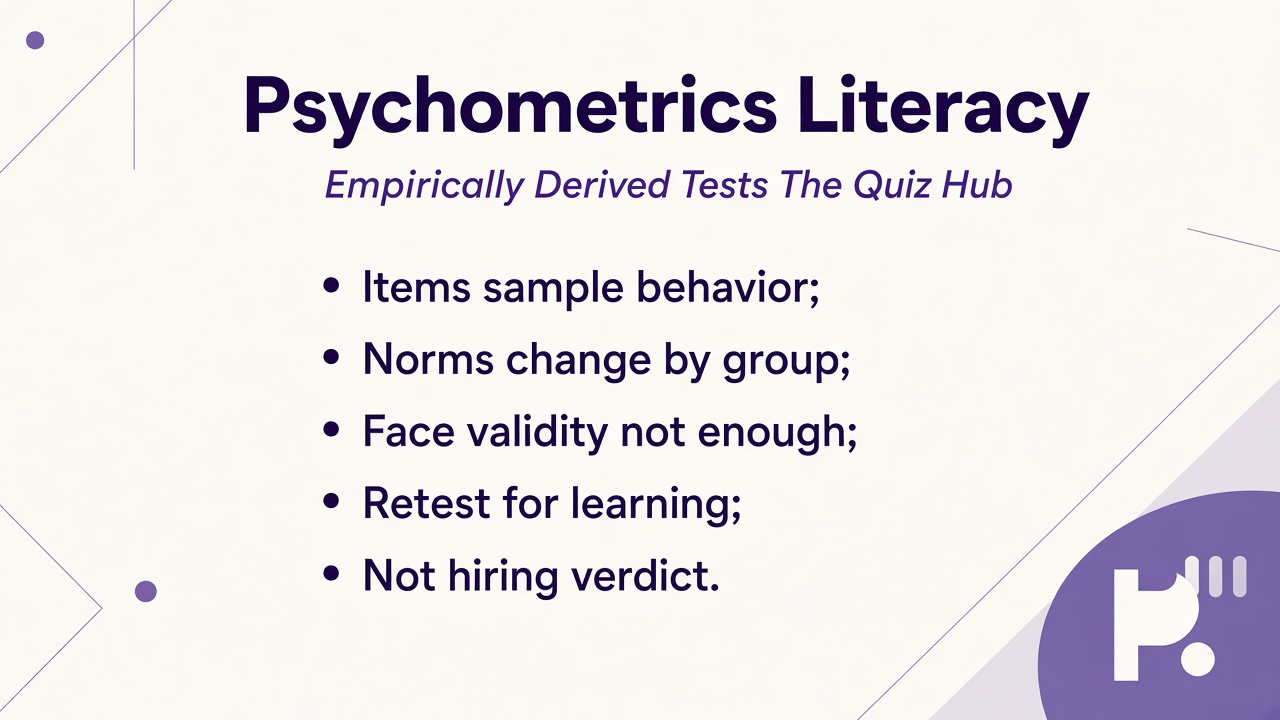
What this quiz can and cannot tell you
Can tell you
- Clarify how empirically derived items sample behavior instead of reading souls from vibes
- Highlight norm-group context and face validity traps worth unlearning
- Encourage structured versus projective contrast without shaming curious beginners
- Spark better questions in intro psych or HR ethics units
Cannot tell you
- Replace licensed clinical batteries, proctored exams, or trained assessor judgment
- Prove IQ rank, hireability, or diagnostic labels from one unofficial screener
- Authorize screening job candidates or students without policy and manual review
- Reproduce copyrighted test items or claim affiliation with test publishers
Why empirically derived test literacy needs humble framing
Search traffic around empirically derived tests usually chases two goals at once: sound smart in class and win arguments online about who is high functioning. Those goals help when they push you toward manuals and sampling logic. They hurt when a catchy total becomes a hiring filter or when projective stories get labeled empirical because they feel profound. Literacy language works best when it names behavior sampling and limits together.
Dr. James Whitfield reviews personality hub screeners with a simple split: reward honest recall about how items are built and honest limits on unofficial framing at the same time. Behavior sampling tracks construct definitions, pilot trimming, and retest learning without pretending one page captures every context. Norms and groups tracks reference samples, standard scores, and era or language shifts without genius labels divorced from manuals. Validity humility tracks face validity traps, structured versus projective contrast, and replication habits without vibe-based perfection myths.
Real learners mix bars. You might score high on sampling vocabulary while low on norm tables, which often describes first-semester students who met traits through memes before coursework. You might score high on validity humility while living outside the norm country, which is valid cross-cultural caution. Reverse items catch overconfidence: claiming projective inkblots always carry empirical keys, treating any raw total as universal genius, or using literacy bars as HR files should not inflate domains meant to track measurement habits.
Pair results with siblings on this hub instead of forcing one psych story. Our Emotional Intelligence Level (EIL) explores everyday trait literacy and context-beats-rank limits when you want hiring-proof humility beyond measurement stems here. The emotional intelligence quiz offers broader EQ domain habits with a different item bank. Browse the personality and psychology hub for more low-stakes screeners. Caption shares as study notes, not as orders to type coworkers from one index.
Courses change which chapter you see weekly. A norms bar might spike during exam week while validity examples sleep until you reread one replication abstract. Retake after a measurement unit and notice whether hiring-limit bars stay high even when content bars rise, which often marks ethical literacy. Psychometrics is a toolkit mirror, not a backstage pass to diagnose strangers.
| Test | Focus |
|---|---|
| Emotional Intelligence Level (EIL) | Everyday EQ literacy and context-beats-rank limits, not dedicated sampling and norms study habits |
| Emotional intelligence quiz | Broader EQ domain habits with a separate item bank, not psychometrics construction literacy |
Empirically Derived Test FAQ
What does this quiz measure?
It measures how much you agree with introductory psychometrics literacy about behavior sampling, norms, validity humility, and study limits. You get an index from 0 to 100 plus four bars. It reflects self-reported study habits on this screener, not licensed test scores.
Is this an official empirically derived test I can use for hiring?
No. This is an unofficial literacy mirror with original agree items. Employers and clinicians use validated batteries with training, manuals, and policy review. Web bars cannot replace that process.
Does a high score prove I have a high IQ?
No. High scores mean you agreed with many literacy and limit statements here. They do not administer IQ tests, predict success, or rank intelligence against friends.
Why contrast projective tasks with empirically derived items?
Online posts often blur storytelling tasks with keyed structured tests. Literacy includes knowing they answer different questions and should not be swapped when you discuss evidence or ethics.
Who reviewed this quiz?
Dr. James Whitfield reviewed the study-not-licensing framing, psychometrics literacy limits, and result explanations. See our editorial policy for review standards.
Reviewed by