What the Empirical and Molecular Formulas Quiz measures
This quiz does not measure IQ, certify you for chemical analysis, or grade your worth as a student. It measures how much you agree with introductory empirical and molecular formula study literacy grouped four ways: empirical and molecular basics about simplest ratios, molecular multiples, mass-percent-to-empirical steps, and molar mass links without claiming the labels always mean the same thing; molar mass and mass percent about periodic table sums, composition percents, sanity checks near one hundred percent, rounding traps, and checklists before mole division; hydrate and problem habits about dot notation, heating-off-water stories, balancing equations before mole ratios, factor-label unit work, and retakes after doubling traps; and study limits and humility about class prep, instructor feedback, and leaving lab safety to supervised courses. You answer 22 statements from strongly disagree to strongly agree, with reverse-worded myths so agreeing with every shortcut cannot inflate every bar. Your answers also feed a second chart on closeness and trust habits, because academic stress sometimes pushes people toward harsh self-rankings. The total becomes an index from 0 to 100 where higher means more reported formula study literacy on this screener, not proof you should skip study when the next exam covers limiting reagents.
Empirical and molecular basics
Simplest whole-number ratios, molecular multiples, mass percent to empirical steps, and molar mass links to molecular formulas.
Molar mass and mass percent
Periodic table sums, composition percents, rounding traps, and checklists before you divide moles on homework.
Hydrates and problem habits
Dot water notation, heating mass stories, balanced equations, unit work, and retakes after hydrate or doubling slips.
Study limits and humility
Class and exam prep, formula retakes, no DIY lab credentialing, and instructor-owned graded work.
How it works
Answer 22 agreement items
Rate each statement from Strongly disagree to Strongly agree. Tap Next after each answer.
Answers sort into four domains
Each answer feeds one of four formula study groups, and every item also feeds a closeness and trust layer.
See your index and charts
You get a 0 to 100 index, a band, and two bar charts you can use before a general chemistry stoichiometry test.
Take the Empirical and Molecular Formulas Quiz
Answer 22 short statements to see your formula study literacy index, four domain bars, and a closeness and trust chart.
What your result means
Your index is the average of all 22 answers, scaled from 0 to 100, with reverse-worded items flipped first. Higher means more reported formula study literacy on this screener. Read study limits and molar mass bars together before you treat the total as exam immunity.
| Band | Index range | Typical reading |
|---|---|---|
| Building formula study literacy | 0 to 35 | Fewer agreed facts on empirical versus molecular labels, molar mass steps, hydrate habits, or study humility on this screener. |
| Mixed formula study literacy | 36 to 65 | Solid facts in some domains with myths about interchangeable labels, ignoring hydrate water mass, skipping unit work, or trivia replacing lab safety. |
| Strong formula study literacy | 66 to 100 | Frequent agreement with accurate empirical and molecular study trivia and healthy class prep limits. |
Tips at a glance
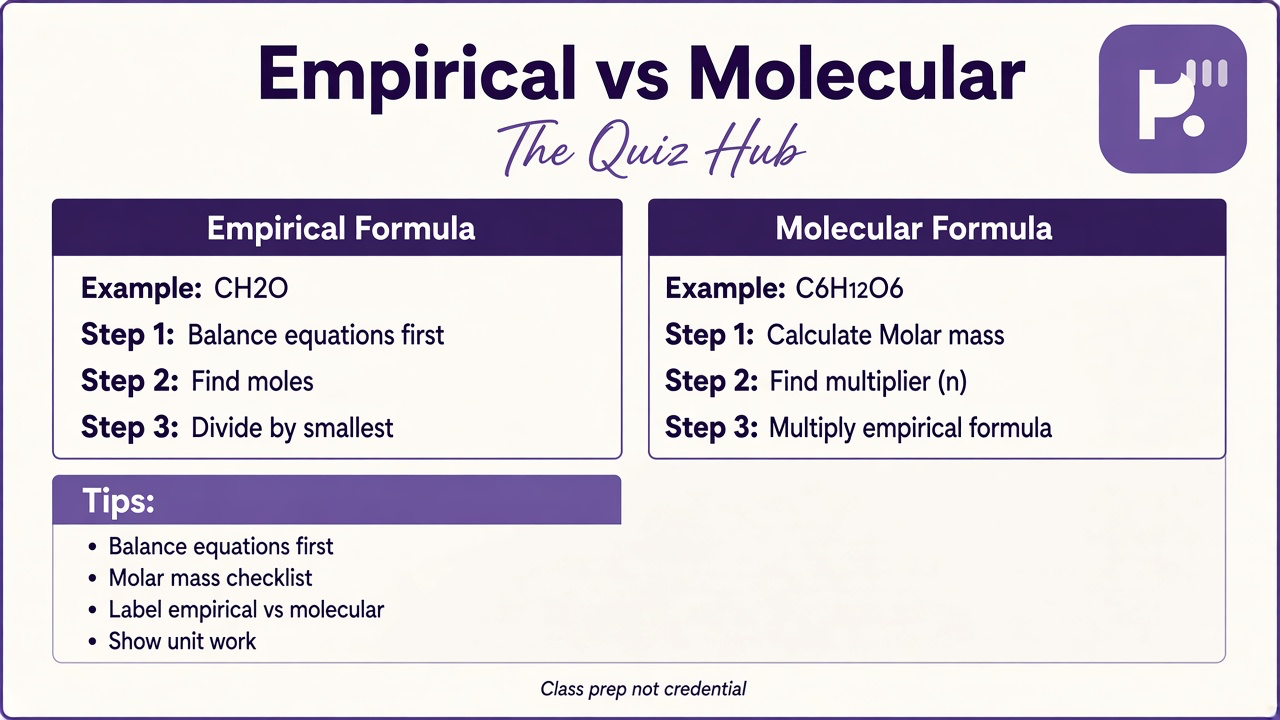
A quick takeaway graphic with topic tips (not your personal quiz scores). Start the quiz for your index, bands, and charts.
What this quiz can and cannot tell you
Can tell you
- Clarify empirical versus molecular vocabulary in plain language
- Highlight common mass percent, molar mass, and hydrate myths worth unlearning
- Encourage balanced-equation and unit-work retake habits without shame
- Spark better questions during gen-chem lectures or study groups
Cannot tell you
- Certify you for analytical lab work, instrument sign-off, or chemical licensing
- Replace instructors, textbooks, or graded exams on advanced stoichiometry proofs
- Prove intelligence rank or predict career success from one screener
- Justify skipping lab safety gear because trivia bars look high
Empirical and molecular formula literacy beyond one worksheet row
Students search empirical and molecular formula quizzes when a general chemistry unit hands them mass percent data and every ratio blur looks like guesswork. An empirical formula states the simplest whole-number atom ratio; a molecular formula can be a multiple when the real molecule contains more atoms. Treating the two labels as always identical is a trap screeners flag on purpose. Glucose-versus-formaldehyde style teaching stories exist so you practice ratio thinking without assuming one name fits every structure.
Mass percent problems give homework a spine. Convert each element percent to moles, divide by the smallest mole amount, and round cautiously to small integers before you write an empirical formula. A molecular formula still needs a molar mass bridge: compare empirical formula mass to the measured molecular mass from lab or textbook values. Skipping the periodic table because you memorized one compound is another myth worth rejecting. Checklists that sum atomic masses with correct subscripts catch missing oxygen and misplaced hydrate water before you divide.
Hydrates add dot notation and heating stories. Copper sulfate pentahydrate language reminds you that crystal water carries mass in composition and mole setups. Ignoring dot water as decoration breaks percent and stoichiometry lines even when the anhydrous name sounds familiar. Balance the reaction equation before mole-to-mole ratios so formula units line up with reaction amounts. Factor-label unit work beats copying a classmate final number without grams or moles attached. Retake after you confuse doubling empirical mass with finding a molecular formula when data say the molecule is twice as heavy.
Study limits are the fourth domain because trivia scores tempt overconfidence. Retakes and mass percent templates are normal class prep; they do not mean you finished quantitative analysis or earned lab credentialing. Agreeing that perfect formula trivia replaces goggles or instructor feedback is another myth worth rejecting. Use this screener as a warm-up, not a verdict. Pair it with our chemical formula practice quiz when you want naming and symbol drills, or the AP chem quiz for broader chemistry recall. Browse the IQ and cognitive test hub for more low-stakes study games. Retake after you can walk one mass percent example from percents to empirical formula to molecular formula without peeking; literacy grows when ratios, molar mass, and hydrate dots stay in order, not when you memorize one hydrate name and hope the exam never asks about unit work.
| Test | Focus |
|---|---|
| Chemical formula practice quiz | Formula naming, symbols, and ratio recall drills, not full mass percent-to-molecular workflow on one page |
| AP chem quiz | Broad AP chemistry unit recall, not dedicated empirical versus molecular study habits alone |
Empirical and Molecular Formulas Quiz FAQ
What does this quiz measure?
It measures how much you agree with introductory empirical and molecular formula study literacy across ratio basics, molar mass and mass percent, hydrate and problem habits, and study humility. You get an index from 0 to 100 and four bars. It reflects self-reported knowledge on this screener, not a graded lab exam or IQ score.
Does a high score mean I am ready for every chemistry lab?
No. It is study trivia and class literacy. Lab safety, instrument training, and instructor sign-off stay separate from any online screener, no matter how high your bars look.
Why are some statements worded as myths?
Reverse-worded myths catch overconfidence. Agreeing that empirical and molecular labels always mean the same thing, that memorization replaces the periodic table, that hydrate dot water has no mass, or that trivia replaces goggles should not inflate your literacy index.
Does this cover every advanced stoichiometry exception?
This screener stays at shared intro material: ratio definitions, mass percent steps, hydrate notation, balancing before mole ratios, and study humility. Advanced limiting reagent proofs and instrumentation depth belong in your course and textbook, not in one short screener.
Who reviewed this quiz?
Dr. James Whitfield, PhD reviewed the educational framing, formula study literacy limits, and result explanations. See our editorial policy for review standards.
Reviewed by