What EMIN-KR literacy measures
This quiz does not administer the official Korean-validated EMIN-KR battery, certify hireability, or diagnose any clinical condition. It measures how much you agree with statements in four groups: cultural context humility about checking norms before stereotype, honor-shame and hierarchy context, and separating one awkward dinner from family-wide verdicts; cross-border empathy habits about open questions, updating when corrected, listening before ranking mood across migration or language stress, and refusing bilingual intuition rank over someone's words; trait reflection not verdict about learnable habits, tough seasons without permanent stamps, private naming after conflict, and humble shares without sibling dunking; and unofficial mirror limits about treating this page as an English literacy mirror, refusing national EQ superiority myths, rejecting viral score meeting law, and using bars for reflection not immigration or hiring proof. You rate 22 statements from strongly disagree to strongly agree, with reverse-worded myths so autopilot responding cannot inflate every bar. Your answers also feed a second chart on closeness and trust habits, because EQ talk sometimes overlaps with how much you fear judgment when vulnerability meets performance pressure. The total becomes an index from 0 to 100 where higher means more reported endorsement of these EMIN-KR literacy habits on this unofficial screener, not proof you outrank calmer teammates by culture or language.
Cultural context humility
Check norms, honor-shame context, and indirect care before cold labels.
Cross-border empathy
Ask-first support, shame-duty updates, migration context, no cousin ranking.
Trait not verdict
Habits over destiny, seasons change, private naming, humble shares.
Unofficial mirror
Not Korean validated, no national EQ rank, reflection not hire proof.
How it works
Answer 22 agreement items
Rate each statement from Strongly disagree to Strongly agree. Tap Next after each answer.
Answers sort into four domains
Each answer feeds one of four EMIN-KR literacy groups, and every item also feeds a closeness and trust layer.
See your index and charts
You get a 0 to 100 index, a band, and two bar charts you can compare with a friend who processes feelings differently.
Take the Emotional Intelligence Test (EMIN-KR)
Answer 22 short statements to see your EMIN-KR literacy index, four domain bars, and a closeness and trust chart.
What your result means
Your index is the average of all 22 answers, scaled from 0 to 100, with reverse-worded items flipped first. Read unofficial-limit bars together with humility and empathy bars before you treat the total as national rank, destiny, or a reason to stereotype people in group chats.
| Band | Index range | Typical reading |
|---|---|---|
| Quieter EMIN-KR literacy endorsement | 0 to 35 | Less agreement with cultural humility, cross-border empathy, trait-not-verdict, and unofficial-limit items on this screener. |
| Mixed EMIN-KR literacy endorsement | 36 to 65 | Some domains show strong humility or empathy; others show reserve, stereotype traps, or strong unofficial-limit awareness. |
| Stronger EMIN-KR literacy endorsement | 66 to 100 | Frequent agreement with humility, cross-border empathy, and trait-not-verdict items; pair with unofficial-limit bars. |
Tips at a glance
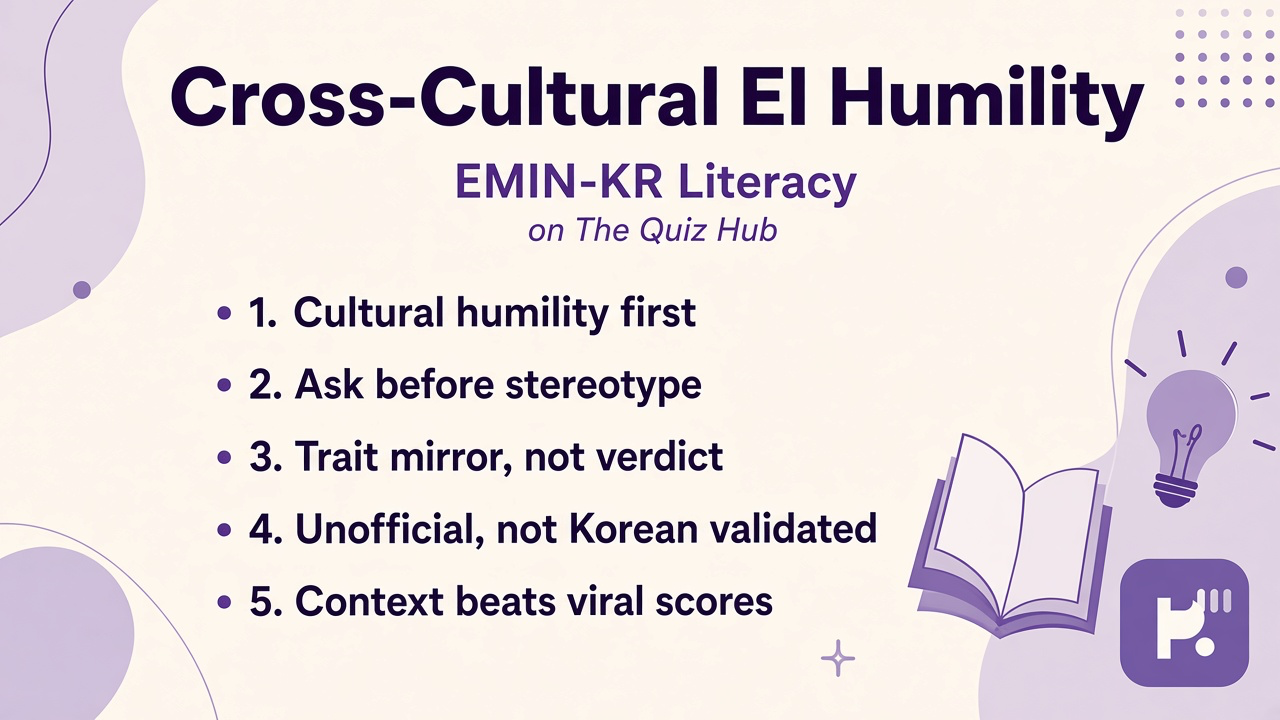
A quick takeaway graphic with topic tips (not your personal quiz scores). Start the quiz for your index, bands, and charts.
What this quiz can and cannot tell you
Can tell you
- Name whether you lean toward cultural humility, cross-border curiosity, or trait-not-verdict habits in the current season
- Separate everyday literacy from myths about Korean-validated scores or national EQ superiority
- Spark honest friend or mentor conversations about assumptions, apologies, and bilingual meeting tone
- Highlight limit myths you might unlearn before you type yourself or others from one score
Cannot tell you
- Replace licensed Korean EMIN-KR protocols, validated ability tests, 360 reviews, or clinical evaluation
- Prove you are more emotionally evolved than friends with different bar shapes or communication styles
- Replace direct conversation, cultural context, or professional care when patterns disrupt safety
- Override respect for someone who shares less because your literacy bar looks lower today
Korean EI searches, cultural humility, and scores that are not verdicts
Search traffic around emotional intelligence test EMIN-KR often wants a verdict: am I high enough EQ for this team, am I failing compared to viral Korean score posts, or finally validated against relatives who process feelings differently. Those questions help when they spark curiosity about context and repair without forcing everyone into performance theater. They hurt when stereotypes replace listening, or when quieter processors get read as low-EQ in every bilingual room. Literacy language works best when ask-first habits and humility stay in the same sentence.
Dr. James Whitfield reviews personality reflection tools with a respect-first lens. Cultural context humility tracks checking norms before cold labels without shaming people who prefer indirect care. Cross-border empathy habits track open questions and updates when corrected without treating bilingual intuition as courtroom evidence. Trait reflection not verdict tracks learnable habits and season shifts without fixing worth from one bar. Unofficial mirror limits keep fun framing visible so EMIN-KR talk does not slide into licensed-instrument pretense, national rank dunking, or online stereotyping.
Real EMIN-KR literacy mixes bars. You might score high on humility while strong on limits, which often describes reflective people who still refuse to certify hireability from threads. You might score high on empathy while low on public sharing, which is a cue for one trusted listener, not shame. Reverse items catch myths: soft speakers lack EQ forever, bilingual intuition beats their words, one low bar ends all people skills, or viral scores decide meeting airtime should not inflate bars meant to track habits.
Pair results with siblings on this hub instead of forcing one EQ story. Our emotional intelligence test EIT explores broader EI literacy with a separate item bank when you want Mayer-Salovey-adjacent language beyond Korean-context limits. The EMIN-1512 and EMIN-19 siblings use different stems for trait habits without cloning this mirror. Browse the personality and psychology hub for more low-stakes screeners. Share scores as conversation starters, not as orders to perform EQ in every stand-up.
Habits change with sleep, grief, language fatigue, and workload. A humility bar might spike after one workshop while trait-not-verdict habits hold steady from old friend rituals. Retake after an honest colleague chat and notice whether unofficial-limit bars stay high even when empathy bars rise; that often marks healthier meeting hygiene. Patterns are data, not destiny boxes.
| Test | Focus |
|---|---|
| Emotional intelligence test EIT | Broader EI literacy with a separate item bank, not Korean-context humility and unofficial-limit framing on this page |
| Emotional intelligence test EMIN-1512 | EMIN-1512 trait habit mirror with its own stems, not national EQ or bilingual humility items here |
| Emotional intelligence test EMIN-19 | Short EMIN variant literacy with unique stems, not cross-border empathy and unofficial Korean-validated limits |
Emotional Intelligence Test (EMIN-KR) FAQ
What does EMIN-KR literacy measure here?
It measures how much you agree with statements about cultural context humility, cross-border empathy habits, trait reflection without verdicts, and unofficial mirror limits. You get an index from 0 to 100 plus four bars. It describes self-reported EMIN-KR literacy habits on this unofficial English-language screener, not validated Korean instrument scores or a fixed personality type.
Is this the official Korean-validated EMIN-KR test?
No. Licensed Korean EMIN-KR protocols use trained materials and validation norms this page does not replicate. This mirror is an everyday habit screener with its own item bank for reflection only, not hiring proof or national EQ certification.
Does a high score mean my EQ is superior in Korean or bilingual settings?
No. High scores mean you agreed with many literacy statements here. Fit in teams depends on role, context, feedback, and ethics, not one web bar. Pair bars with limits, and skip using totals to rank coworkers or relatives by culture or language.
Why include unofficial-limit items beside humility and empathy?
EMIN-KR searches often skip power and validation context. Limit bars keep literacy separate from licensed-instrument pretense, viral score flexing, and treating unofficial screeners like immigration or hiring credentials.
Who reviewed this quiz?
Dr. James Whitfield reviewed the respectful framing, cultural humility reverse items, and unofficial-limit language. See our editorial policy for review standards.
Reviewed by