What the EMDT study screener measures
This quiz does not measure IQ, certify you for ethics licensing, or grade your worth as a person. It measures how much you agree with introductory moral development study literacy grouped four ways: Kohlberg stage literacy about preconventional, conventional, and postconventional teaching lanes, gradual reasoning in hypotheticals, and rejecting fixed rank over people; classic teaching stories about Heinz-style dilemmas, obedience-versus-harm vignettes, paired Piaget context, and rejecting plot-summary substitutes for full syllabi; moral development study habits about paragraph justifications, study-group debate, stage-and-story flashcards, and retakes after lecture without treating web scores as hiring proof; and study limits and humility about class prep, instructor critiques, empathy when harm is real, and leaving diagnosis of character to qualified contexts. You answer 22 statements from strongly disagree to strongly agree, with reverse-worded myths so agreeing with every shortcut cannot inflate every bar. Your answers also feed a second chart on closeness and trust habits, because academic stress sometimes pushes people toward harsh self-rankings. The total becomes an index from 0 to 100 where higher means more reported moral development study literacy on this screener, not proof you should skip study when the next exam covers Gilligan or cultural limits.
Kohlberg stage literacy
Preconventional, conventional, and postconventional lanes, gradual shifts in story reasoning, and labels as teaching tools not permanent rank.
Classic teaching stories
Heinz dilemmas, obedience-versus-harm plots, classroom debate, and Piaget pairing without licensing from one vignette.
Moral dev study habits
Justification paragraphs, study-group stage debate, flashcards, spaced retakes, and perspective bias notes before essays.
Study limits and humility
Class and discussion prep, syllabus depth, no social-media policing from scores, and instructor-owned graded ethics work.
How it works
Answer 22 agreement items
Rate each statement from Strongly disagree to Strongly agree. Tap Next after each answer.
Answers sort into four domains
Each answer feeds one of four moral development study groups, and every item also feeds a closeness and trust layer.
See your index and charts
You get a 0 to 100 index, a band, and two bar charts you can use before a developmental psych or ethics unit test.
Take the Emotional and Moral Development Test (EMDT)
Answer 22 short statements to see your moral development study literacy index, four domain bars, and a closeness and trust chart.
What your result means
Your index is the average of all 22 answers, scaled from 0 to 100, with reverse-worded items flipped first. Higher means more reported moral development study literacy on this screener. Read study limits and teaching-story bars together before you treat the total as exam immunity or moral superiority.
| Band | Index range | Typical reading |
|---|---|---|
| Building moral dev study literacy | 0 to 35 | Fewer agreed facts on Kohlberg stages, teaching stories, study habits, or class-only limits on this screener. |
| Mixed moral dev study literacy | 36 to 65 | Solid facts in some domains with myths about skipping development, licensing from vignettes, or quiz scores replacing hiring judgment. |
| Strong moral dev study literacy | 66 to 100 | Frequent agreement with accurate moral development study trivia and healthy class prep limits. |
Tips at a glance
A quick takeaway graphic with topic tips (not your personal quiz scores). Start the quiz for your index, bands, and charts.
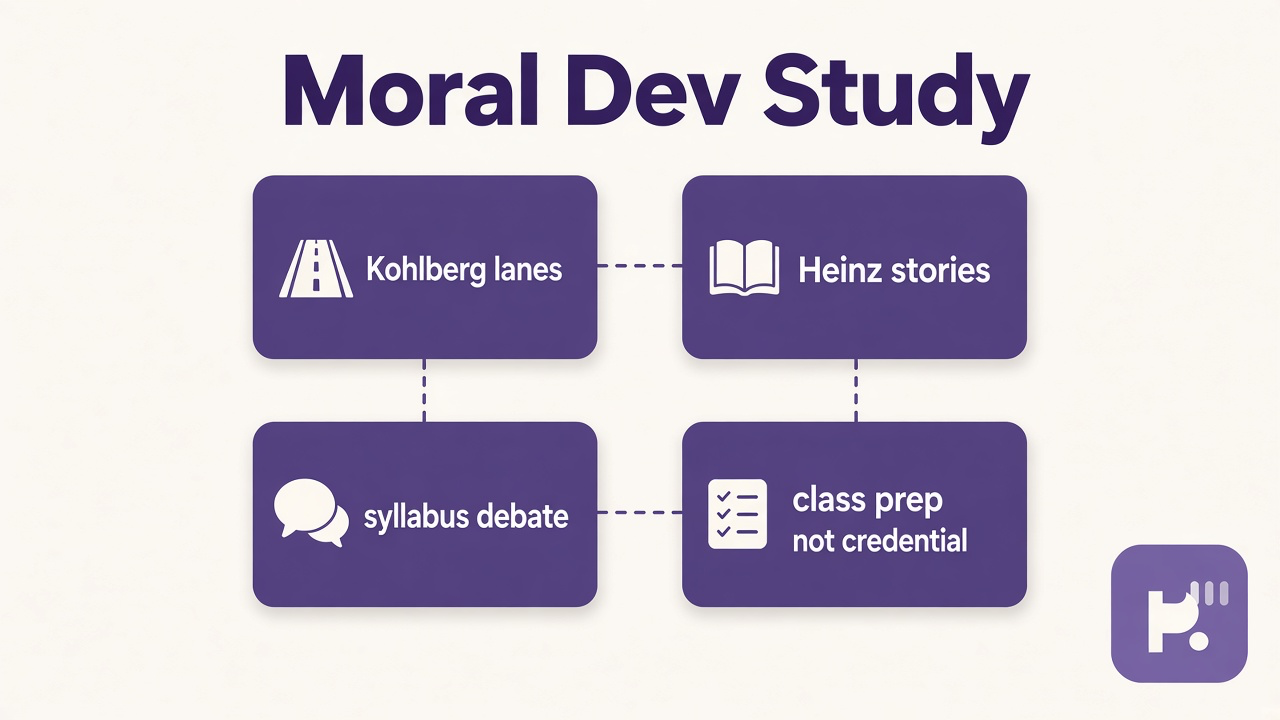
What this quiz can and cannot tell you
Can tell you
- Clarify Kohlberg stage vocabulary in plain language tied to classroom stories
- Highlight common dilemma and stage myths worth unlearning before the midterm
- Encourage debate and flashcard retake habits without shame
- Spark better questions during developmental psych or ethics lectures
Cannot tell you
- Certify you for hiring ethics panels, clinical licensing, or professional moral authority
- Replace instructors, textbooks, or graded exams on Gilligan critiques and cultural context
- Prove moral rank over classmates or strangers from one screener
- Justify skipping empathy or accountability when real harm happens offline
Moral development study literacy beyond one Kohlberg handout
Students search emotional and moral development tests when a developmental psych or ethics unit hands them Kohlberg stage names and every lane blurs with Piaget week. Preconventional stories often foreground punishment, reward, and self-interest before learners name broader social rules. Conventional examples highlight law-and-order or good-citizen motives in textbook vignettes. Postconventional cases sometimes introduce universal principles that clash with local customs on the syllabus. Treating every age as identical reasoning is a trap screeners flag on purpose.
Teaching stories give homework a spine. The Heinz dilemma asks whether stealing medicine to save a life can be justified and which principles students cite. Obedience-versus-harm plots test whether blind rule-following beats preventing harm. Classroom debate before philosopher names appear mirrors how many instructors assess participation. Claiming one memorized plot summary replaces Gilligan critiques, cultural readings, or instructor exceptions is another myth worth rejecting.
Study habits turn labels into essays. One-paragraph justifications per character, study groups that argue stage labels after a vignette, and flashcards that pair each stage with one story beat beat one cram night that evaporates before the midterm. Retakes after lecture separate fear-of-punishment answers from law-and-order answers. Noting narrator perspective helps students spot bias before graded responses. Agreeing that a high web score should steer hiring without interviews is another myth worth rejecting.
Study limits are the fourth domain because trivia scores tempt overconfidence and online dunking. Retakes and dilemma rehearsal are normal class prep; they do not mean you finished graduate ethics or earned moral authority over relatives. Agreeing that stage vocabulary diagnoses strangers from one thread should not inflate your literacy index. Use this screener as a warm-up, not a verdict. Pair it with our developmental psychology quiz when you want broader lifespan recall, or the child development quiz for earlier milestone context. Browse the IQ and cognitive test hub for more low-stakes study games. Retake after you can summarize Heinz and one non-Heinz vignette with stage labels from memory; literacy grows when stages, stories, and humility stay in order, not when you memorize one column of terms and hope the exam never asks about cultural limits.
| Test | Focus |
|---|---|
| Developmental psychology quiz | Broader lifespan and theory recall, not dedicated Kohlberg stage and dilemma study habits on one page |
| Child development quiz | Early milestone and parenting literacy, not adolescent moral reasoning vignettes and ethics debate prep |
Emotional and Moral Development Test (EMDT) FAQ
What does this quiz measure?
It measures how much you agree with introductory moral development study literacy across Kohlberg stages, classic teaching stories, study habits, and study humility. You get an index from 0 to 100 and four bars. It reflects self-reported knowledge on this screener, not a graded ethics exam, clinical diagnosis, or proof you are more moral than other people.
Is this the official Emotional and Moral Development Test credential?
No. This page is an educational study screener about common classroom Kohlberg and dilemma material. Official credentials, licensing, and graded program requirements stay with your institution and qualified instructors, not with any online agree-or-disagree quiz.
Why are some statements worded as myths?
Reverse-worded myths catch overconfidence. Agreeing that every age reasons identically, that one plot summary replaces the syllabus, that web scores should guide hiring, or that stage labels diagnose strangers should not inflate your literacy index.
Does this cover every critique of Kohlberg?
This screener stays at shared intro material: stage lanes, famous dilemmas, study habits, and humility. Gilligan critiques, cross-cultural ethics depth, and advanced philosophy belong in your course and textbook, not in one short screener.
Who reviewed this quiz?
Dr. James Whitfield, PhD reviewed the educational framing, moral development study literacy limits, and result explanations. See our editorial policy for review standards.
Reviewed by