What the Electrophoresis Quiz measures
This quiz does not measure IQ, certify you for clinical molecular diagnostics, or grade your worth as a student. It measures how much you agree with introductory gel electrophoresis literacy grouped four ways: gel and buffer basics about agarose sieving, running buffer ions, wells, fragment size trends, and gel percent choices; run technique about ladders, loading dye, electrode polarity, well volume habits, and cable checks; safety and PPE about eye protection, gloves, stain disposal, and keeping food off benches; and study not clinical cert about pre-lab retakes, instructor sign-off, and leaving hospital workflows to supervised training. You answer 22 statements from strongly disagree to strongly agree, with reverse-worded myths so agreeing with every shortcut cannot inflate every bar. Your answers also feed a second chart on closeness and trust habits, because academic stress sometimes pushes people toward harsh self-rankings. The total becomes an index from 0 to 100 where higher means more reported gel literacy on this screener, not proof you should skip PPE when the next lab uses stains or UV.
Gel and buffer basics
Agarose sieving, running buffer ions, wells, size migration trends, and gel percent choices in plain intro language.
Run technique
DNA ladders, loading dye, positive electrode migration, well loading limits, and polarity checks before power on.
Safety and PPE
Goggles, gloves, stain and waste disposal, and food-free bench habits in teaching labs.
Study not clinical cert
Pre-lab literacy, TA and instructor rules, no hospital bench credentialing, and humility about class prep.
How it works
Answer 22 agreement items
Rate each statement from Strongly disagree to Strongly agree. Tap Next after each answer.
Answers sort into four domains
Each answer feeds one of four gel literacy groups, and every item also feeds a closeness and trust layer.
See your index and charts
You get a 0 to 100 index, a band, and two bar charts you can use before an intro molecular biology lab week.
Take the Electrophoresis Quiz
Answer 22 short statements to see your gel literacy index, four domain bars, and a closeness and trust chart.
What your result means
Your index is the average of all 22 answers, scaled from 0 to 100, with reverse-worded items flipped first. Higher means more reported gel electrophoresis literacy on this screener. Read safety and study-not-clinical bars together before you treat the total as lab sign-off.
| Band | Index range | Typical reading |
|---|---|---|
| Building gel literacy | 0 to 35 | Fewer agreed facts on agarose basics, run technique, PPE habits, or study limits on this screener. |
| Mixed gel literacy | 36 to 65 | Solid facts in some domains with myths about water-only buffer, reversed wells, optional gloves, or trivia replacing sign-off. |
| Strong gel literacy | 66 to 100 | Frequent agreement with accurate gel trivia and healthy PPE and study limits. |
Tips at a glance
A quick takeaway graphic with topic tips (not your personal quiz scores). Start the quiz for your index, bands, and charts.
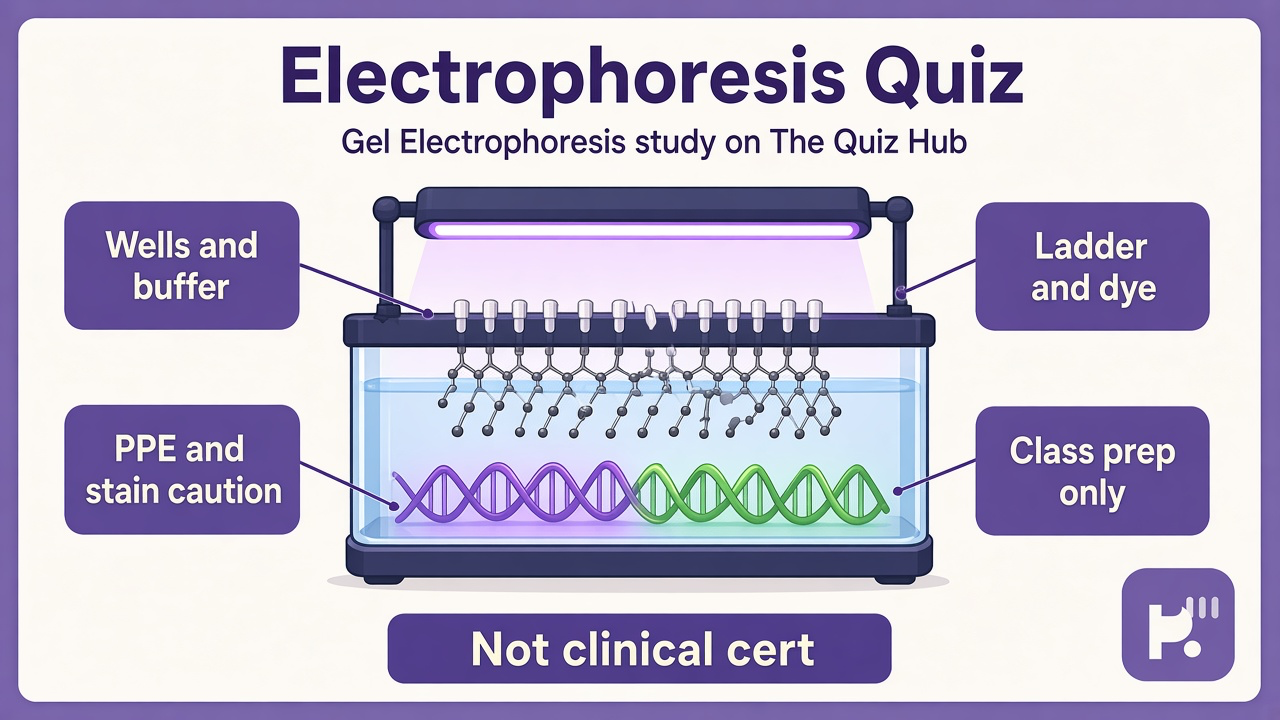
What this quiz can and cannot tell you
Can tell you
- Clarify agarose gel, buffer, well, and polarity vocabulary in plain language
- Highlight common ladder, loading, and electrode myths worth unlearning before lab
- Encourage PPE and disposal habits without shame before a wet lab
- Spark better questions during pre-lab or study group walkthroughs
Cannot tell you
- Certify you for hospital molecular diagnostics, CLIA workflows, or clinical bench authorization
- Replace instructors, lab manuals, or graded practical exams on technique depth
- Prove intelligence rank or predict career success from one screener
- Justify skipping gloves, goggles, or waste rules because trivia bars look high
Gel literacy beyond one blurred band photo
Students search gel electrophoresis when a molecular biology unit hands them a gel box photo and every band looks like abstract art. Agarose forms a porous matrix that sieves nucleic acids by size in countless teaching labs. Running buffer is not decorative water; ions carry current and help keep pH stable while fragments migrate. Mixing buffer roles with plain distilled water alone is a trap quizzes flag on purpose.
Wells sit on the negative electrode side in standard DNA setups because phosphate backbones carry negative charge at teaching-lab pH and fragments travel toward the positive pole. Loading dye adds density so samples sink instead of floating out of wells, and a visible dye front shows run progress. DNA ladders give reference bands so you can estimate unknown fragment sizes by comparison, not by guessing from gel color alone. Reversing well orientation toward the positive electrode is another myth worth rejecting before you plug in a power supply.
Safety belongs in the same story as pretty bands. Eye protection matters near stains, splashes, and UV transilluminators instructors describe on day one. Gloves reduce skin contact with buffers and stain alternatives your safety sheet names. Stained gel pieces and contaminated tips go into labeled waste streams your course defines, not into casual trash when rules say otherwise. Treating gloves as optional after stain contact is a habit worth unlearning even when trivia scores look strong.
Study limits are the fourth domain because online scores tempt overconfidence. Pre-lab videos, handouts, and TA walkthroughs are normal class prep; they do not mean you finished clinical fellowship training or earned hospital bench sign-off. Agreeing that perfect gel trivia replaces documented PPE or instructor authorization is another myth worth rejecting. Use this screener as a warm-up, not a verdict. Pair it with our DNA quiz when you want broader nucleic acid recall, or the chem lab quiz for general bench habit reflection. Browse the IQ and cognitive test hub for more low-stakes study games. Retake after you can sketch polarity and wells from memory without peeking; literacy grows when buffer, wells, and PPE stay in order, not when you memorize one ladder photo and hope lab day never asks where the positive lead goes.
| Test | Focus |
|---|---|
| DNA quiz | Broader nucleic acid and genetics recall, not dedicated agarose run technique and PPE on one page |
| Chem lab quiz | General chemistry bench habits and safety reflection, not gel polarity and ladder reading depth |
Electrophoresis Quiz FAQ
What does this quiz measure?
It measures how much you agree with introductory gel electrophoresis literacy across gel and buffer basics, run technique, safety and PPE, and study-not-clinical limits. You get an index from 0 to 100 and four bars. It reflects self-reported knowledge on this screener, not a graded lab practical or IQ score.
Does a high score mean I am certified for clinical molecular labs?
No. It is study trivia and pre-lab literacy. Hospital diagnostics, instrument training, and supervisor sign-off stay separate from any online screener, no matter how high your bars look.
Why are some statements worded as myths?
Reverse-worded myths catch overconfidence. Agreeing that distilled water alone replaces running buffer, that wells should face the positive electrode for DNA, that gloves are optional after stains, or that trivia replaces required PPE should not inflate your literacy index.
Does this cover every gel type like SDS-PAGE or pulsed-field runs?
This screener stays at shared intro material: agarose nucleic acid gels, teaching-lab polarity, ladders, loading dye, PPE, and disposal humility. Protein SDS-PAGE and specialized instruments belong in your course and manual, not in one short screener.
Who reviewed this quiz?
Dr. James Whitfield, PhD reviewed the educational framing, gel literacy limits, and result explanations. See our editorial policy for review standards.
Reviewed by