What Election Quiz measures
This quiz does not pick candidates, certify you for ballot access, or rank whose vote matters more. It measures how much you agree with beginner-friendly election process trivia grouped four ways: registration and eligibility about address updates, official deadline checks, state rule humility, and sample ballot homework without telling you how to mark choices; ballots and turnout about polling plans, mail and absentee instructions, provisional ballots, and certified counting timelines without law school depth; civic respect about non-intimidating behavior, careful sharing, patient poll workers, family disagreements without trivia bullying, and reporting credible threats; and institutions and process about federal versus state roles, primaries versus generals, Electoral College basics for presidential races, and peaceful transfer norms without endorsing any party platform. You rate 22 statements from strongly disagree to strongly agree, with reverse-worded myths so one viral clip cannot inflate every bar. Your answers also feed a second chart on closeness and trust habits, because election stress sometimes chases winning arguments over honest connection. The total becomes an index from 0 to 100 where higher means more reported process literacy on this screener, not proof you should lecture neighbors or skip respect when bars spike.
Registration and eligibility
Address updates, official deadlines, state rule humility, and sample ballot homework without vote shaming.
Ballots and turnout
Polling plans, mail instructions, provisional ballots, and patience for certified results.
Civic respect
Calm discourse, careful sharing, poll worker patience, and trivia without intimidation.
Institutions and process
Branches, election calendars, Electoral College basics, and peaceful transfer norms without party picks.
How it works
Answer 22 agreement items
Rate each statement from Strongly disagree to Strongly agree. Tap Next after each answer.
Answers sort into four domains
Each answer feeds one of four election process groups, and every item also feeds a closeness and trust layer.
See your index and charts
You get a 0 to 100 index, a band, and two bar charts you can compare with a friend who loves civics podcasts or local news.
Take the Election Quiz
Answer 22 short statements to see your election process index, four domain bars, and a closeness and trust chart.
What your result means
Your index is the average of all 22 answers, scaled from 0 to 100, with reverse-worded items flipped first. Read civic respect and registration bars together before you treat a high institution bar as license to quiz strangers on party loyalty. Process trivia is for fun reflection; mixed families deserve patience more than scoreboard wins.
| Band | Index range | Typical reading |
|---|---|---|
| Building election process literacy | 0 to 35 | Fewer agreed facts on registration habits, ballot basics, civic respect, or institution trivia on this screener. |
| Mixed election process literacy | 36 to 65 | Solid facts in some domains with deadline traps or respect blind spots in others. |
| Strong election process literacy | 66 to 100 | Frequent agreement with accurate registration, ballot, respect, and institution facts; still fun only. |
Tips at a glance
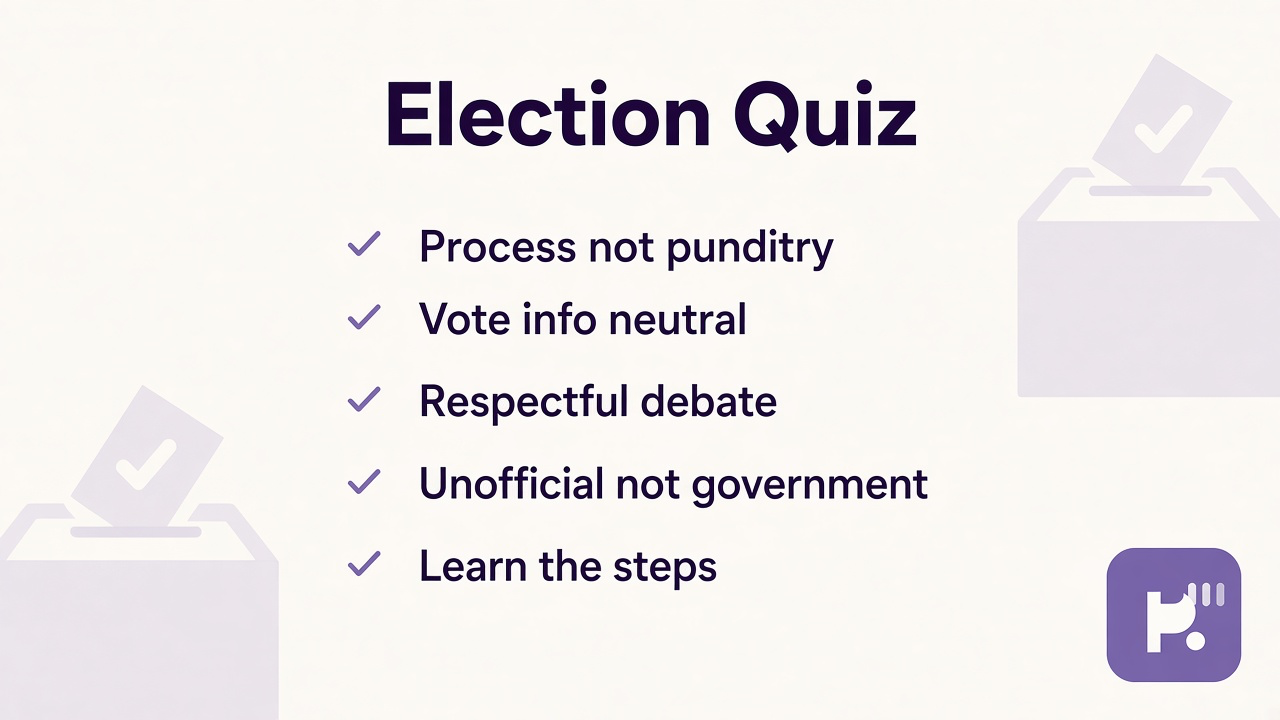
A quick takeaway graphic with topic tips (not your personal quiz scores). Start the quiz for your index, bands, and charts.
What this quiz can and cannot tell you
Can tell you
- Highlight registration and ballot habits worth revisiting before the next election
- Separate turnout logistics from respectful neighbor behavior without merging them into partisan traps
- Encourage official-source curiosity when rules change county to county
- Spark better questions for school projects, new voter roommates, and curious relatives
Cannot tell you
- Tell you how to vote, which party to join, or which candidate deserves your ballot
- Prove you should shame neighbors, workers, or relatives based on bars
- Replace election officials, attorneys, threat investigators, or licensed counselors
- Turn civics scores into harassment, intimidation, or fake patriot badges online
Election trivia as playful mirror, not party loyalty court
Search traffic around election quizzes usually wants two things: share a civics score without sitting through a campaign ad marathon, and learn one new fact for the group chat. Those goals help when readers notice that process trivia starts conversations, not courtroom verdicts on patriotism. They hurt when people treat bars like proof someone is un-American, gullible, or too partisan, or when threads mock poll workers who kept lines moving.
Dr. Rachel Kim reviews fun novelty quizzes with a simple split: reward honest curiosity about registration logistics and respectful civic behavior at the same time. Registration and eligibility tracks address updates, official deadline checks, and humble state rule lookups without pretending one screener replaces legal advice. Ballots and turnout tracks polling plans, mail instructions, provisional ballots, and certified counting patience without turning stems into bar exam finals. Civic respect keeps non-intimidating behavior, careful sharing, and patient treatment of workers visible beside feeds that demand performative outrage. Institutions and process keeps federal versus state roles, primary versus general calendars, Electoral College basics, and peaceful transfer norms visible without endorsing any party platform.
Real readers mix bars. You might score high on civic respect while keeping institution bars moderate, which often describes neighbors who are kind at the door yet rusty on civics class vocabulary. You might score high on institution trivia with moderate registration bars, which can mean strong podcast memory yet a stale address on file. Reverse items catch sloppy answers: insisting registration never closes anywhere, claiming social posts count ballots, demanding quiz losers lose voting rights, or expecting Supreme Court night-of calls should not inflate bars meant to track layered process stories.
Pair results with siblings on this hub instead of forcing one election story. Our citizenship test quiz leans broader naturalization-style civics when you want history and government breadth without current cycle framing. The amendments quiz stays on constitutional change literacy when you want Bill of Rights context without candidate names. Browse the fun and novelty hub for more light screeners. Caption shares as fun civics trivia and skip ambushes on relatives who never asked for a pop quiz.
Rules shift faster than meme timelines. Mail ballot envelopes, ID checks, and recount triggers vary by state while federal races share some national calendars. When you share results, say curiosity beats ranking citizens. When you borrow turnout tips, credit election officials who publish plain-language guides and respect people who vote quietly. Retake after one local sample ballot and one official FAQ and watch whether respect bars rise even if institution bars lag, which often means you separated performative scoring from actual table manners.
| Test | Focus |
|---|---|
| Citizenship test quiz | Broader naturalization-style civics rather than current-cycle process trivia lanes |
| Amendments quiz | Constitutional amendment literacy rather than ballot logistics and turnout habits |
Election Quiz FAQ
What does Election Quiz measure?
It measures how much you agree with statements about registration habits, ballots and turnout basics, civic respect, and neutral institution process facts. You get an index from 0 to 100 plus four bars. It describes self-rated process trivia on this screener, not party loyalty, moral ranking, or proof you voted the right way.
Is this a partisan test or candidate picker?
No. This page uses non-partisan civics process facts and respectful behavior items. It is playful trivia, not campaign coaching. Election officials and attorneys remain the right guides for eligibility and ballot disputes.
Does a high score mean I should quiz my relatives on politics?
No. High bars mean you related to trivia statements here. Civic respect items explicitly reject intimidation and trivia bullying. Use curiosity to listen, not to ambush.
Why mix registration habits with Electoral College basics?
Election search intent blends turnout logistics and civics class memory. Split bars keep registration wins separate from institution literacy and respect habits so results stay honest about which parts you endorse.
Who reviewed this quiz?
Dr. Rachel Kim reviewed the fun-only framing, non-partisan process split, and respectful civic tone. See our editorial policy for review standards.
Reviewed by