What this educational communication screener measures
This quiz does not rate your teachers, predict job performance, certify teaching licenses, or diagnose learning disorders. It measures how often you report learner-side classroom communication habits grouped four ways: clear instructions when you re-read prompts, track due dates, restate tasks, and ask clarifying questions instead of guessing; feedback loops when you read comments, revise drafts, ask what rubrics mean, and use practice scores to pick review topics instead of repeating unchanged work or taking scores personally; student voice when you ask useful questions, listen before you respond, share drafts in study groups, and avoid silence from fear or talk that shuts others out; and study focus when you emphasize learning gains over letter grades alone and refuse to treat reflection screeners like instructor report cards. You answer 22 how-often statements about a typical learning week, with reverse-worded traps so one good day cannot hide frequent skipping of prompts or feedback. Your answers also feed a second chart on closeness and trust habits, because some people avoid office hours or group work when vulnerability feels risky. The total becomes an index from 0 to 100 where higher means more frequent reported effective communication habits on this screener, not proof you should evaluate staff or skip professional help when learning feels stuck.
Clear instructions
Rubrics, syllabi, due dates, restating tasks, and clarifying questions before you guess.
Feedback loops
Reading comments, revising, rubric questions, and using scores to plan review.
Student voice
Questions, listening, study-group sharing, and balanced participation.
Study focus
Learning goals, specific help-seeking, and skipping teacher-rating misuse of reflection tools.
How it works
Answer 22 frequency items
Rate each statement from Never to Very often for a typical learning week. Tap Next after each answer.
Answers sort into four domains
Each answer feeds one of four communication habit groups, and every item also feeds a closeness and trust layer.
See your index and charts
You get a 0 to 100 index, a band, and two bar charts you can use for study planning or retakes.
Take the Effectiveness of Educational Communication Quiz
Answer 22 short statements to see your educational communication habit index, four domain bars, and a closeness and trust chart.
What your result means
Your index is the average of all 22 answers, scaled from 0 to 100, with reverse-worded items flipped first. Higher means more frequent reported effective learner communication habits on this screener. Read instructions and feedback bars together before you treat a high student voice bar as license to skip revision or rate instructors online.
| Band | Index range | Typical reading |
|---|---|---|
| Building educational communication habits | 0 to 35 | Fewer frequent clarity, feedback, voice, or study-focus habits on this learning-week screener. |
| Mixed educational communication habits | 36 to 65 | Solid habits in some domains with instruction traps, feedback avoidance, or voice extremes in others. |
| Strong educational communication habits | 66 to 100 | Frequent clarity, feedback, voice, and study-focus habits reported; still reflection only. |
Tips at a glance
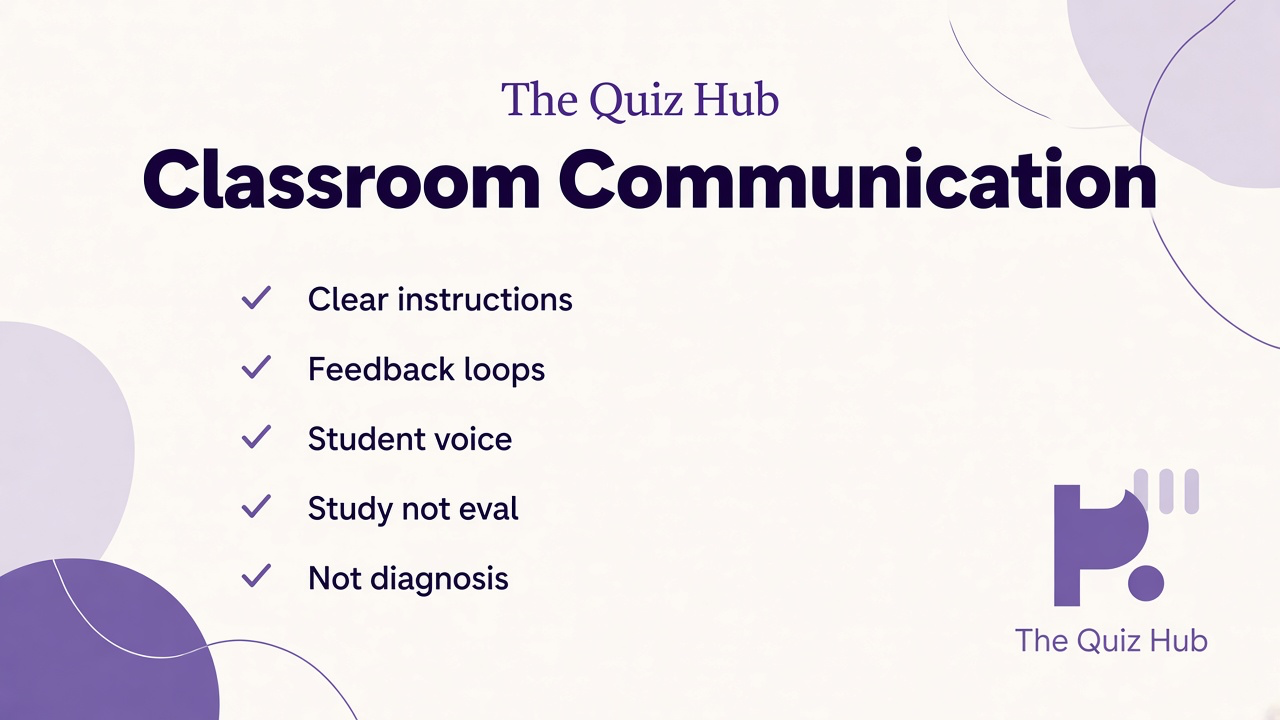
A quick takeaway graphic with topic tips (not your personal quiz scores). Start the quiz for your index, bands, and charts.
What this quiz can and cannot tell you
Can tell you
- Separate prompt literacy, feedback use, voice, and study-focus habits in plain language
- Highlight loops that help you ask better questions and revise before deadlines
- Give vocabulary for tutoring intake or study-group agreements
- Offer a baseline if you retake after one term of new habits
Cannot tell you
- Evaluate teacher quality, tenure decisions, or school staffing from one learner screener
- Diagnose ADHD, dyslexia, anxiety, or other conditions from frequency items alone
- Replace IEP teams, disability services, licensed therapists, or formal communication assessments
- Prove you should harass instructors or classmates based on bar charts
Educational communication as learner habit, not teacher trial
Search traffic around educational communication quizzes often blurs two jobs: improving how you send and receive information in class, and venting about instructors on review sites. Those goals diverge. Learner-side habits, reading prompts, using feedback, asking clear questions, and listening in discussions, change outcomes you control before any grade posts. Teacher evaluation belongs in structured institutional channels with context this page does not have.
Clear instructions start before the first sentence of your draft. Syllabus weeks dump dates into an LMS; rubrics hide verbs like analyze or compare that change the whole product. Re-reading directions, restating the task, and asking one clarifying question beats heroic guessing the night before submission. Reverse items catch starting without the full prompt or assuming you alone are confused when silence usually means everyone is tired, not that the task was obvious.
Feedback loops turn comments into progress. Reading feedback before the next attempt, trying one revision, and asking what abstract rubric language means separates practice from repetition. Treating a low score as personal dislike blocks the same information that could help on the retake. Pair feedback habits with student voice: ask aloud when the room needs an example, listen before you pivot, and invite quieter peers instead of filling every pause.
Study focus keeps reflection tools honest. Letter grades matter for transcripts, yet communication effectiveness grows when you note what changed in your understanding, not only the letter. Posting instructor ratings while angry, or forwarding classroom screeners to administrators as stealth evaluations, misuses learner reflection and erodes trust. Office hours work best with specific questions tied to prompts or drafts, not vague frustration that staff cannot act on.
Use this screener as a warm-up before a heavy term, not a verdict on anyone's career. Pair it with our communication skills quiz for broader listening and clarity habits, and the cognitive biases in online communication quiz when group chats distort what you heard in lecture. Browse the IQ and cognitive test hub for more study screeners. Retake after you run one full revision cycle on an assignment; bars often shift when feedback stops feeling like an insult and starts feeling like data.
| Test | Focus |
|---|---|
| Communication skills quiz | General listening and clarity habits rather than classroom prompt and rubric loops |
| Cognitive biases in online communication | Group chat distortion and bias habits rather than syllabus and feedback literacy |
Effectiveness of Educational Communication Quiz FAQ
What does this quiz measure?
It measures how often you report learner-side classroom communication habits across clear instructions, feedback loops, student voice, and study focus. You get an index from 0 to 100 and four bars. It describes your learning-week habits on this screener, not teacher quality or course grades.
Is this a teacher evaluation or performance review?
No. Items focus on what you do as a learner: reading prompts, using feedback, asking questions, and keeping study focus. It is not designed to score instructors or substitute for school evaluation systems.
Does a high score mean my teachers are bad?
No. Higher indexes mean you reported more frequent effective learner communication habits here. Strong habits can coexist with challenging courses. Use bars to adjust your side of the loop, not to rank staff publicly.
Why do some statements sound like common student traps?
Reverse-worded items catch shortcuts. Often skipping prompts, ignoring feedback, staying silent from fear, dominating discussions, or treating screeners like teacher report cards should not inflate an effectiveness index meant to track constructive habits.
Who reviewed this quiz?
Dr. James Whitfield, PhD reviewed the educational framing, learner-not-evaluator limits, and result explanations. See our editorial policy for review standards.
Reviewed by