What Economics Chapter 5 Quiz measures
This quiz does not grade your official transcript, certify you as a financial advisor, or predict stock returns. It measures how much you agree with statements in four groups: supply concepts about law of supply language, producers as sellers, input cost and technology shifts, and supply schedules versus quantity supplied; demand concepts about law of demand language, consumers as buyers, substitute and income shifts, and quantity demanded versus whole demand relationships; equilibrium and markets about clearing price, surpluses and shortages, basic elasticity vocabulary, and curve shifts on standard graphs; and study supplement limits about using quizzes as review, trusting instructor graphs, rejecting licensing fantasies, and avoiding investment or tax advice claims. You rate 22 statements from strongly disagree to strongly agree, with reverse worded items so autopilot responding cannot inflate every bar. Your answers also feed a second chart on closeness and trust habits, because people who hide grade anxiety sometimes overlap with how much they ask for help on problem sets. The total becomes an index from 0 to 100 where higher means more endorsed chapter five literacy statements on this screener, not proof you must tutor the whole lecture hall tonight.
Supply concepts
Law of supply, schedules, seller roles, and shift stories for costs or technology.
Demand concepts
Law of demand, schedules, buyer roles, and shift stories for income or substitutes.
Equilibrium and markets
Clearing price, shortages, surpluses, elasticity intro, and graph shifts.
Study supplement limits
Review before exams, trust class graphs, no licensing or finance advice claims.
How it works
Answer 22 agreement items
Rate each statement from Strongly disagree to Strongly agree. Tap Next after each answer.
Answers sort into four domains
Each answer feeds one of four chapter five literacy groups, and every item also feeds a closeness and trust layer.
See your index and charts
You get a 0 to 100 index, a band, and two bar charts you can compare with a study partner who loves graph workshops.
Take the Economics Chapter 5 Quiz
Answer 22 short statements to see your economics chapter 5 literacy index, four domain bars, and a closeness and trust chart.
What your result means
Your index is the average of all 22 answers, scaled from 0 to 100, with reverse worded items flipped first. Read study supplement limits before celebrating a high supply or equilibrium bar. Intro models are teaching tools; instructors and accredited advisors set grades and money decisions that matter.
| Band | Index range | Typical reading |
|---|---|---|
| Building chapter 5 literacy | 0 to 35 | Fewer agreed facts on supply, demand, equilibrium, or study supplement limits on this screener. |
| Mixed chapter 5 literacy | 36 to 65 | Some supply and demand domains click; others stay fuzzy or secondhand. |
| Stronger chapter 5 literacy | 66 to 100 | Frequent agreement across supply, demand, equilibrium, and study limits; still educational only. |
Tips at a glance
A quick takeaway graphic with topic tips (not your personal quiz scores). Start the quiz for your index, bands, and charts.
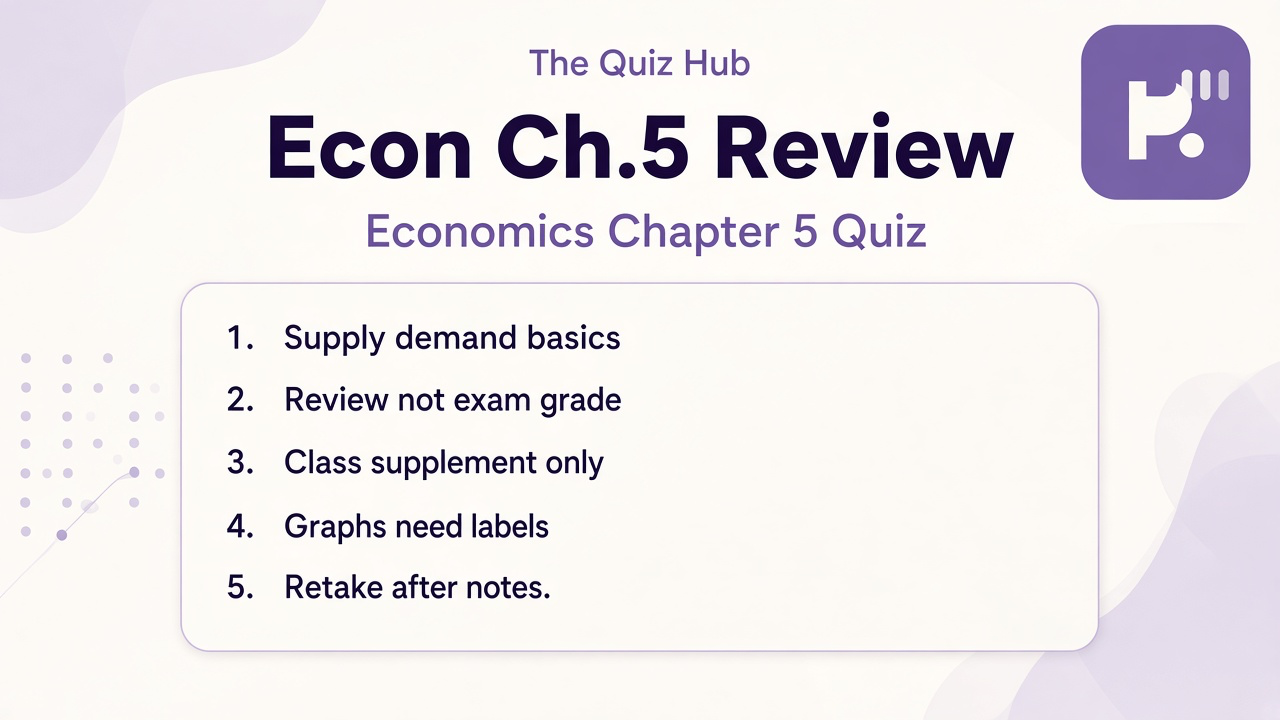
What this quiz can and cannot tell you
Can tell you
- Clarify supply, demand, and equilibrium vocabulary in plain introductory language
- Highlight common curve slope and quantity versus schedule myths worth unlearning
- Encourage retake and graph redraw habits without shame
- Spark better questions during chapter five review sessions
Cannot tell you
- Replace instructor grades, accredited economics degrees, or licensing exams
- Give personal investment, tax, or retirement planning advice
- Prove you should skip tutoring when assigned graphs still confuse you
- Turn scores into dunking on classmates still learning shift notation
Chapter five literacy beyond one graph screenshot
Students land on chapter five review when supply and demand curves finally appear on the same page and every shift arrow looks interchangeable. Sellers and buyers are roles in a model, not personality types. Quantity supplied at one price is not the same sentence as a whole supply schedule, and the same careful split applies on the demand side. Quizzes that mix those phrases on purpose mirror what instructors warn about on the first midterm.
Law of supply and law of demand are ceteris paribus stories: hold other factors steady and describe how quantity responds when price moves along a curve. Shift language belongs to different sentences about income, substitutes, input costs, or technology. Calling every upward line demand because you once saw a meme is a myth reverse items catch before overconfidence spreads in group chats.
Equilibrium is where planned quantity supplied meets planned quantity demanded at a price in the simplest classroom market. Surplus and shortage vocabulary explain why prices sometimes move when shelves look full or lines look long. Intro elasticity words describe responsiveness, not prophecy about every real world crisis. Price control examples in textbooks show why ceilings and floors can break the tidy intersection picture even when politicians promise otherwise.
Study supplement limits matter because search traffic blends homework help with fantasy credentials. Retakes, tutoring, and instructor problem sets are normal; they do not mean you finished an MBA or passed securities exams. Dr. James Whitfield reviews iq cognitive screeners with a simple split: reward graph literacy and honest humility at the same time.
Pair results with siblings on this hub instead of forcing one economics story. Our commerce quiz questions leans trade term and business cycle recall rather than full chapter five curve workshop on this page. Browse the IQ and cognitive test hub for more low stakes study screeners. Retake after you can label one supply shift and one demand shift on an unlabeled graph without peeking; literacy grows when curves stay in order, not when you memorize that equilibrium starts with e and hope the exam never asks what a surplus means at a fixed price.
| Test | Focus |
|---|---|
| Commerce quiz questions | Trade terms and business cycle recall rather than full supply demand graph workshop on this page |
| IQ and cognitive hub | Broader study screeners rather than chapter five supply and demand stems alone |
Economics Chapter 5 Quiz FAQ
What does this quiz measure?
It measures how much you agree with introductory supply and demand literacy across supply concepts, demand concepts, equilibrium language, and study supplement habits. You get an index from 0 to 100 and four bars. It reflects self reported vocabulary on this screener, not your official course grade or an IQ score.
Is this quiz my chapter five exam grade?
No. It is optional review. Instructors grade problem sets, class participation, and proctored exams. Use this screener to spot weak bars before you study, not as a transcript entry.
Why are some statements worded as myths?
Reverse worded myths catch overconfidence. Agreeing that supply and demand mean the same thing always, that demand slopes upward always, that price ceilings never cause shortages, or that trivia replaces licensing exams should not inflate your literacy index.
Does this quiz give investment advice?
No. It stays at introductory classroom vocabulary about markets in models. Personal investing, tax planning, and licensing paths need qualified professionals and accredited coursework, not agree or disagree items online.
Who reviewed this quiz?
Dr. James Whitfield reviewed the educational framing, economics literacy limits, and result explanations. See our editorial policy for review standards.
Reviewed by