What East Asia Capitals Quiz measures
This quiz does not grade diplomatic expertise, rank how much you should argue online, or certify you for employment screening. It measures how much you agree with statements in four groups: China-Japan-Korea seats about Beijing, Tokyo, Seoul, and Pyongyang plus common trap metros; Mongolia and Taiwan seats about Ulaanbaatar, Taipei labels on travel maps, and keeping capital drills out of comment-thread fights; spelling literacy about atlas forms, homophone slips, and reviewing missed flashcards; and travel study curiosity about regional chunks, blank outline maps, trip packing motivation, and rejecting auto-expert myths. You rate 22 statements from strongly disagree to strongly agree, with reverse-worded trap cities and spelling myths so autopilot responding cannot inflate every bar. Your answers also feed a second chart on closeness and trust habits, because study shame or perfectionism sometimes blocks asking classmates for map help. The total becomes an index from 0 to 100 where higher means more endorsed East Asia capital literacy on this screener, not proof you must memorize every secondary city overnight.
China, Japan, and Korea seats
Beijing, Tokyo, Seoul, Pyongyang recall and rejecting Shanghai or Busan capital traps.
Mongolia and Taiwan seats
Ulaanbaatar and Taipei map labels with travel atlas habits, not online scoreboard fights.
Spelling literacy
English atlas spellings, Seoul homophone slips, and flashcard review after misses.
Travel study curiosity
Regional chunks, blank maps, trip motivation, and capital drills separate from politics hot takes.
How it works
Answer 22 agreement items
Rate each statement from Strongly disagree to Strongly agree. Tap Next after each answer.
Answers sort into four domains
Each answer feeds one of four capital literacy groups, and every item also feeds a closeness and trust layer.
See your index and charts
You get a 0 to 100 index, a band, and two bar charts you can compare with a friend who loves map trivia nights.
Take the East Asia Capitals Quiz
Answer 22 short statements to see your East Asia capital literacy index, four domain bars, and a closeness and trust chart.
What your result means
Your index is the average of all 22 answers, scaled from 0 to 100, with reverse-worded items flipped first. Read travel study curiosity before celebrating a high China-Japan-Korea bar. Capital recall is for class and trips; kindness beats map dunking on people who are still learning.
| Band | Index range | Typical reading |
|---|---|---|
| Building East Asia capital literacy | 0 to 35 | Fewer agreed facts on core seats, wider East Asia dots, spelling care, or travel study habits on this screener. |
| Mixed East Asia capital literacy | 36 to 65 | Solid recall in some domains with trap cities, spelling slips, or politics-as-scoreboard myths still snagging a bar. |
| Stronger East Asia capital literacy | 66 to 100 | Frequent agreement across core seats, wider dots, spelling care, and travel study habits; still fun only. |
Tips at a glance
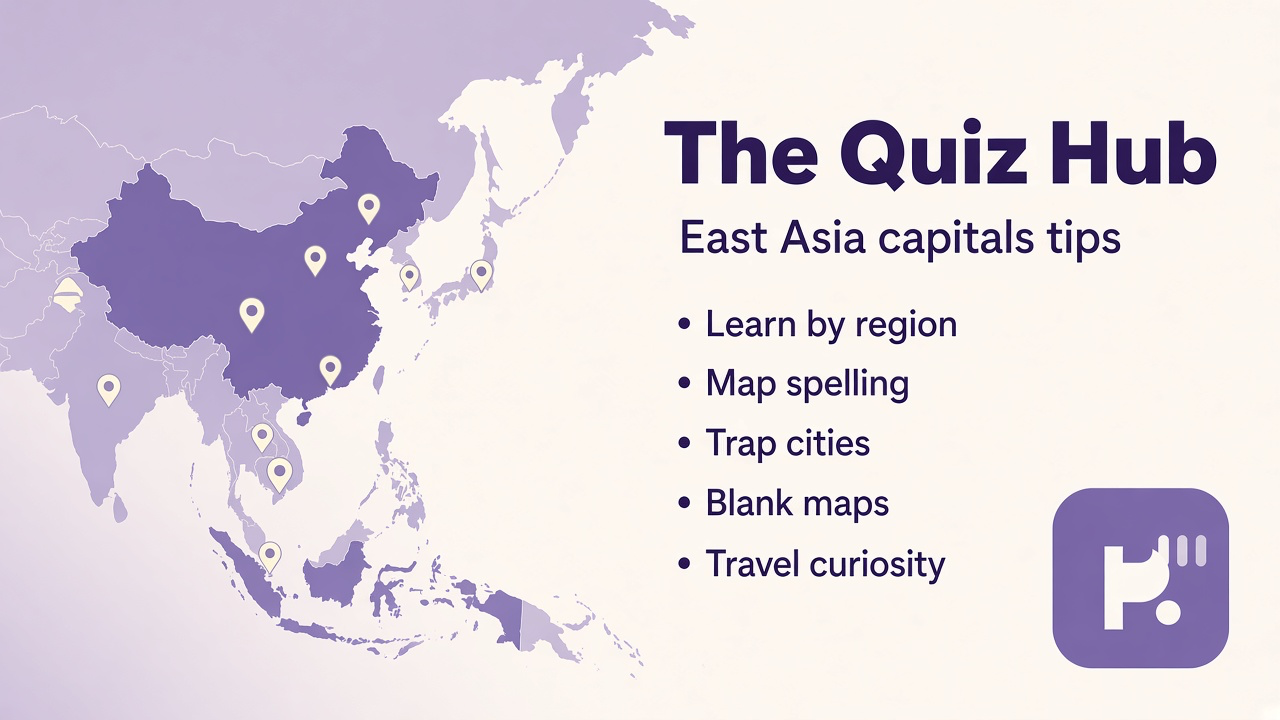
A quick takeaway graphic with topic tips (not your personal quiz scores). Start the quiz for your index, bands, and charts.
What this quiz can and cannot tell you
Can tell you
- Show which East Asia capital literacy cluster your self-report resembles this month
- Spark a fun map night with friends who want regional chunks, not continent panic lists
- Highlight when skyline fame might be masking trap-city mistakes on study maps
- Offer a baseline if you retake after a geography unit, trip, or semester break
Cannot tell you
- Prove you understand every foreign policy headline or historical treaty from capital names alone
- Replace instructor map exams, AP Human Geography grading, or certified geography credentials
- Turn scores into harassment, nationalism baiting, or classroom bullying about where someone grew up
- Settle diplomatic debates, immigration paperwork, or official government naming disputes online
East Asia capitals as travel literacy, not politics scoreboard
Search traffic around East Asia capital quizzes usually wants two things: nail the dots before a map test and brag a little before a trip. Those goals help when readers notice that capital drills are memory games tied to government seats, not proof you should debate strangers at midnight. They hurt when people treat bars like nationalism trophies or when trap cities like Shanghai and Busan stay stuck because skyline photos outrank atlas keys.
Dr. Rachel Kim reviews fun novelty geography quizzes with a simple split: reward honest recall and honest limits at the same time. China-Japan-Korea seats tracks Beijing, Tokyo, Seoul, and Pyongyang without pretending every famous metro is a capital. Mongolia and Taiwan seats tracks Ulaanbaatar and Taipei labels readers see on travel maps while keeping stems in study language, not flame-war language. Spelling literacy tracks atlas forms, homophone slips, and flashcard repair instead of blaming fonts. Travel study curiosity keeps regional chunks, blank maps, and trip packing motivation visible beside listicles that demand instant expert status.
Real readers mix bars. You might score high on China-Japan-Korea while keeping Mongolia and Taiwan seats moderate, which often describes students who watched drama sets in Seoul yet never labeled Ulaanbaatar. You might score high on spelling with moderate travel curiosity, which can mean you ace flashcards yet skip outline map practice. Reverse items catch sloppy answers: insisting Shanghai is China's capital, claiming memorizing seats makes you a policy expert, or treating quizzes like comment-thread weapons should not inflate bars meant to track layered literacy stories.
Pair results with siblings on this hub instead of forcing one East Asia story. Our asia capitals quiz spreads East, South, Southeast, and Central seats when you want continent context with stems written to stay distinct. The upcoming east asia map quiz leans country shapes and regional chunks without repeating every capital line. Browse the fun and novelty hub for more light screeners. Caption shares as study fun and skip map dunking on classmates who are still learning.
Trips and semesters move faster than trivia apps. You might fly through Tokyo Haneda yet forget Pyongyang spelling until a teacher asks. When you share results, say travel curiosity. When you borrow study tips, credit classmates who lent you blank maps. Retake after one regional flashcard week and watch whether spelling bars rise even if wider-seat bars lag, which often means you separated skyline fame from government dots on the page.
| Test | Focus |
|---|---|
| Asia capitals quiz | Whole-continent capital recall across East, South, Southeast, and Central lanes rather than East Asia focus only |
| East asia map quiz | Country shapes and regional map chunks rather than capital city spelling drills |
East Asia Capitals Quiz FAQ
What does East Asia Capitals Quiz measure?
It measures how much you agree with statements about China-Japan-Korea seats, Mongolia and Taiwan atlas labels, spelling literacy, and travel study curiosity. You get an index from 0 to 100 plus four bars. It describes self-rated capital recall on this screener, not a political ranking, diplomacy exam, or proof you should argue online.
Is this the same as the Asia capitals quiz?
No. This page focuses on East Asia government seats, spelling habits, trap metros, and study framing. The Asia capitals sibling spreads multiple Asian regions with stems written to stay distinct. You can take both; they reward different study passes.
Does a high score mean I should debate politics in comment threads?
No. High bars mean you related to capital literacy statements here. Travel study curiosity items explicitly reject treating scores like foreign policy credentials. Use results for map fun and class review, not for dunking on strangers.
Why include spelling items with capital facts?
Intent brief readers asked for spelling literacy beside recall. Seoul homophones, Ulaanbaatar vowel patterns, and atlas forms show up on airline boards and flashcards. Split bars keep seat recall separate from spelling care so results stay honest.
Who reviewed this quiz?
Dr. Rachel Kim reviewed the fun-only framing, travel curiosity tone, and limits against politics-scoreboard misuse. See our editorial policy for review standards.
Reviewed by