What the Earthworm Anatomy Quiz measures
This quiz does not dissect your worm tray, certify you for veterinary licensing, or score your gardening license. It measures how much you agree with introductory earthworm anatomy literacy grouped four ways: segmented body about annelid rings, anterior and posterior ends, clitellum, and diagram labels; burrowing and movement about setae, peristalsis, moist soil, tunnel channels, and tray observation habits; soil health about castings, decomposition, living soil signs, garden helper roles, and limits on worm-only fixes; and gentle handling and study about damp handling, sun exposure myths, unofficial framing, and leaving dissection grading to instructors. You answer 22 statements from strongly disagree to strongly agree, with reverse-worded myths so agreeing with every shortcut cannot inflate every bar. Your answers also feed a second chart on closeness and trust habits, because list-chasing fandom sometimes chases certainty over patient field ethics. The total becomes an index from 0 to 100 where higher means more reported earthworm anatomy literacy on this screener, not proof you should skip lab safety when live animals are involved.
Segmented body
Annelid segments, clitellum band, mouth and anus ends, and simple classroom diagram habits.
Burrowing and movement
Setae grip, peristalsis waves, moist soil tunnels, aeration channels, and tray observation limits.
Soil health
Castings, decaying matter, living soil signs, garden helpers, and no magic worm-only fixes.
Gentle handling and study
Damp gentle touch, no hot sun abuse, trivia not dissection grades, and instructor-owned safety rules.
How it works
Answer 22 agreement items
Rate each statement from Strongly disagree to Strongly agree. Tap Next after each answer.
Answers sort into four domains
Each answer feeds one of four earthworm anatomy groups, and every item also feeds a closeness and trust layer.
See your index and charts
You get a 0 to 100 index, a band, and two bar charts you can use before a biology lab quiz.
Take the Earthworm Anatomy Quiz
Answer 22 short statements to see your earthworm anatomy literacy index, four domain bars, and a closeness and trust chart.
What your result means
Your index is the average of all 22 answers, scaled from 0 to 100, with reverse-worded items flipped first. Higher means more reported earthworm anatomy literacy on this screener. Read gentle study and soil health bars together before you treat the total as lab expertise.
| Band | Index range | Typical reading |
|---|---|---|
| Building earthworm anatomy literacy | 0 to 35 | Fewer agreed facts on segments, burrowing, soil role, or gentle handling items on this screener. |
| Mixed earthworm anatomy literacy | 36 to 65 | Solid facts in some domains with myths about unsegmented bodies, pavement-only worms, or worm-only soil fixes. |
| Strong earthworm anatomy literacy | 66 to 100 | Frequent agreement with accurate worm anatomy trivia and humble study limits. |
Tips at a glance
A quick takeaway graphic with topic tips (not your personal quiz scores). Start the quiz for your index, bands, and charts.
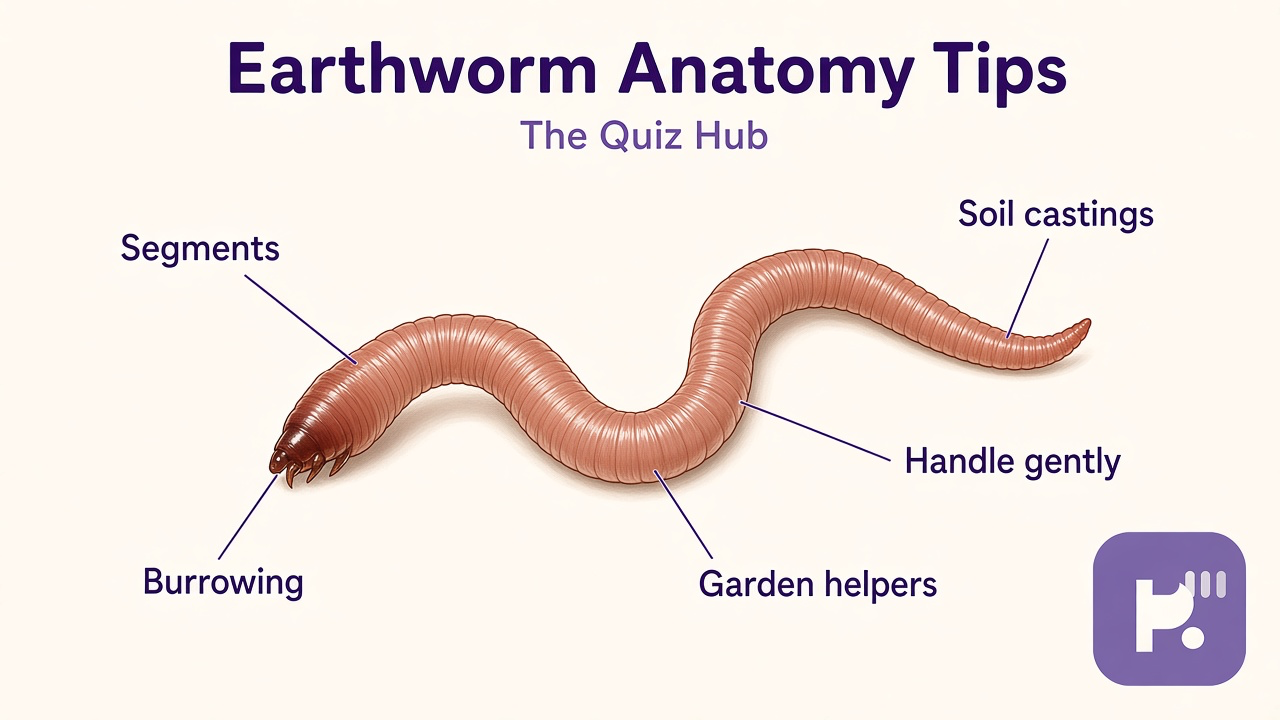
What this quiz can and cannot tell you
Can tell you
- Clarify segments, clitellum, and anterior-posterior ends in plain language
- Highlight common unsegmented-body and pavement-only worm myths worth unlearning
- Encourage gentle handling and retake habits without shame
- Spark better questions during school worm tray or diagram units
Cannot tell you
- Grade formal dissection practicals or vet licensing exams from trivia answers
- Replace instructor lab safety briefings or animal care policies
- Certify you for agricultural consulting or soil testing credentials
- Prove worms in your garden are healthy when neglect or drought stresses them
Earthworm anatomy literacy beyond one tray photo
Students search earthworm anatomy when a biology unit hands them a tray or diagram and every ring looks the same. Annelids repeat segments along the body, so literacy starts with knowing which end is anterior, where food enters, and where the clitellum sits for reproduction talk teachers often save for later. Mixing the clitellum with the mouth is a trap quizzes flag on purpose.
Burrowing is the second lane. Setae grip tunnel walls while muscle waves push the worm forward or backward. Moist soil matters because the surface needs to stay wet for gas exchange habits instructors mention in safety sheets. Burrows are not just worm highways; they can help air and water move through soil when gardens are managed with care, not only when trivia scores spike.
Soil health connects structure to ecology. Castings add organic matter; decaying leaves and plant bits feed worms that feed soil food webs. Gardeners sometimes smile when worms show up because living soil often beats dead dust, though worms alone cannot fix compaction, drought, or missing compost. Reverse items reject both always-pest myths and magic-worm-only fixes so scores stay honest.
Gentle handling is the fourth domain because live labs outlast flashcards. Damp hands, shade, and quick returns to soil reduce stress. Hot sun for photos harms worms fast and fails every ethics bar worth keeping. This screener says study trivia aloud so nobody treats a high index as dissection exam credit or district licensing.
Use this screener as a warm-up, not a verdict. Pair it with one labeled diagram from class and our animal classification quiz when annelids show up beside other invertebrate groups. Browse the earth day quiz for holiday curiosity without replacing worm unit homework. Visit the fun and novelty hub for more light science games. Retake after you can trace segments, burrowing, and castings in one sentence without peeking; literacy grows when body parts and soil role stay linked, not when you memorize that clitellum starts with c and hope the tray never asks where the mouth lives.
| Test | Focus |
|---|---|
| Animal classification quiz | Broad invertebrate and vertebrate groups, not earthworm segment and setae depth |
| Earth day quiz | Holiday habits and planet trivia rather than annelid anatomy labels |
Earthworm Anatomy Quiz FAQ
What does this earthworm anatomy quiz measure?
It measures how much you agree with introductory earthworm anatomy literacy across segmented body basics, burrowing and movement, soil health, and gentle handling study habits. You get an index from 0 to 100 and four bars. It reflects self-reported knowledge on this screener, not a dissection practical grade or IQ score.
Is this quiz enough to grade my dissection lab?
No. It is study trivia and care literacy. Your instructor owns dissection rules, safety briefings, and practical grades. Follow school policies for live worms and preserved specimens.
Why are some statements worded as myths?
Reverse-worded myths catch overconfidence. Agreeing that worms are smooth unsegmented tubes, that they only crawl on pavement, that every garden worm is a pest, that castings alone fix all soil, that hot sun photos are fine, or that trivia replaces dissection certification should not inflate your literacy index.
Does this cover every annelid species or advanced histology?
This screener stays at shared intro anatomy: segments, movement, soil role, and gentle handling. Advanced taxonomy, marine polychaete detail, and full histology slides belong in dedicated courses.
Who reviewed this quiz?
Dr. Rachel Kim, PhD reviewed the educational framing, anatomy literacy limits, and result explanations. See our editorial policy for review standards.
Reviewed by