What the Dysfunctional Attitude Scale screener measures
This quiz does not certify you on the published Beck Dysfunctional Attitude Scale, and it cannot diagnose depression, anxiety, or personality disorders. Only a qualified clinician using interview methods and validated tools can do that. It measures how much you agree with Beck DAS-inspired cognitive themes researchers group when people rate rigid beliefs about worth and control, organized four ways: perfectionism and all-or-nothing standards; approval seeking that ties self-esteem to others reactions; dependency beliefs that outsource coping; and helplessness limits that treat setbacks as permanent doom. You answer 22 statements from strongly disagree to strongly agree, with reverse-worded items so agreeing with flexible habits or accurate limits about this tool cannot hide frequent harsh beliefs on other items. Your responses also feed a second chart on closeness and trust habits, because perfection and approval pressure often rise when vulnerability feels risky. The total becomes an index from 0 to 100 where higher means more reported dysfunctional attitude agreement on this screener, not proof you are defective.
Perfectionism
All-or-nothing standards, mistake catastrophizing, and flawless output demands.
Approval seeking
Worth tied to praise, fear of dislike, and hiding opinions to stay liked.
Dependency
Needing others to lead, reassure, or make ordinary tasks feel possible.
Helplessness limits
Hopeless future beliefs, permanent sadness predictions, and effort feels pointless themes.
How it works
Answer 22 agreement items
Rate each statement from Strongly disagree to Strongly agree. Tap Next after each answer.
Answers sort into four domains
Each answer feeds one of four attitude groups, and every item also feeds a closeness and trust layer.
See your index and charts
You get a 0 to 100 index, a band, and two bar charts you can bring to a therapist.
Take the Dysfunctional Attitude Scale Screener
Answer 22 short statements to see your dysfunctional attitude concern index, four domain bars, and a closeness and trust chart.
What your result means
Your index is the average of all 22 answers, scaled from 0 to 100, with reverse-worded items flipped first. Higher means more reported dysfunctional attitude agreement on this screener. Read perfectionism and helplessness bars together before the total, since approval pressure can hide hopeless limits or vice versa.
| Band | Index range | Typical reading |
|---|---|---|
| Lower reported attitude concern | 0 to 35 | Less agreement with perfection traps, approval hunger, dependency, or helplessness limits on this screener. |
| Mixed reported attitude concern | 36 to 65 | Some domains look flexible while perfectionism, approval, dependency, or helplessness themes spike under stress. |
| Higher reported attitude concern | 66 to 100 | Frequent agreement with perfection, approval, dependency, or helplessness limits; structured support may help. |
Tips at a glance
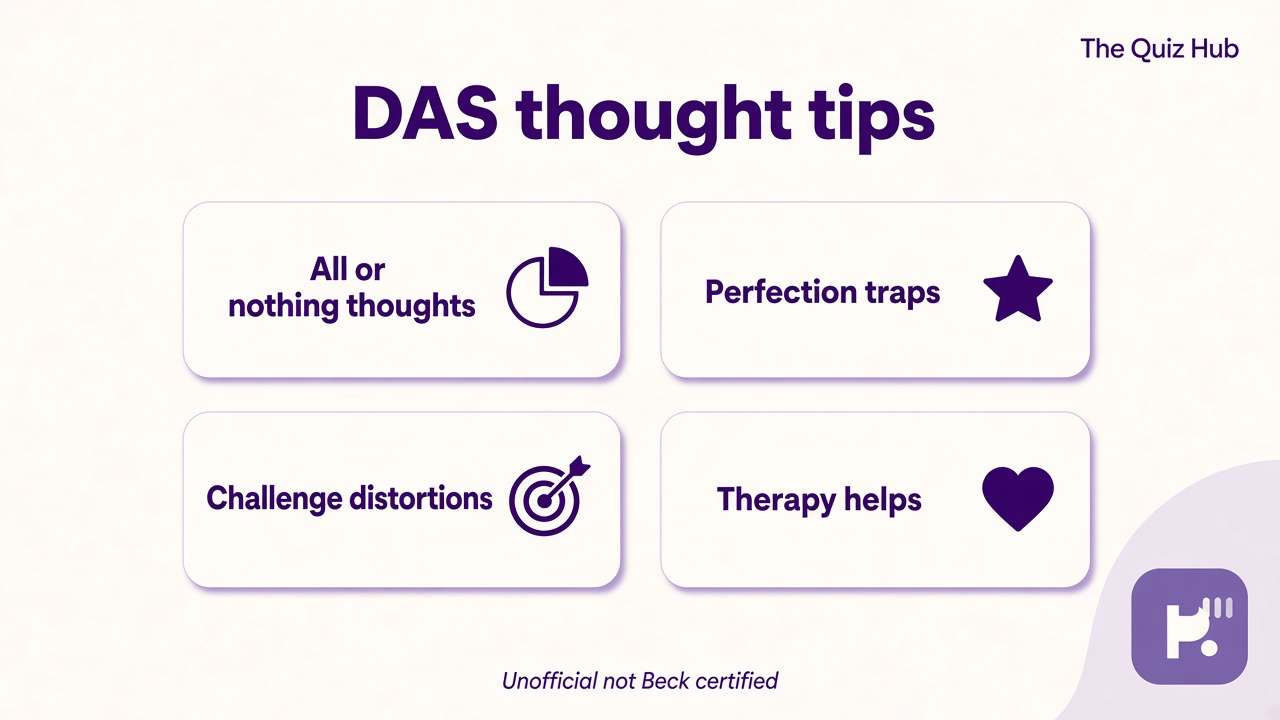
A quick takeaway graphic with topic tips (not your personal quiz scores). Start the quiz for your index, bands, and charts.
What this quiz can and cannot tell you
Can tell you
- Name perfection, approval, dependency, and helplessness themes in plain language
- Highlight when flexible thinking or therapy limits are missing
- Give you vocabulary for CBT intake or thought-record homework
- Offer a baseline if you retake after skills practice or a stress season
Cannot tell you
- Replace the certified Beck DAS or any clinician-administered attitude measure
- Diagnose depression, anxiety, or personality disorders without evaluation
- Replace crisis care, safety planning, or medication decisions
- Prove your thoughts are fixed forever from one online score
Dysfunctional attitudes: perfection, approval, dependency, and limits
Aaron Beck and colleagues linked rigid beliefs about worth and control to vulnerability for low mood. The published Dysfunctional Attitude Scale is a research and clinical tool with specific items and scoring. Your score on a screen at home is not the same as a proctored Beck DAS. What still matters for self-reflection is whether perfection rules, approval hunger, dependency, or hopeless limits show up often enough to drain your energy.
Perfectionism in this frame is not high standards alone. It is the jump from one typo to total failure, or the rule that only flawless work deserves respect. All-or-nothing thinking shrinks learning because any blemish cancels pride. Cognitive behavioral therapists often start with gentle evidence lists: what went okay, what one fix would help, and whether strangers would judge you as harshly as you judge yourself.
Approval seeking ties mood to applause. Neutral faces become proof you are unlovable; disagreement feels like a moral verdict. Healthy connection includes conflict and repair. If you hide every opinion to stay safe, resentment and loneliness can grow even when people still like you. Dependency beliefs sound like needing someone else to lead every bill, schedule, or hard conversation. Some support is human; chronic outsourcing can shrink confidence in your own judgment.
Helplessness limits treat one bad month as a sealed future. They predict permanent sadness from a rough week or declare effort pointless before you test small steps. Those thoughts deserve challenge, not shame. Licensed clinicians use structured homework, not motivational posters alone. Our cognitive errors questionnaire CFQ screens related distortion frequency with a different item set. The Beck cognitive insight scale BCIS focuses on insight rather than attitude endorsement.
Retake after a month of one thought record per week, then compare domain bars, not only the total. This dysfunctional attitude scale screener is agree-or-disagree reflection about Beck-inspired themes, not certified Beck scoring. If rigidity pairs with hopelessness about safety, skip online debate and prioritize crisis resources before another quiz.
| Test | Focus |
|---|---|
| Cognitive errors questionnaire CFQ | Frequency of all-or-nothing, mind reading, and catastrophizing loops rather than DAS attitude themes |
| Beck cognitive insight scale BCIS | Insight and self-reflection on beliefs rather than dysfunctional attitude endorsement |
Dysfunctional Attitude Scale Screener FAQ
What does this quiz measure?
It measures how much you agree with Beck DAS-inspired themes grouped as perfectionism, approval seeking, dependency, and helplessness limits. You get an index from 0 to 100 plus four domain bars. It reports self-reported agreement, not a clinical diagnosis.
Is this the official Beck Dysfunctional Attitude Scale?
No. This is an unofficial, inspired screener for self-reflection. It is not Beck certified and cannot replace a clinician-administered DAS or full evaluation.
Does a high score mean I am broken?
No. A higher index means you agreed with more rigid attitude statements on this tool today. Those patterns often soften with CBT skills, support, and sometimes medication when mood symptoms are present. Bring bars to a licensed therapist rather than treating the score as identity.
What should I do if my score is high?
Try one thought record with evidence for and against your harshest belief. Book therapy if loops repeat for months. Call or text 988 (US) if you feel hopeless, unsafe, or unable to cope.
Who reviewed this quiz?
Dr. Elena Vasquez, PhD reviewed the YMYL framing, unofficial Beck limits, and safety notes. See our editorial policy for review standards.
Reviewed by