What Leaky Gut Quiz measures
This quiz is not affiliated with Dr. Axe, any supplement company, or any social media wellness personality. It does not diagnose leaky gut, intestinal permeability disorders, celiac disease, IBS, or any other condition. Only a licensed clinician using history, examination, and appropriate testing can do that. It measures how often in the past month you noticed gut-health literacy habits specialists wish patients could separate from marketing, grouped four ways: barrier science habits that distinguish research on mucosal barriers from checkout-page slogans; symptom chasing when bloating, fatigue, or brain fog get pinned on permeability before other causes; diet and supplement habits around influencer elimination lists, cleanses, and repair stacks; and clinical boundaries about bringing persistent symptoms to GI or primary care instead of trusting quiz scores. You answer 22 how-often statements about the past month, with reverse-worded items so one good week cannot hide frequent myth habits across other days. Your responses also feed a second chart on closeness and trust habits, because health anxiety and intimacy avoidance sometimes fuel late-night supplement research. The total becomes an index from 0 to 100 where higher means more reported literacy-supportive habits on this screener, not proof your gut is healthy or that you should avoid medical care.
Barrier science
How often you checked permeability claims against real gastroenterology context instead of slogans.
Symptom chasing
How often common symptoms triggered leaky-gut certainty before broader causes or clinicians.
Diet and supplements
How often influencer cleanses, cut lists, or stacks shaped eating without qualified guidance.
Clinical boundaries
How often you sought professional evaluation instead of quiz-or-personality proof.
How it works
Answer 22 frequency items
Rate each statement from Never to Very often for the past month. Tap Next after each answer.
Answers sort into four domains
Each answer feeds one of four literacy habit groups, and every item also feeds a closeness and trust layer.
See your index and charts
You get a 0 to 100 index, a band, and two bar charts you can bring to a clinician.
Take the Leaky Gut Quiz
Answer 22 short statements to see your gut barrier literacy habit index, four domain bars, and a closeness and trust chart.
What your result means
Your index is the average of all 22 answers, scaled from 0 to 100, with reverse-worded items flipped first. Higher means more reported literacy-supportive habits on this screener. Read symptom chasing and clinical boundaries bars together before you treat the total as permission to skip GI care.
| Band | Index range | Typical reading |
|---|---|---|
| Building gut barrier literacy habits | 0 to 35 | More frequent myth-heavy or worry-heavy habits on barrier science, symptoms, diet, or clinical boundaries. |
| Mixed gut barrier literacy habits | 36 to 65 | Some careful checking with lingering influencer habits or symptom spirals in other domains. |
| Stronger gut barrier literacy habits | 66 to 100 | More frequent evidence-minded checking with fewer myth-driven shortcuts on this screener. |
Tips at a glance
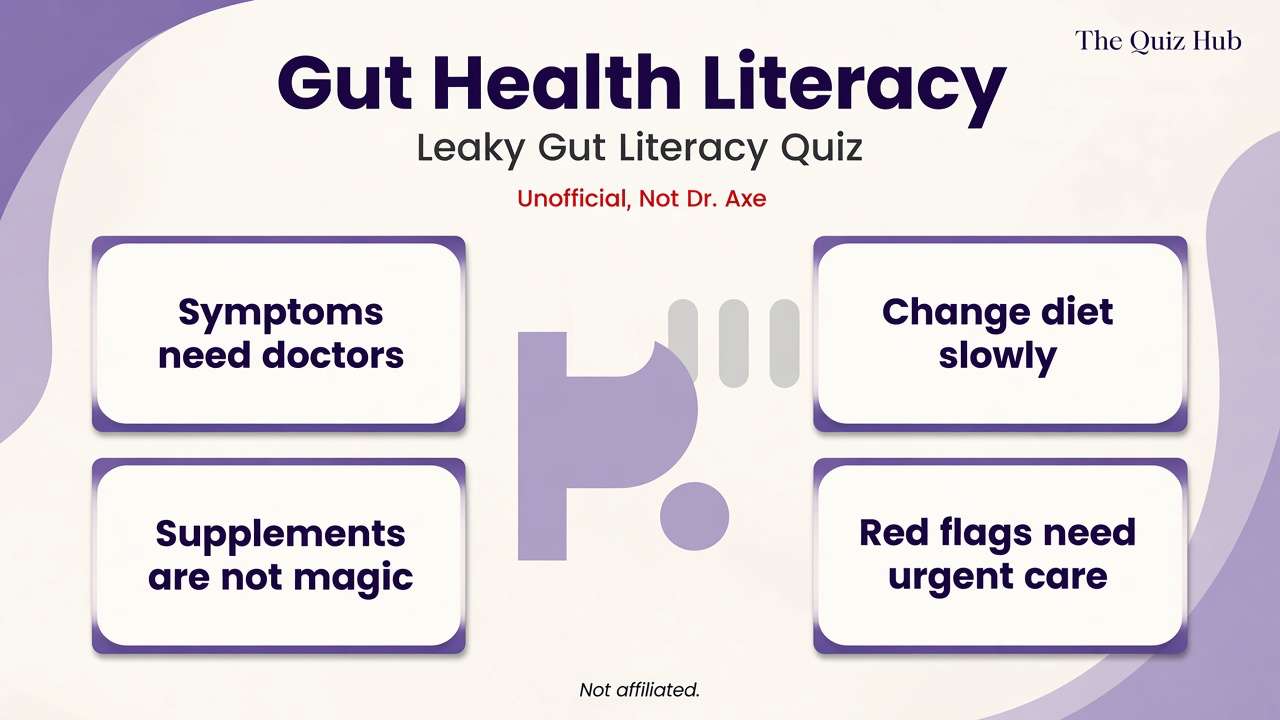
A quick takeaway graphic with topic tips (not your personal quiz scores). Start the quiz for your index, bands, and charts.
What this quiz can and cannot tell you
Can tell you
- Organize past-month habits into science, symptoms, supplements, and clinician-boundary buckets
- Give you language for primary care or GI intake without using influencer jargon alone
- Highlight when marketing may be outpacing your evidence checks
- Offer a baseline if you retake after pausing unproven protocols
Cannot tell you
- Diagnose leaky gut, IBS, celiac disease, or any GI condition from self-report alone
- Replace colonoscopy, labs, breath tests, or biopsies your clinician recommends
- Endorse Dr. Axe, any creator, or any supplement stack as safe for you
- Prove you should avoid doctors because literacy habits looked strong on one day
Leaky gut literacy: science, slogans, and when to see a clinician
Search traffic for leaky gut quizzes spikes whenever wellness personalities repackage intestinal permeability research into simple cures. Barrier function is a real topic in gastroenterology: the gut lining regulates what passes into the bloodstream, and researchers study tight junctions, inflammation, and disease states such as celiac disease in controlled settings. That science is not the same as a meme that every headache proves holes in your gut or that a personality-branded cleanse will seal them by Friday. Literacy starts by separating vocabulary you hear on podcasts from diagnoses only clinicians can make after history, exam, and sometimes endoscopy, labs, or breath tests.
Symptoms overlap. Bloating, fatigue, brain fog, skin flares, and mood dips appear in IBS, food intolerances, thyroid disorders, sleep debt, anxiety, and dozens of other conditions. Jumping to leaky gut as the single explanation feels satisfying because it offers a villain and a shopping list. It can also delay care when something treatable,anemia, inflammatory bowel disease, or medication side effects,needs a workup. A past-month frequency check on symptom spirals is not shaming your body; it is noticing whether urgency outran evidence.
Diet and supplement marketing thrives on fear. Elimination lists, charcoal protocols, and repair powders multiply faster than randomized trials can evaluate them. Some patients need medically supervised diets; others harm themselves with unnecessary restriction. Pharmacists and clinicians can review interactions when you already take prescriptions. Buying stacks because a famous name said your gut is porous trades anxiety for expense without a plan to measure improvement.
Clinical boundaries protect you when literacy is high but symptoms persist. The American College of Gastroenterology and other medical societies publish patient education on when to seek care for chronic diarrhea, blood in stool, unexplained weight loss, or iron deficiency. This screener mirrors habit signals,how often you brought concerns to a doctor, how often quiz scores replaced appointments,in four bars so you can describe patterns without guessing diagnostic labels. Our gut health quiz emphasizes broader digestive wellness reflection; pair it with this barrier-literacy focus, not instead of care when red flags appear.
Retake after one month of pausing unproven protocols and comparing domain bars, not only the total. If symptoms continue despite better literacy habits, tell a gastroenterologist; shame about past supplement purchases rarely fixes inflammation. Literacy is a filter for marketing noise, not a replacement for stethoscopes, scopes, or labs when your clinician recommends them.
| Test | Focus |
|---|---|
| Gut health quiz | General digestive wellness reflection rather than leaky-gut marketing literacy emphasis |
| Candida quiz | Yeast worry frequency patterns without barrier-science and influencer-boundary domains |
Leaky Gut Quiz FAQ
What does this quiz measure?
It measures how often in the past month you noticed gut barrier literacy habits across science checking, symptom spirals, diet and supplement traps, and clinical boundaries. You get an index from 0 to 100 and four bars. It reports self-reported habit frequency, not a medical diagnosis.
Is this quiz affiliated with Dr. Axe?
No. The Quiz Hub is not affiliated with Dr. Axe, any supplement company, or any wellness personality. The URL topic reflects common search language; the screener is independent gut-health literacy education.
Can this quiz diagnose leaky gut?
No. Intestinal permeability and related conditions are evaluated by licensed clinicians using appropriate history, examination, and testing. Use this tool to reflect on literacy habits, not to confirm or rule out disease.
Why are some items reverse-worded?
Reverse-worded myth and shortcut habits catch overconfidence. Reporting very often that quiz scores prove permeability, that doctors always dismiss you, or that every symptom means gut holes should not inflate your literacy index.
Who reviewed this quiz?
Dr. Elena Vasquez, PhD reviewed the YMYL framing, non-affiliation statement, medical limits, and clinician referral guidance. See our editorial policy for review standards.
Reviewed by