What Down Syndrome Quiz measures
This quiz does not diagnose Down syndrome, interpret prenatal screening, or replace genetic counseling or pediatric care. It measures how much you agree with awareness literacy statements grouped four ways: syndrome basics about trisomy 21, variation in abilities, and transmission; respectful language about dignity, slurs, and family preferences; inclusion and support about school, work, friendships, and therapies without default segregation; and ally literacy about myths, pity, speaking directly to people, and limits on quiz-as-diagnosis framing. You answer 22 statements from strongly disagree to strongly agree, with reverse-worded myths so one lucky guess cannot inflate every bar. Your answers also feed a second chart on closeness and trust habits, because ally work sometimes mixes genuine care with discomfort around difference or conflict. The total becomes an index from 0 to 100 where higher means more reported awareness literacy on this screener, not proof you should speak for a disabled person or skip professional evaluation when diagnosis is the question.
Syndrome basics
Trisomy 21, varied abilities, health and longevity with supports, not contagious, not uniform.
Respectful language
Names before labels, no slurs, ask preferences, follow advocacy guidance with humility.
Inclusion and support
Inclusive classrooms, workplace accommodations, friendships, therapies as tools not verdicts.
Ally literacy
Avoid pity and stereotypes, speak to the person, know this quiz cannot diagnose.
How it works
Answer 22 agreement items
Rate each statement from Strongly disagree to Strongly agree. Tap Next after each answer.
Answers sort into four domains
Each answer feeds one of four awareness groups, and every item also feeds a closeness and trust layer.
See your index and charts
You get a 0 to 100 index, a band, and two bar charts you can use to pick what to study next.
Take the Down Syndrome Quiz
Answer 22 short statements to see your Down syndrome awareness literacy index, four domain bars, and a closeness and trust chart.
What your result means
Your index is the average of all 22 answers, scaled from 0 to 100, with reverse-worded items flipped first. Higher means more reported awareness literacy on this screener. Read respectful language and ally literacy bars together before you treat the total as expertise.
| Band | Index range | Typical reading |
|---|---|---|
| Building Down syndrome awareness literacy | 0 to 35 | Fewer agreed facts on basics, language, inclusion, or ally limits on this screener. |
| Mixed Down syndrome awareness literacy | 36 to 65 | Solid facts in some domains with myths or overconfidence in others. |
| Strong Down syndrome awareness literacy | 66 to 100 | Frequent agreement with accurate awareness facts and healthy ally limits. |
Tips at a glance
A quick takeaway graphic with topic tips (not your personal quiz scores). Start the quiz for your index, bands, and charts.
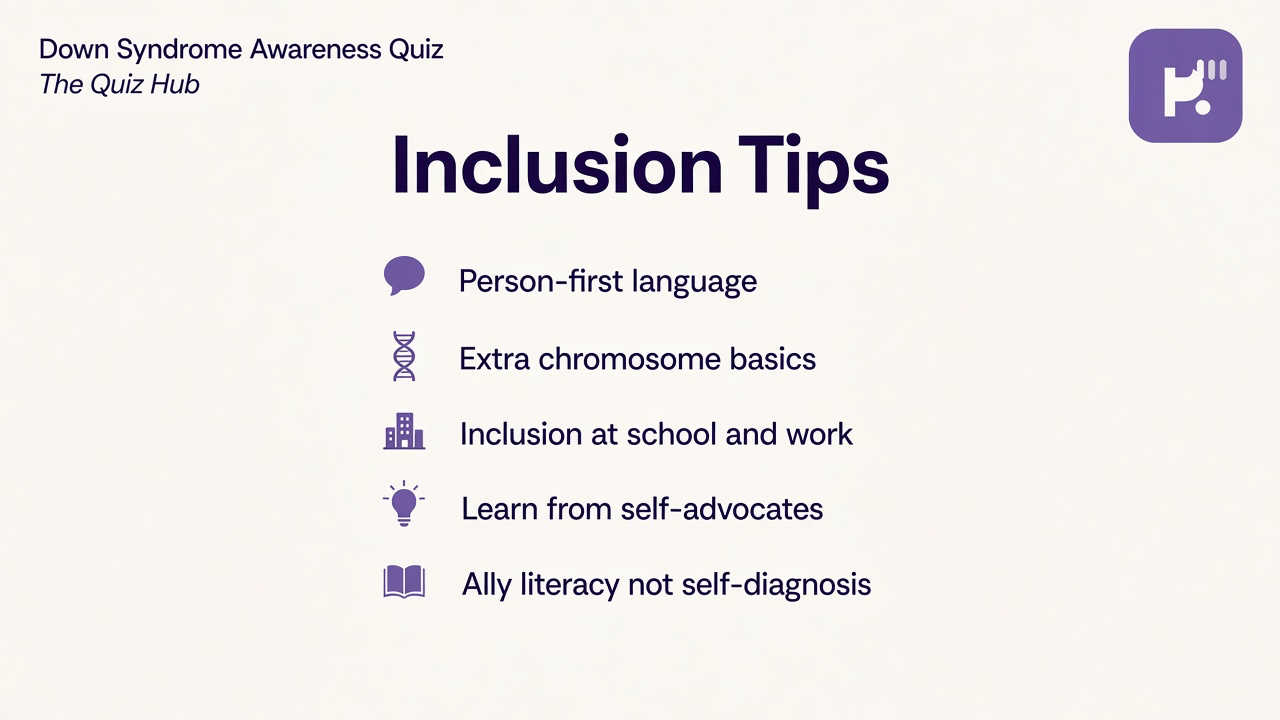
What this quiz can and cannot tell you
Can tell you
- Highlight basics, language, and inclusion facts worth revisiting
- Separate dignified ally habits from pity or segregation myths
- Encourage study-and-retake habits without shame
- Clarify that diagnosis questions belong with clinicians, not quizzes
Cannot tell you
- Diagnose Down syndrome in you, your child, or anyone else
- Replace genetic counseling, prenatal test interpretation, or medical care
- Rank your moral worth as an ally from one score
- Prove you should speak over people with lived experience because trivia felt easy
Why Down syndrome awareness belongs in dignified, ally-first language
People land on a Down syndrome quiz for different reasons. Parents may want language for an IEP meeting. Teachers may want to correct a stereotype before it spreads in a hallway. Neighbors may simply want to know what trisomy 21 means without turning a child into a prop. Down syndrome usually involves an extra copy of chromosome 21. It is a genetic condition, not a contagious illness, and it is not caused by parental blame. Abilities, personalities, health needs, and dreams vary widely. Awareness starts with those facts so dignity stays centered on the person, not the chromosome count.
Language shapes whether someone feels seen or summarized. Many families prefer person-centered phrasing such as a person with Down syndrome, while others embrace identity-first wording. Slurs and mockery cause harm even when the speaker meant no offense. Allies ask which words a person or family uses and follow their lead. Reducing someone to a diagnosis in every sentence trains others to forget their name, humor, and agency. Literacy here means humility, not performing expertise.
Inclusion is more than inspirational posters. Federal and local education laws, workplace accommodation practice, and plain community design determine whether students learn beside peers, whether adults get fair hiring interviews, and whether friendships form naturally. Therapies and individualized plans are supports, not proof that learning is impossible. Default segregation often reflects adult anxiety, not student need. Employers who assume every candidate with Down syndrome must avoid public roles waste talent and violate the spirit of civil rights protections allies claim to support.
Ally literacy includes myth-busting without centering yourself. People with Down syndrome experience ordinary moods, ambitions, and bad days; the always happy stereotype is dehumanizing. Speaking directly to a person, with patience for processing or speech differences, respects adulthood better than talking past them to a companion. No awareness quiz can answer do I have Down syndrome; that question belongs with clinicians using appropriate evaluation and, when relevant, genetic testing. The NIH Down syndrome research hub and national advocacy groups publish beginner-friendly explainers allies can read before they retake this screener.
Save your lowest bar as one study topic this week. Name one basic fact, one language habit, and one inclusion practice. Retake, and notice which myths no longer trick you. Awareness literacy is a bridge to listening, not a badge that replaces people with lived experience as the final authority on their lives.
| Test | Focus |
|---|---|
| Disability awareness quiz | Broader disability inclusion literacy rather than Down syndrome-specific facts and language |
| Attitudes towards physical disability scale | Attitude reflection screener, not chromosome 21 and ally myth literacy |
Down Syndrome Quiz FAQ
What does this quiz measure?
It measures how much you agree with Down syndrome awareness literacy statements across basics, respectful language, inclusion, and ally habits. You get an index from 0 to 100 and four bars. It reflects self-reported knowledge on this screener, not a medical diagnosis or genetic test result.
Can this quiz tell me if I have Down syndrome?
No. Down syndrome is diagnosed by qualified clinicians using medical history, physical examination, and when appropriate genetic testing. This quiz is for allies, parents, and educators learning facts and language, not for self-diagnosis.
Who is this quiz for?
It is for parents, teachers, coworkers, and allies who want a structured check on common facts, dignified language, and inclusion habits. People with Down syndrome may take it too, but it does not define their identity or replace their voice.
Why are some statements worded as myths?
Reverse-worded myths catch overconfidence. Agreeing that everyone is identical, that segregation is always best, that people are always cheerful, or that this quiz can diagnose Down syndrome should not inflate your literacy index.
Who reviewed this quiz?
Dr. Elena Vasquez, PhD reviewed the YMYL framing, non-diagnostic limits, and dignified disability language guidance. See our editorial policy for review standards.
Reviewed by