What the Dominant Motivation of Teenagers Quiz measures
This quiz does not diagnose ADHD, anxiety, depression, or any mental health condition, and it does not tell you which career to pick. It measures how often you have noticed four motivational pulls that researchers and educators often discuss with teens, grouped as belonging drive when acceptance and inclusion shape your choices, achievement drive when grades, goals, and comparison fuel effort, autonomy drive when doing things your way and resisting micromanagement matter most, and novelty drive when boredom and fresh experiences pull you toward change. You answer 22 how-often statements about the past month at school and in your social life, with reverse-worded items so one lucky never streak cannot hide a pattern. Your responses also feed a second chart on closeness and trust habits, because social fear and motivational fuel often overlap in adolescence. The total becomes an index from 0 to 100 where higher means more frequent reported pulls across this screener, not proof that one drive is your permanent identity. Read the four domain bars to see which motivation dominated this month.
Belonging drive
How often fitting in, group inclusion, or fear of being left out steered your choices.
Achievement drive
How often grades, goals, rankings, or recognition pushed you to compare and compete.
Autonomy drive
How often self-direction, ownership, and resistance to being managed fueled you.
Novelty drive
How often restlessness, new experiences, or stale routines pulled you toward change.
How it works
Answer 22 frequency items
Rate each statement from Never to Very often for the past month. Tap Next after each answer.
Answers sort into four domains
Each answer feeds one of four motivation groups, and every item also feeds a closeness and trust layer.
See your index and charts
You get a 0 to 100 index, a band, and two bar charts showing which drives ran hottest.
Take the Dominant Motivation of Teenagers Quiz
Answer 22 short statements to see your teen motivation pattern index, four domain bars, and a closeness and trust chart.
What your result means
Your index is the average of all 22 answers, scaled from 0 to 100. Higher means more frequent reported motivational pulls on this screener. Compare domain bars before you treat the total as your dominant type; the tallest bar is usually the better story for this month.
| Band | Index range | Typical reading |
|---|---|---|
| Lower reported motivational pull | 0 to 35 | Fewer frequent belonging, achievement, autonomy, or novelty pulls this month. |
| Mixed motivational pattern | 36 to 65 | Some domains run hot while others look quieter on good weeks. |
| Stronger reported motivational pull | 66 to 100 | Frequent pulls across belonging, achievement, autonomy, or novelty domains. |
Tips at a glance
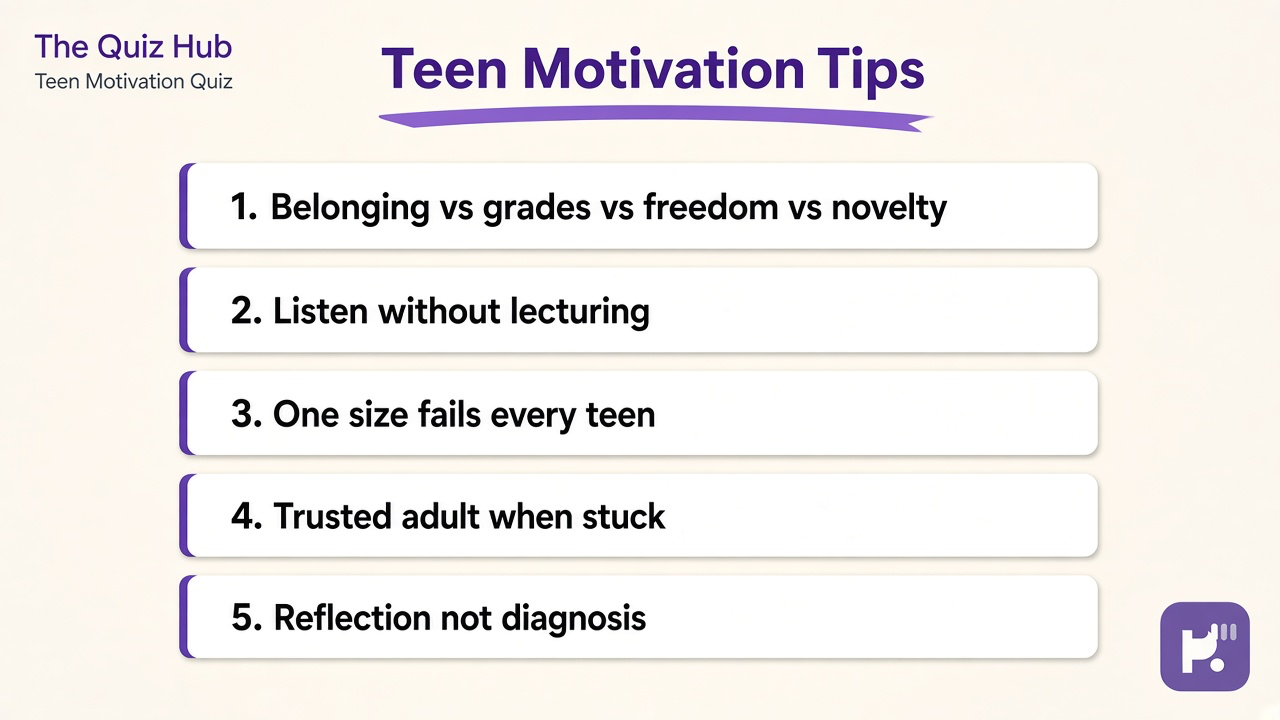
A quick takeaway graphic with topic tips (not your personal quiz scores). Start the quiz for your index, bands, and charts.
What this quiz can and cannot tell you
Can tell you
- Show whether belonging, achievement, autonomy, or novelty pulled hardest lately
- Give language for counselor or mentor conversations about stress and goals
- Highlight when social fear or grade pressure might need balance
- Offer a baseline if you retake after a semester change
Cannot tell you
- Diagnose mental health disorders or learning conditions
- Replace therapy, psychiatric evaluation, or school psychological testing
- Lock you into one motivation type for life
- Predict college admission, job success, or moral character from one score
Teen motivation: belonging, achievement, autonomy, and novelty
Adolescence is when motivation stops being only about stickers and starts being about identity. You might hustle for grades because college talk got loud, or you might skip homework because a friend group drama drained every spare neuron. Psychologists often describe belonging, competence, autonomy, and curiosity as core fuels, even when they use different labels. This quiz groups your month into four teen-friendly buckets so you can name what is driving you without turning a Tuesday into a personality verdict.
Belonging drive shows up in group chats, lunch tables, and the fear that one missed invite means you are invisible. It is not vanity; humans are wired to track acceptance. When belonging runs hot, you might people-please, hide opinions, or overcommit to clubs that look cool. When it runs quiet, you might feel lonely even while busy. Neither bar is good or bad forever; it is data about what your nervous system cared about this month.
Achievement drive is the grade graph, the captain armband, the leaderboard, the parent praise you still hear in your head. It can build skills and resilience when paired with rest. It can also feed shame spirals when one test defines your worth. Comparing bars with belonging helps: are you studying for you, or to stay in the friend tier that values straight A's? Autonomy drive asks whether the goal still feels chosen when the applause fades.
Autonomy drive is the itch when adults schedule every hour or when a group project assumes you will follow without input. Teens need room to experiment, fail, and own repairs. High autonomy with low belonging can look like lone-wolf independence; high belonging with low autonomy can look like always asking permission to have an opinion. Novelty drive adds the restlessness layer: new creators, new hangouts, new hobbies, sometimes new risks. Boredom is information, not a character flaw, yet novelty without anchors can scatter grades and sleep.
Use your tallest bar as a conversation starter, not a cage. If achievement and belonging both spike, try one boundary and one celebration that are not about comparison. If novelty dominates, channel it into a project you finish before you chase the next shiny thing. Retake after midterms or a friend-group change and notice what shifts. Motivation is weather; you are still the person learning to steer through it.
| Test | Focus |
|---|---|
| Autonomy questionnaire | General self-direction and choice ownership rather than teen school-and-social motivation mix |
| Assessment of motivation for success | Success and achievement framing when grades and goals are the only worry |
Dominant Motivation of Teenagers Quiz FAQ
What does this quiz measure?
It measures how often belonging, achievement, autonomy, and novelty pulls showed up in your school and social life over the past month. You get an index from 0 to 100 and four domain bars. It reports self-reflection frequency, not a clinical diagnosis or a fixed motivation type.
Which motivation is dominant for me?
Compare your four domain bars. The tallest bar is usually the strongest pull on this screener for the month you reported. The total index is an average, so it can hide a spike in one area.
Can teens take this quiz?
Yes. The items assume school and friend-group context typical of adolescence and young adulthood. Parents and educators can use it as a conversation prompt, not as a report card on a teen's character.
Is a high achievement bar bad?
Not automatically. Achievement drive can support learning and goals. It becomes a problem when comparison, shame, or exhaustion run the show. Pair scores with how you feel, not only with what you produce.
Who reviewed this quiz?
Dr. Elena Vasquez, PhD reviewed the self-reflection limits, teen motivation framing, and non-diagnosis language. See our editorial policy for review standards.
Reviewed by