What the Does My Teacher Have a Crush on Me Quiz measures
This quiz does not prove what a teacher feels or whether misconduct occurred. It measures how often you have noticed behaviors students list when they wonder if an educator likes them romantically, grouped four ways: inappropriate attention that feels targeted, boundary crossing through secrets or private contact, student safety reporting cues that make telling an adult feel necessary, and gossip or confusion that substitutes for facts. You answer 22 how-often statements about recent weeks, with reverse-worded items so one dramatic rumor cannot inflate your score. Your responses also feed a second chart on closeness and trust habits, because fear, flattery, and shame often overlap when power is uneven. The total becomes an index from 0 to 100 where higher means more reported signals on this screener, not permission to flirt back or to stay silent when you feel unsafe.
Inappropriate attention
How often praise, looks, or jokes feel romantic rather than ordinary teaching warmth.
Boundary crossing
How often secrecy, gifts, alone time, or off-platform messages break student-teacher limits.
Student safety reporting
How often their behavior pushed you toward telling an adult or saving evidence.
Gossip and confusion
How often rumors and replayed moments replaced clear, policy-safe facts.
How it works
Answer 22 frequency items
Rate each statement from Never to Very often for recent weeks at school. Tap Next after each answer.
Answers sort into four domains
Each answer feeds one of four signal groups, and every item also feeds a closeness and trust layer.
See your index and charts
You get a 0 to 100 index, a band, and two bar charts you can review with a parent or counselor.
Take the Does My Teacher Have a Crush on Me Quiz
Answer 22 short statements to see your teacher attention signal index, four domain bars, and a closeness and trust chart.
What your result means
Your index is the average of all 22 answers, scaled from 0 to 100. Higher means more reported signals. Read the four bars before the total, since gossip can spike while boundary crossing still needs adult support.
| Band | Index range | Typical reading |
|---|---|---|
| Few inappropriate attention signs | 0 to 35 | Little flirtation, secrecy, or reporting worry beyond ordinary teaching. |
| Mixed teacher attention signs | 36 to 65 | Some personal warmth without clear policy violations every week. |
| Several teacher attention signs | 66 to 100 | Repeated personal attention or secrecy cues; tell a trusted adult. |
Tips at a glance
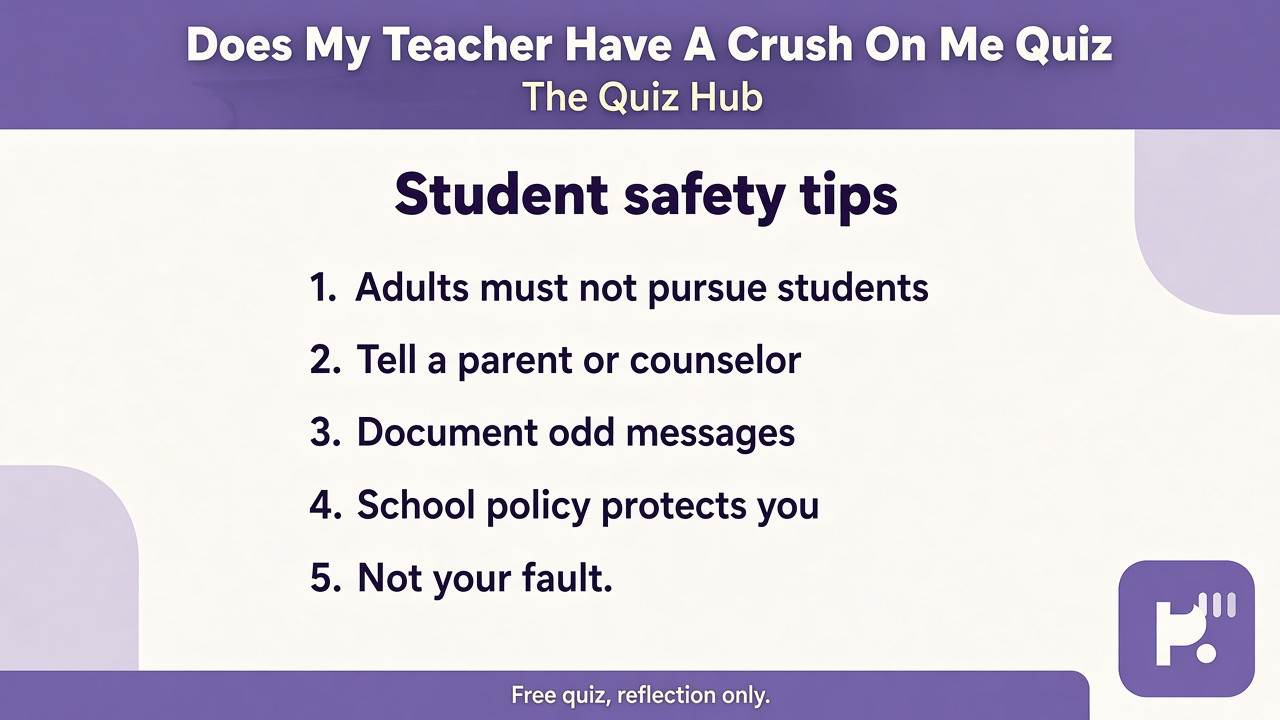
A quick takeaway graphic with topic tips (not your personal quiz scores). Start the quiz for your index, bands, and charts.
What this quiz can and cannot tell you
Can tell you
- Organize confusing classroom moments into four clear domains
- Prompt you to document messages and use school reporting lines
- Highlight when secrecy or alone time deserves a trusted adult
- Offer a baseline to retake after a class change or new semester
Cannot tell you
- Prove whether your teacher has a crush or committed misconduct
- Replace counselors, administrators, or child protection investigators
- Tell you to meet an adult alone to get clarity
- Separate mentorship from grooming with legal certainty
Teacher attention: crush rumors, boundaries, and telling an adult
School crushes in headlines are rare compared with everyday confusion: a teacher who remembers your name, gives extra feedback, or smiles when you raise your hand. The hard part is separating mentorship from attention that crosses a line. Students hold less power in that relationship, so your comfort and policy matter more than whether a friend thinks it is romantic.
Inappropriate attention often shows up as comments on your body, dating life, or social media instead of your work. Boundary crossing shows up as secret chats, gifts, rides, or closed-door meetings without a legitimate school reason. Neither requires you to flirt back or keep quiet to protect their reputation. Schools exist to teach, not to date students.
Gossip is the weakest evidence in the building. Hallway jokes can feel exciting because they make you the main character, yet they rarely come with facts or consent. Compare rumors with patterns over weeks: Do they respect your no when you step back? Do they keep contact on official channels? Do other staff supervise interactions? Our does my teacher hate me quiz helps when cold tone, not romance, is what you are decoding.
Student safety reporting is not betrayal; it is how policies protect kids. Save screenshots with dates, note witnesses, and bring a parent or counselor into the loop before you confront an adult alone. Mandatory reporting rules mean many staff must act when they learn enough. You are not responsible for an adult choosing to break boundaries.
If attention stops when adults are watching, that pattern matters. If it rises when you are vulnerable about grades or home stress, that matters too. Retake after a class change and watch whether bars drop when supervision returns. A drop suggests proximity and gossip were doing more work than romance. A rise despite policy is a reason to escalate, not to decode alone.
| Test | Focus |
|---|---|
| Does my teacher hate me quiz | Strict or cold tone versus romantic attention when mood is the worry |
| Do I have a crush on my teacher quiz | Your own flutter feelings, not reading adult boundary violations |
Does My Teacher Have a Crush on Me Quiz FAQ
What does this quiz measure?
It measures how often you have noticed inappropriate attention, boundary crossing, safety reporting worry, and gossip confusion at school. You get an index from 0 to 100 and four bars. It reports what you have seen, not investigation findings.
Can a teacher legally date a student?
Students deserve protection regardless of age gaps in your state. Schools treat staff-student romance as misconduct. This quiz is not legal advice; talk with a parent or counselor about your district rules.
Should I tell someone if my score is high?
Yes, when you feel safe to do so. Bring a parent, guardian, or school counselor into the conversation. Save messages and note dates. High scores describe signals you noticed, not proof, yet adults need facts to help.
Is hallway gossip enough to report?
Gossip alone is weak proof, but it can prompt you to look at message logs and patterns. Reporting is for behavior and evidence, not rumors by themselves.
Who reviewed this quiz?
Dr. James Whitfield, PhD reviewed the framing, student safety limits, and mandatory reporting context. See our editorial policy for review standards.
Reviewed by