What the Does My Ex Miss Me Quiz measures
This quiz does not read your ex's mind or guarantee they want you back. It measures how often you have noticed behaviors people often label as missing you: unprompted contact, social media hints, nostalgic references, and contrast cues that suggest moving on. You answer 22 how-often statements since the breakup, with reverse-worded items so one polite logistics text cannot hide a pattern of distance. Your answers also feed a second chart on closeness and trust habits, because attachment anxiety can make neutral silence feel like rejection. The total becomes an index from 0 to 100 where higher means more reported missing signals on this screener, not proof you should reunite. If the relationship involved control, threats, or violence, use professional or community support instead of chasing scores.
Direct contact
How often they texted, called, or appeared in person without clear logistics.
Social signals
How often posts, stories, or reactions seemed tied to your shared history.
Nostalgic reach
How often memories, inside jokes, or mutual friends came up.
Moving-on cues
How often distance, new dating, or firm boundaries showed up instead.
How it works
Answer 22 frequency items
Rate each statement from Never to Very often since the breakup. Tap Next after each answer.
Answers sort into four domains
Each answer feeds one of four signal groups, and every item also feeds a closeness and trust layer.
See your index and charts
You get a 0 to 100 index, a band, and two bar charts you can compare over time if you retake.
Take the Does My Ex Miss Me Quiz
Answer 22 short statements to see your ex missing signal index, four relationship bars, and a closeness and trust chart.
What your result means
Your index is the average of all 22 answers, scaled from 0 to 100, with reverse-worded items flipped first. Higher means more reported missing signals. Read moving-on cues alongside nostalgic reach before you interpret the total.
| Band | Index range | Typical reading |
|---|---|---|
| Few missing signals | 0 to 35 | Little direct contact, nostalgia, or targeted social activity since the split. |
| Mixed missing signals | 36 to 65 | Some nostalgia or contact mixed with distance or new life signs. |
| Several missing signals | 66 to 100 | Frequent contact, nostalgia, or social hints; still not reunion advice. |
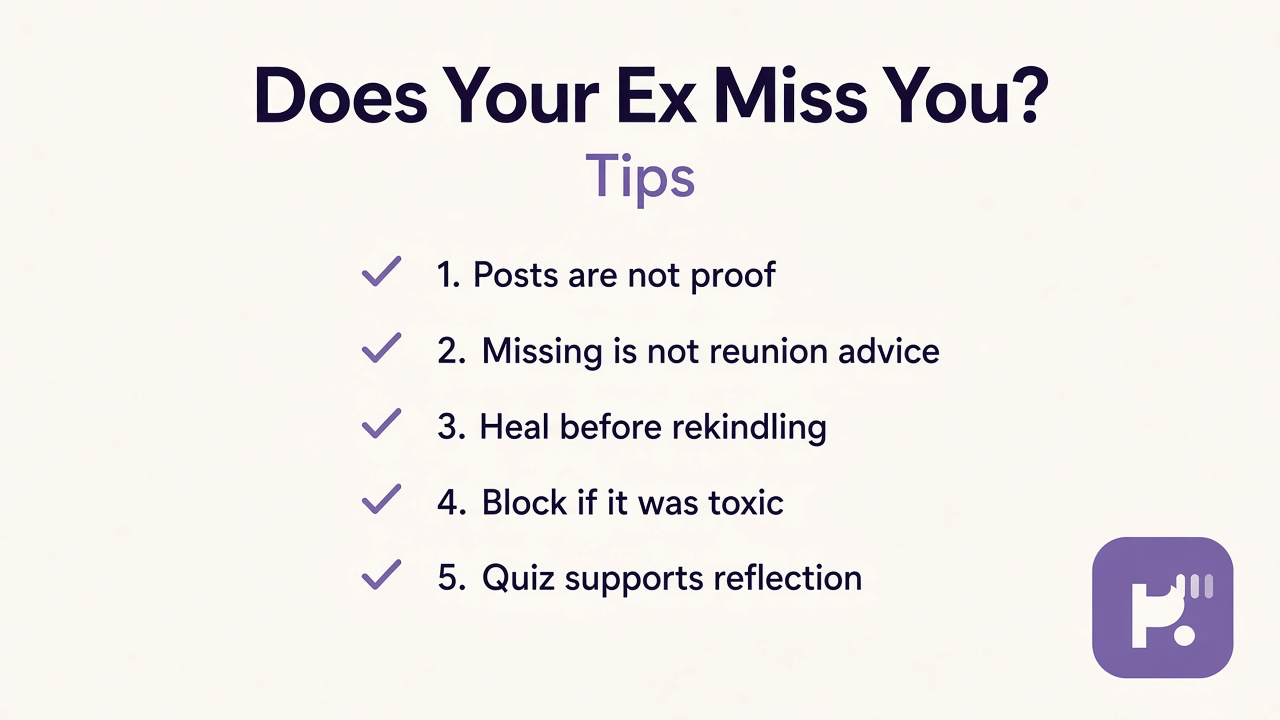
Tips at a glance
A quick takeaway graphic with topic tips (not your personal quiz scores). Start the quiz for your index, bands, and charts.
What this quiz can and cannot tell you
Can tell you
- Organize hope and hurt into four observable domains
- Separate breadcrumbs from clear reunion effort
- Highlight when no contact may be healthier than decoding
- Offer a baseline to retake after a boundary experiment
Cannot tell you
- Prove whether your ex misses you or wants reconciliation
- Replace therapy, safety planning, or legal advice
- Detect abuse or manipulation on its own
- Tell you whether to reply, meet, or reunite
Does my ex miss me? Signals versus stories
The question usually arrives in the quiet after no contact, or worse, after breadcrumbs that reopen everything. Missing someone is human; assuming missing means reunion is where people get hurt. This quiz sorts direct contact, public social signals, nostalgic reach, and moving-on cues so you can see what you are actually observing, not what a playlist suggests.
Direct contact is the highest-cost signal: texts without logistics, showing up near your routine, or care in their tone when they ask how you are. Social signals are cheaper: story views, sad lyrics, photos that feel aimed at you. Algorithms and mutual friends amplify noise. Nostalgic reach includes inside jokes, memory talk, and questions through third parties. None of these prove a plan to try again; they prove your ex still has feeling noise in the system.
Moving-on cues matter as much as nostalgia. Dating openly, respecting no-contact, or building routines without you can coexist with private grief. Reverse items keep polite co-parent texts from inflating a fantasy. If your score is low, grief may still be real on your side even if their side looks quiet. Healing is not a competition.
If your score is high, pause before you reply. Ask whether the problems that ended the relationship changed, whether both people want the same future, and whether past jealousy or control still lurks. Our do I miss him quiz focuses on your pull, not their behavior. The am I healed from my breakup quiz tracks recovery progress rather than their social feed.
Retake after a month of firm boundaries and compare bars. Love that is worth rebuilding should include honest words, not only missing feelings at midnight. If toxicity was part of the story, let missing be information you file away while you move toward safety and self-respect.
| Test | Focus |
|---|---|
| Do I miss him quiz | Your longing and habits, not your ex's outward signals |
| Am I healed from my breakup quiz | Recovery progress, not whether they watch your stories |
Does My Ex Miss Me Quiz FAQ
What does this quiz measure?
It measures how often you have noticed possible missing-you signals since the breakup across contact, social media, nostalgia, and moving-on cues. You get an index from 0 to 100 and four bars. It reflects your observations, not their private thoughts.
Does a high score mean we should get back together?
No. It means you reported more signals that people often read as missing you. Reunion needs mutual intent, changed patterns, and safety, not a quiz index.
They viewed my stories but never text. What does that mean?
Story views are low-effort attention. Compare that bar with direct contact and nostalgic reach before you treat it as proof of love.
We have no contact. Does that mean they do not miss me?
Not necessarily. No contact can be respect, healing, or a boundary. Silence is weak data for your worth and strong data for moving forward if the relationship hurt you.
Who reviewed this quiz?
Dr. Priya Sharma, PhD reviewed the relationship framing, safety notes, and result explanations. See our editorial policy for review standards.
Reviewed by