What the Does My Baby Have Colic Quiz measures
This quiz does not diagnose colic or any medical condition. Pediatricians diagnose colic patterns after history, exam, and often after checking growth, feeding, and warning signs. It measures how often you have noticed crying features parents commonly compare to colic, in four groups: clustered long crying spells especially in the evening, limits on how well soothing works once a bout starts, belly tension signs such as leg pulling and red face, and caregiver strain including sleep loss and fear of losing patience. You answer 22 how-often statements about the past two weeks, with reverse-worded items so optimism cannot hide a week of very often answers. Your responses also feed a second chart on closeness and trust habits, because exhausted parents sometimes isolate instead of asking for help. The total becomes an index from 0 to 100 where higher means more frequent pattern concern on this screener, not a final colic label.
Crying clusters
How often long intense crying spells stacked, especially in predictable evening windows.
Soothing limits
How often feeding, holding, or motion failed to settle crying for long stretches.
Belly tension
How often crying came with leg pulling, tight tummy, clenched fists, or red face.
Caregiver strain
How often the pattern disrupted sleep, meals, or your sense of safe patience.
How it works
Answer 22 frequency items
Rate each statement from Never to Very often for the past two weeks. Tap Next after each answer.
Answers sort into four domains
Each answer feeds one of four crying groups, and every item also feeds a closeness and trust layer.
See your index and charts
You get a 0 to 100 index, a band, and two bar charts you can share with your pediatrician or partner.
Take the Does My Baby Have Colic Quiz
Answer 22 short statements to see your colic pattern concern index, four domain bars, and a closeness and trust chart.
What your result means
Your index is the average of all 22 answers, scaled from 0 to 100. Higher means more frequent reported colic-like patterns on this screener. Read the domain bars before the total, since caregiver strain can spike even when belly signs look mild.
| Band | Index range | Typical reading |
|---|---|---|
| Lower colic pattern concern | 0 to 35 | Fewer long crying clusters or soothing failures in the past two weeks. |
| Mixed colic pattern concern | 36 to 65 | Some intense evenings; other days feel manageable. |
| Higher colic pattern concern | 66 to 100 | Frequent intense crying clusters; pediatric visit to rule out illness. |
Tips at a glance
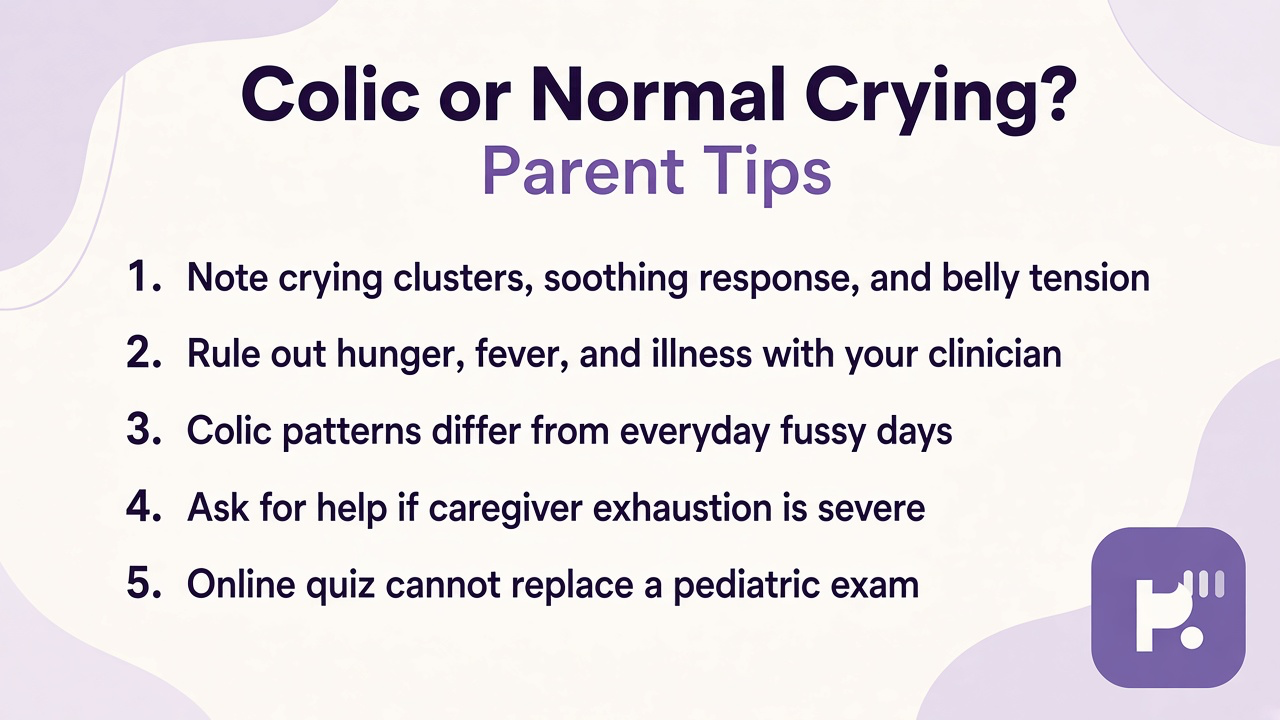
A quick takeaway graphic with topic tips (not your personal quiz scores). Start the quiz for your index, bands, and charts.
What this quiz can and cannot tell you
Can tell you
- Organize crying worries into timing, soothing, belly signs, and support load
- Give you vocabulary for a pediatric visit or lactation consult
- Highlight when to ask for help so no one holds screaming alone
- Offer a baseline if you retake after treatment trials
Cannot tell you
- Diagnose colic, reflux, allergy, or infection
- Replace weight checks, exam, or tests your doctor orders
- Tell you to ignore fever, vomiting, or poor feeding
- Measure your worth as a parent
Colic crying: patterns, red flags, and support
Colic is a word for intense, repeated crying in an otherwise growing infant, usually in the first months of life. Parents who search this question are often standing in a dark kitchen at 6 p.m., bouncing a baby who has already eaten and been changed, wondering why nothing works. The crying is real, the exhaustion is real, and the label is only useful if it leads to support and a check for problems that need treatment.
Clinicians often use pattern clues such as long bouts, predictable timing, and difficulty soothing, then rule out fever, illness, reflux, cow-milk protein allergy, and inadequate intake. The Centers for Disease Control and Prevention reminds families to seek care when infants have fever in the first months, refuse feeds, or look lethargic. The World Health Organization's maternal and child health materials stress responsive care and caregiver rest when crying is intense. Neither source treats colic as a parent failure.
This quiz mirrors what you might report at a visit: how long, how often, what soothing you tried, and whether legs and belly look tense. Gas and immature digestion contribute to discomfort, but so can overstimulation and overtiredness. Video of a typical bout helps clinicians distinguish arching from reflux from normal fuss. If your index is high, book the appointment instead of waiting for three weeks of misery out of pride.
Support plans matter as much as labels. Tag-team holding so each caregiver gets a break, white noise, swaddling if safe for sleep practices you follow, and avoiding chaotic evenings when possible can shave minutes off bouts even before medication trials. Lactation consultants and pediatricians can discuss feeding mechanics if crying peaks after feeds. Compare with our developmental milestones quiz only for broader development reflection, not crying diagnosis.
If rage or despair surges while your baby screams, you are not alone and you are not evil. Place the baby in a safe sleep space, step away, and call someone. Shaken baby prevention campaigns exist because sleep-deprived brains need offload, not shame. Retake this screener after interventions to see whether reported frequency eases, and tell your doctor what helped even a little.
| Test | Focus |
|---|---|
| Developmental milestones quiz | Milestone timing rather than crying duration and soothing patterns |
| Child development quiz | Broader development reflection without colic-specific crying clusters |
Does My Baby Have Colic Quiz FAQ
What does this quiz measure?
It measures how often you have noticed colic-like crying clusters, soothing limits, belly tension, and caregiver strain in the past two weeks. You get an index from 0 to 100 plus four domain bars. It describes parent-reported patterns, not a medical diagnosis.
Can this quiz tell me if my baby has colic?
No. Colic is a clinical pattern after your pediatrician rules out other causes. This tool helps you organize what you are seeing before or during that visit.
What symptoms mean I should call the doctor right away?
Call promptly for fever, vomiting, blood in stool, poor feeding, lethargy, or if your baby looks unwell to you. Intense crying alone still deserves a visit, but emergencies come first.
I am afraid I might shake my baby. What should I do?
Put your baby in a safe place, leave the room if you need to, and call a partner, friend, pediatrician, or crisis line. In the US, call or text 988. Help is part of keeping your baby safe.
Who reviewed this quiz?
Dr. Elena Vasquez, PhD reviewed the YMYL framing, caregiver safety notes, and medical limits. See our editorial policy for review standards.
Reviewed by