What the Does My Baby Have Cerebral Palsy Quiz measures
This quiz does not diagnose cerebral palsy. Only a clinician who examines your baby, reviews birth history, and sometimes orders tests can do that. It measures how often you have noticed patterns that parents and pediatricians often discuss when cerebral palsy is on the worry list, grouped four ways: muscle tone that seems too stiff or too floppy, movement delays relative to age expectations, feeding and oral motor strain, and asymmetry such as one-sided fisting or head turning. You answer 22 how-often statements about the past two weeks, with reverse-worded items so a string of never cannot hide a cluster of very often answers. Your responses also feed a second chart on closeness and trust habits, because infant health fear sometimes makes it hard to ask for help or share worries with a partner. The total becomes an index from 0 to 100 where higher means more frequent concern on this screener, not a confirmed condition.
Muscle tone
How often stiffness, floppiness, scissoring legs, or persistent fisting stood out compared with age guides.
Movement delays
How often head control, rolling, reaching, or tummy-time progress felt behind expectations.
Feeding and oral
How often feeds brought fatigue, choking, tongue thrust, or slow weight gain worries.
Asymmetry
How often one side looked stronger, more fisted, or more turned than the other during play.
How it works
Answer 22 frequency items
Rate each statement from Never to Very often for the past two weeks. Tap Next after each answer.
Answers sort into four domains
Each answer feeds one of four sign groups, and every item also feeds a closeness and trust layer.
See your index and charts
You get a 0 to 100 index, a band, and two bar charts you can bring to your pediatrician.
Take the Does My Baby Have Cerebral Palsy Quiz
Answer 22 short statements to see your motor concern index, four domain bars, and a closeness and trust chart.
What your result means
Your index is the average of all 22 answers, scaled from 0 to 100. Higher means more frequent reported concerns on this screener. Read the domain bars before the total, since feeding strain can dominate while movement looks typical.
| Band | Index range | Typical reading |
|---|---|---|
| Lower reported concern | 0 to 35 | Fewer frequent motor, feeding, or asymmetry worries in the past two weeks. |
| Mixed reported concern | 36 to 65 | Some signs show up; others look typical on good days. |
| Higher reported concern | 66 to 100 | Frequent motor or delay signs; book pediatric evaluation, not a web diagnosis. |
Tips at a glance
A quick takeaway graphic with topic tips (not your personal quiz scores). Start the quiz for your index, bands, and charts.
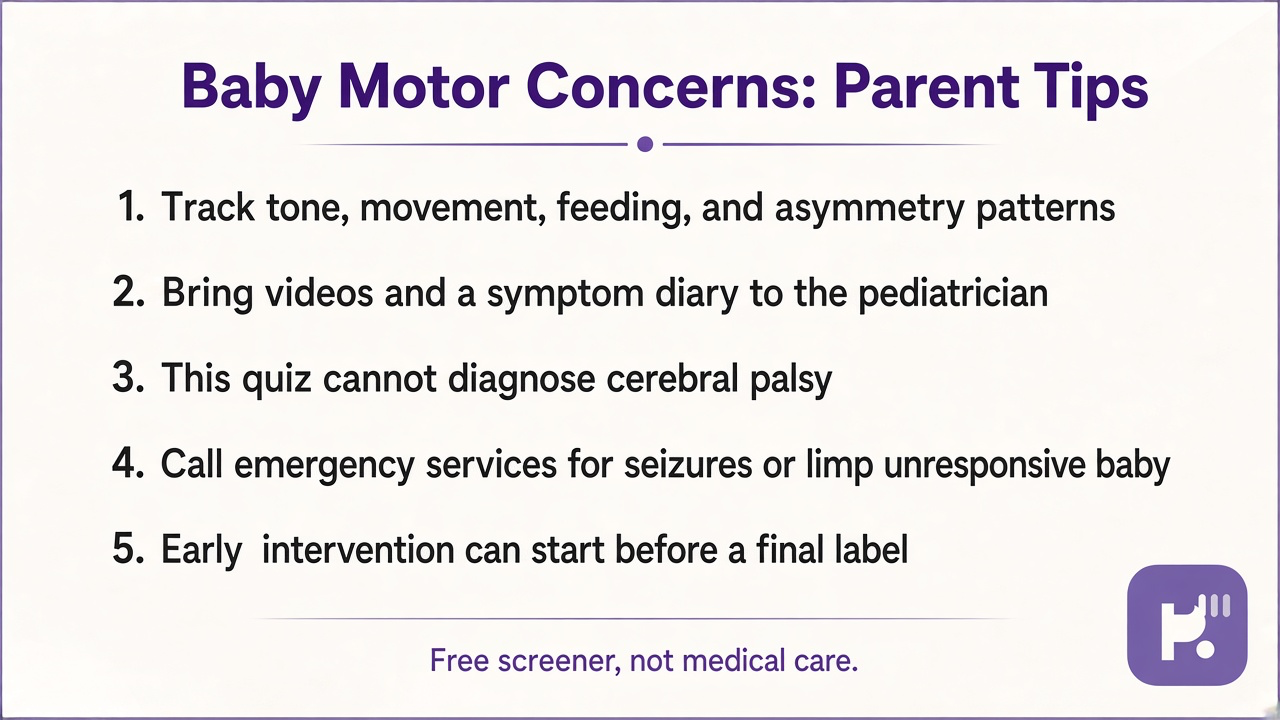
What this quiz can and cannot tell you
Can tell you
- Organize worries into tone, movement, feeding, and asymmetry buckets
- Give you language for a pediatric visit or early intervention call
- Show which domain feels heaviest this fortnight
- Offer a baseline if you retake after therapy starts
Cannot tell you
- Diagnose cerebral palsy, stroke, or any neurological condition
- Replace hands-on exam, hearing vision checks, or brain imaging when indicated
- Account for prematurity corrections without your doctor's input
- Tell you to delay care because a score was low once
Cerebral palsy worries: what parents can do next
Cerebral palsy describes a group of disorders that affect movement and posture because of early brain development differences. Parents who search this question are usually scared by a stiff spell, a floppy nap, or a cousin who rolled earlier. Fear is normal, and so is the need to separate observation from diagnosis. Babies have off days; illness, reflux, and sleep deprivation change tone. Persistent patterns that repeat across settings are what clinicians weigh.
The Centers for Disease Control and Prevention publishes cerebral palsy information for families that stresses evaluation when movement looks uneven or skills stop progressing. The World Health Organization's developmental difficulties guidance likewise urges early support when caregivers see ongoing delay. Neither agency invites parents to label cerebral palsy from a checklist alone. They invite conversation with trained clinicians who watch your baby move in person.
This quiz groups parent reports the way many pediatric visits start: tone, milestones, feeding, and asymmetry. Torticollis can look like head preference; reflux can look like arching; vision problems can reduce reaching. That is why a high index here means call the doctor, not declare cerebral palsy in a group chat. Early intervention services in many regions can evaluate motor skills without waiting for a final diagnosis, which helps families whether the answer is cerebral palsy, a mild delay, or something else entirely.
Bring videos and a symptom diary to appointments. Note whether stiffness shows during diaper changes only or also during happy play. Mention birth history, jaundice, NICU stays, and any regression, because losing a skill matters urgently. If your pediatrician is reassuring but your worry persists, a second opinion or developmental specialist is reasonable. You can also try our developmental milestones quiz for a broader milestone reflection, still not a substitute for exam.
Caregiver mental health counts too. Constant googling can shrink sleep and patience, which makes every cry feel catastrophic. If anxiety about your baby's body is overwhelming daily life, tell your clinician; parent support is part of infant care. Retake this screener after a visit if you want to track whether reported frequency eases once you have a plan.
| Test | Focus |
|---|---|
| Developmental milestones quiz | Broader milestone reflection without cerebral palsy-specific tone and asymmetry items |
| Child development quiz | General child development habits rather than infant motor red flags |
Does My Baby Have Cerebral Palsy Quiz FAQ
What does this quiz measure?
It measures how often you have noticed tone, movement, feeding, or asymmetry concerns in the past two weeks. You get an index from 0 to 100 plus four domain bars. It reports parent observation frequency, not a clinical diagnosis.
Can this quiz tell me if my baby has cerebral palsy?
No. Cerebral palsy is diagnosed by a qualified clinician after exam and sometimes tests. This tool helps you organize worries to discuss with your pediatrician.
My baby was premature. Does that change milestones?
Often yes. Many teams use adjusted age for preterm infants. Bring gestational age at birth to your visit so comparisons are fair.
When should I call the doctor urgently?
Call emergency services for trouble breathing, limpness, seizures, or unresponsiveness. Call your pediatrician soon for persistent asymmetric tone, feeding failure, or loss of skills.
Who reviewed this quiz?
Dr. Elena Vasquez, PhD reviewed the YMYL framing, medical limits, and pediatric care guidance. See our editorial policy for review standards.
Reviewed by