What the Does God Hate Me Quiz measures
This quiz does not decide whether God hates you. No website can. It measures how often spiritual scrupulosity-style distress has shown up for you lately, in four groups clinicians and researchers often see together: fear of divine rejection, doubt about forgiveness, repeated spiritual rituals for relief, and shame that isolates you. You answer 22 how-often statements about the past month, and some are worded the other way around so a string of never cannot hide the pattern. Your answers also feed a second chart on closeness and trust habits, because shame and fear often make it hard to tell anyone what you are carrying. The total becomes an index from 0 to 100 where a higher number means more frequent distress on this screener, not a worse soul or a weaker faith.
Feared rejection
How often you fear divine anger, punishment, or being cut off because of who you are or what you thought.
Moral doubt
How often you question whether you are forgiven, pure enough, or allowed to feel peace.
Ritual relief
How often you repeat spiritual acts to feel safe, then doubt whether they counted.
Shame spiral
How often shame about faith or thoughts pulls you away from people and into self-blame.
How it works
Answer 22 frequency items
Rate each statement from Never to Very often for the past month. Tap Next after each answer.
Answers sort into four domains
Each answer feeds one of four domains, and every item also feeds a closeness and trust layer.
See your index and charts
You get a 0 to 100 index, a band, and two bar charts you can share with a therapist or pastor.
Take the Does God Hate Me Quiz
Answer 22 short statements to see your scrupulosity strain index, four domain bars, and a closeness and trust chart.
What your result means
Your index is the average of all 22 answers, scaled from 0 to 100. Higher means more frequent spiritual fear on this screener. Read the domain bars before the total, since ritual checking can spike one bar while rejection fear stays quiet.
| Band | Index range | Typical reading |
|---|---|---|
| Lower scrupulosity strain | 0 to 35 | Less frequent fear that God rejects you; brief spikes can still happen under stress. |
| Mixed scrupulosity strain | 36 to 65 | Some days feel spiritually steady; other days fear and checking take over. |
| Higher scrupulosity strain | 66 to 100 | Frequent fear of divine rejection; seek professional help, not a theology answer online. |
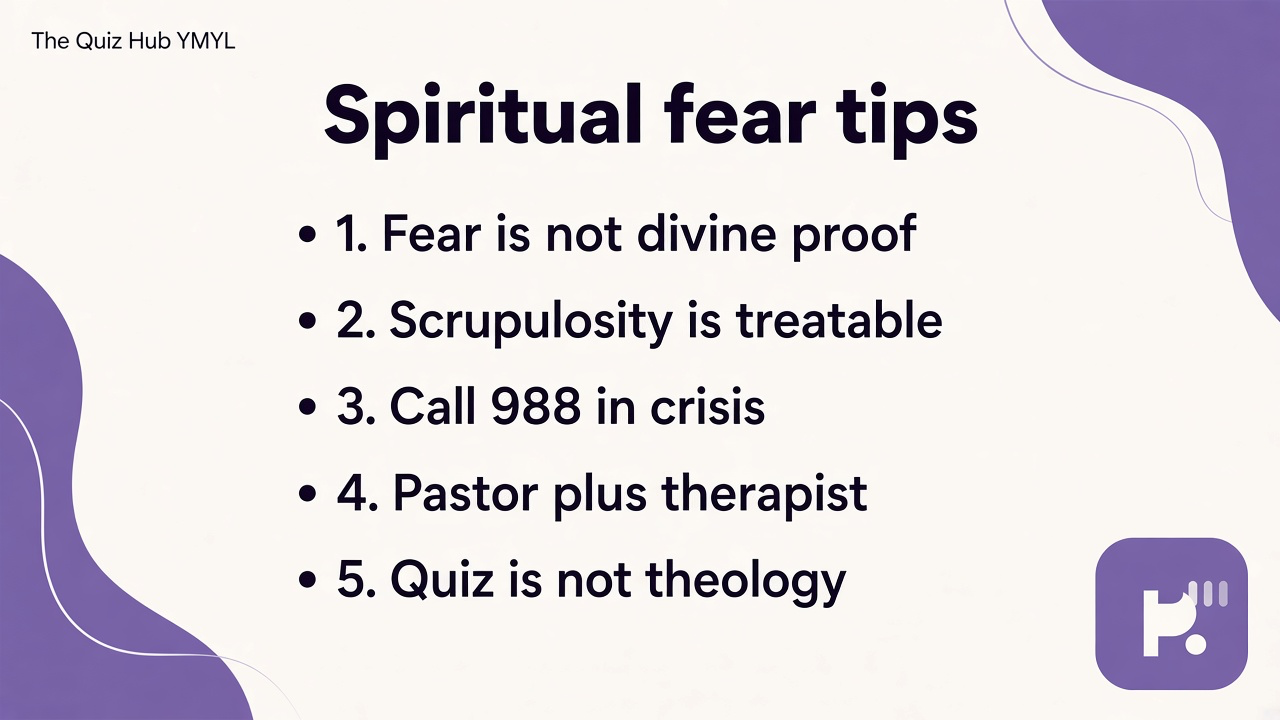
Tips at a glance
A quick takeaway graphic with topic tips (not your personal quiz scores). Start the quiz for your index, bands, and charts.
What this quiz can and cannot tell you
Can tell you
- Put words to spiritual fear patterns you may have hidden
- Show which domain, fear, doubt, rituals, or shame, feels biggest
- Encourage appropriate professional or pastoral support
- Offer a baseline if you retake during or after treatment
Cannot tell you
- Tell you what God thinks or whether you are saved
- Diagnose OCD, depression, or any mental health condition
- Replace confession, sacraments, or faith teaching in your tradition
- Judge the sincerity of your beliefs or your character
Spiritual fear versus divine judgment
Many people who search this question are not looking for a debate. They are exhausted. A thought arrives, shame follows, and the mind insists that God must see them the way they see themselves in that moment. The ache is real even when the conclusion is not something any caring faith leader would affirm. Sleep loss, appetite changes, and pulling away from worship can ride along with that fear, which is why this page treats the pattern as distress first.
Clinicians use the term scrupulosity for obsessive religious or moral fear that does not ease with ordinary reassurance. It sits close to obsessive-compulsive disorder: intrusive thoughts, urgent rituals, and a brief calm that collapses. Jonathan Abramowitz and colleagues have written extensively on how religious OCD differs from healthy conscience, mainly in how much suffering it causes and how little relief lasts. Your quiz result is built around that clinical lens, not around declaring who is in or out of grace.
Theology and mental health answer different questions. A pastor or imam or rabbi can walk with you through scripture, tradition, and meaning. A therapist can help you change the loop of fear, checking, and avoidance when it hijacks daily life. Many people need both. This page deliberately avoids verdict language about God because online quizzes cannot see your context, your tradition, or your heart.
If your score is high, treat that as a signal to get human help, not as proof of damnation. Exposure and response prevention, a first-line OCD therapy, is often adapted for scrupulosity with a clinician who respects your faith. Medication decisions belong with a prescriber who knows your full picture. You can also try our moral scrupulosity OCD test for a related screen. And if hopelessness mixes with this fear, call or text 988 in the US or use your local crisis line. Suffering this intense is treatable, and it is not the last word on who you are.
Keep a short list of thoughts that repeat and bring it to your first appointment. Patterns help clinicians move faster than a vague I feel awful, and you deserve care that moves at that pace.
| Test | Focus |
|---|---|
| Moral scrupulosity OCD test | Focuses on moral and religious OCD patterns with a clinical framing |
| OCD test | Broader obsessive-compulsive screening, not spiritual fear alone |
Does God Hate Me Quiz FAQ
What does this quiz measure?
It measures how often you have felt spiritual rejection fear, moral doubt, ritual checking, and shame spirals in the past month. You get an index from 0 to 100 plus four domain bars. It describes distress frequency, not God's opinion of you.
Can this quiz tell me if God hates me?
No. No quiz can. It can show whether spiritual fear is frequent enough that professional or pastoral support might help. Faith questions belong with trusted leaders in your tradition.
Is this the same as losing my faith?
Not necessarily. Scrupulosity often hits devout people hardest because they care deeply about doing right. Doubt and terror can coexist with sincere belief.
What should I do if my score is high?
Consider a licensed therapist who treats OCD or scrupulosity, and a faith leader who will not demand endless reassurance. Call or text 988 (US) if you feel hopeless or unsafe.
Who reviewed this quiz?
Dr. Elena Vasquez, PhD reviewed the YMYL framing, crisis resources, and limits around theology and diagnosis. See our editorial policy for review standards.
Reviewed by