
What the Do You Know Youtubers Quiz measures
This quiz does not ask you to name famous faces from a photo. It asks how well you know your own YouTube world, in four groups: your viewing habits, what you know about the creators you follow, how well you follow channel culture such as collabs, feuds, and memes, and how well you understand the feed, the money, and the trust side of the platform. You rate 22 statements from strongly disagree to strongly agree, and a few are worded the other way around so that agreeing with everything does not inflate your total. A second chart on closeness and trust habits sits beside your main score, because the feeling of knowing a creator is partly about how you handle one-sided closeness. Your answers become a YouTube savvy index from 0 to 100. Higher means you know more about your viewing world, not that you watch more.
Watch habits
How well you know your own viewing patterns, from hours to the kind of video you pick when tired.
Creator knowledge
How well you know the creators you follow, their style, their start, and what is sponsored.
Channel culture
How well you follow the in-jokes, feuds, collabs, and trends around the channels you watch.
Platform sense
How well you understand how the feed, creator income, and video credibility work.
How it works
Answer 22 agree or disagree items
Rate each statement from Strongly disagree to Strongly agree. Tap Next after each answer.
Answers sort into four domains
Each answer feeds one of four YouTube groups, and every item also feeds a closeness and trust layer.
See your index and charts
You get a 0 to 100 index, a band, and two bar charts you can compare with a friend who watches too.
Take the Do You Know Youtubers Quiz
Answer 22 short statements to see your YouTube savvy index, four savvy bars, and a closeness and trust chart.
What your result means
Your index is the average of all 22 answers, scaled from 0 to 100, with reverse-worded items flipped first. Look at the four bars before the total, since many people are sharp on creators and thin on how the platform works.
| Band | Index range | Typical reading |
|---|---|---|
| Lower YouTube savvy | 0 to 35 | You watch casually and know little about creators or how the feed works. |
| Mixed YouTube savvy | 36 to 65 | You know your favorite channels well and treat the rest as noise. |
| Higher YouTube savvy | 66 to 100 | You follow creators, community lore, and the platform with real detail. |
Tips at a glance
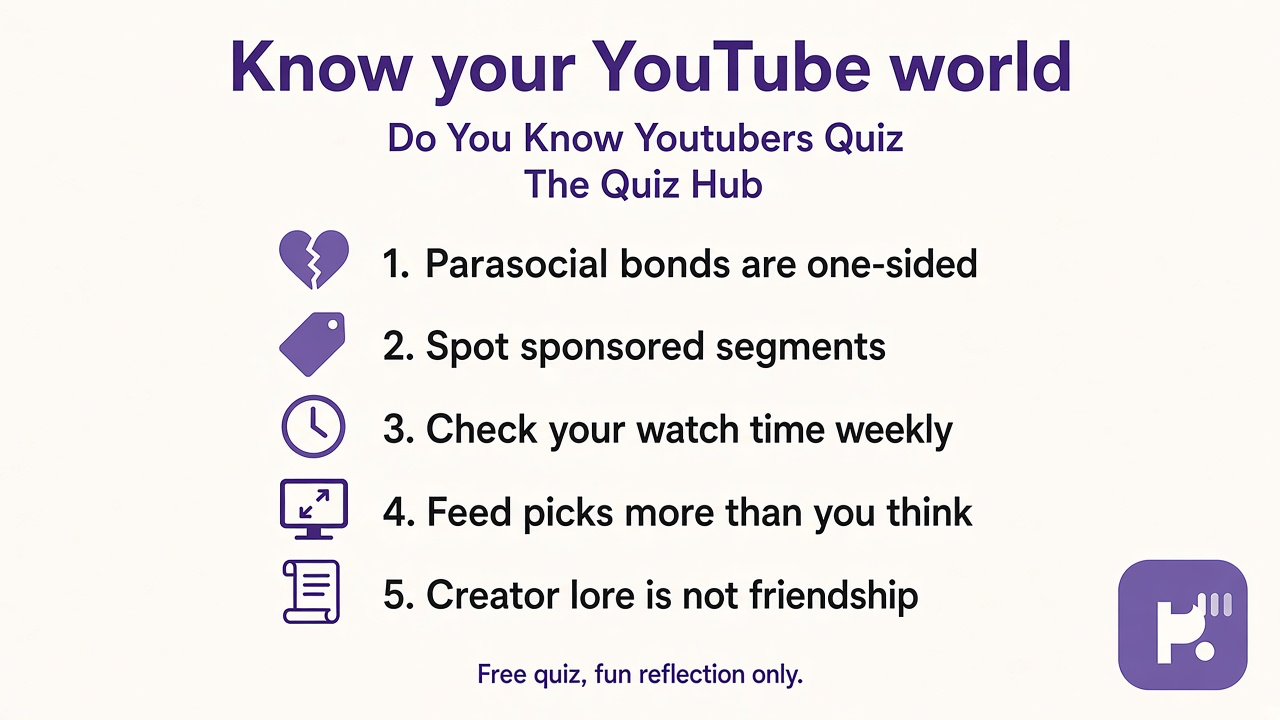
A quick takeaway graphic with topic tips (not your personal quiz scores). Start the quiz for your index, bands, and charts.
What this quiz can and cannot tell you
Can tell you
- Show which parts of the YouTube world you know well and which are hazy
- Point out when the feed may be choosing more of your viewing than you are
- Give you a fun comparison point with friends who watch different channels
- Suggest a next creator or habit to try
Cannot tell you
- Test trivia about specific famous creators, since it rates your own familiarity
- Measure intelligence, taste, or social skill
- Diagnose screen overuse or any mental health condition
- Tell you who to follow or whether a creator is trustworthy
Knowing a creator versus feeling like you do
Most people searching for this want a quick, friendly way to see where they stand. Are they casual viewers who catch whatever the feed serves, or people who could hold a long conversation about a creator's career? Either is fine, and there is no right amount of YouTube to know. The interesting part is how closely your feeling of knowing someone matches what you actually know.
Sociologists Donald Horton and R. Richard Wohl gave this feeling a name in 1956: parasocial interaction. They described the one-sided bond viewers form with performers who speak straight to the camera, and the idea fits YouTube almost perfectly. A creator who shares a morning routine, a bad week, or a joke about their dog feels like a friend. The bond is real on the viewer side, yet the creator chooses what to show and cannot know you back. Recognizing this does not spoil the fun. It just keeps the bond in proportion.
The four bars in your result mirror that split. Watch habits and platform sense are about you and the system: how much time you spend and how the feed and income shape what you see. Creator knowledge and channel culture are about the people and the communities. A high platform-sense score is especially useful, because it helps you spot a sponsored segment, a recycled clip, or a confident claim from a channel with no expertise. Pew Research Center surveys have found that YouTube is used by a large majority of US adults, so these skills matter for most of us, from teenagers picking up study tips to adults following cooking or repair channels.
Use your score as a mirror for your habits. If your watch-habits bar is low, try checking your watch time for a week and see what surprises you. If your platform bar is low, read the short overview of parasocial interaction and then check the recommendation settings in your own account. And if you notice that you feel closer to a creator than to the people in your life, that is a cue to reach out to a friend, not a reason to feel bad.
| Test | Focus |
|---|---|
| Do you know SupergirlyGamer quiz | Focuses on one specific creator instead of your viewing world as a whole |
| Brainrot quiz | Tests how deep you are into viral internet culture beyond one platform |
Do You Know Youtubers Quiz FAQ
What does this quiz measure?
It measures how well you know your own YouTube world across viewing habits, creators, channel culture, and platform sense. Your 22 answers become an index from 0 to 100 with four bars. It rates your familiarity, not how much you watch.
Will I have to name specific YouTubers?
No. The quiz asks about what you know and do, so it works whichever creators you watch. That also keeps it fair for viewers of small niche channels.
Does a higher score mean I watch too much?
Not at all. The index tracks how well you know what you watch, and some of the highest scorers watch only a few hours a week. If time on video is crowding out sleep or people, a health professional can help.
What is a parasocial bond with a creator?
It is the one-sided feeling of closeness a viewer builds with a performer, described by Horton and Wohl in 1956. It is common and usually harmless, but the creator does not know you back.
Who reviewed this quiz?
Dr. James Whitfield, PhD reviewed the framing, the limits note, and the result explanations. See our editorial policy for review standards.
Reviewed by
