
What this ap euro quiz measures
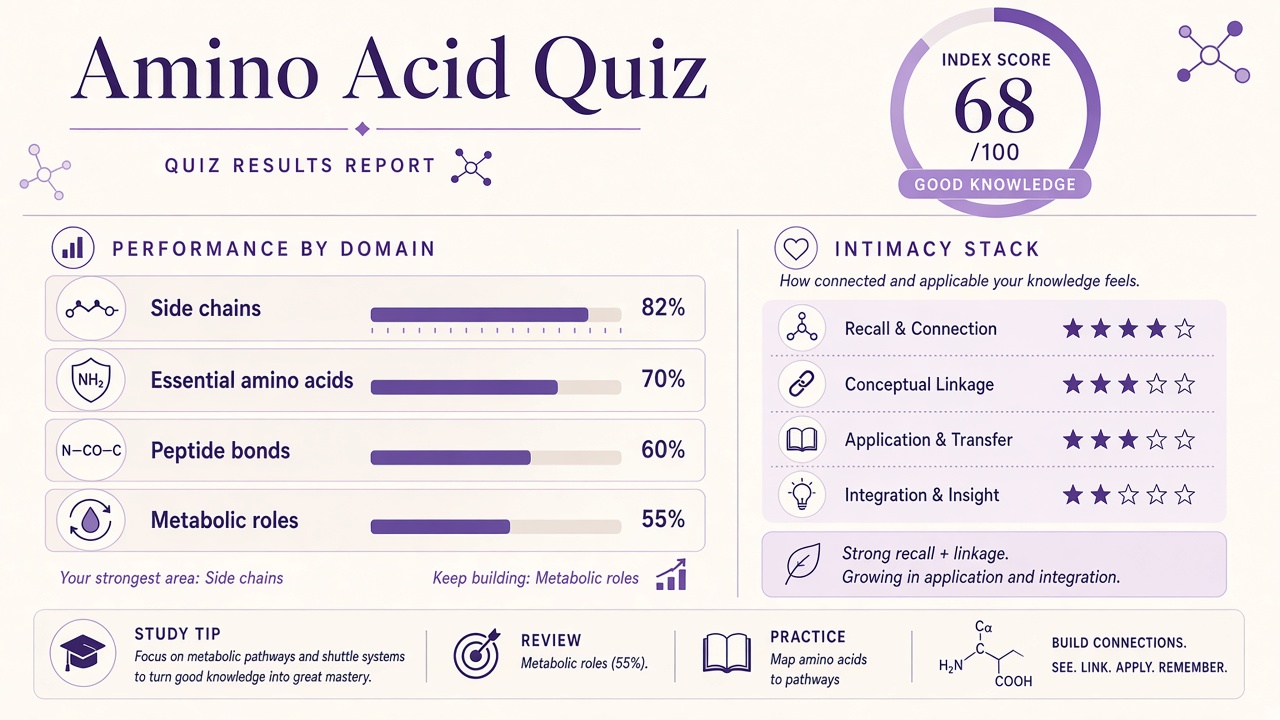
This AP Euro quiz estimates how confidently you recall early-modern and revolutionary-era themes. Twenty original agree-disagree items group into Renaissance humanism, Reformation religion, absolutism, and Enlightenment revolution following Western Civilizations (Cole et al., 2017) and College Board AP European History Course and Exam Description (2025). Each item also maps to a fear-of-intimacy stack layer adapted from FOIS-style intimacy avoidance themes (Descutner and Thelen, 1991). Your index averages these patterns into a 0 to 100 score.
Renaissance and humanism
Italian city-states, art patronage, humanist education, and printing.
Reformation and religion
Luther, Calvin, Catholic response, and religious wars.
Absolutism and state building
Louis XIV, Peter the Great, English constitutional limits, and mercantilism.
Enlightenment and revolution
Philosophes, natural rights, French Revolution phases, and Napoleon era.
How it works
Answer 20 agree-disagree items
Rate each statement from Strongly disagree to Strongly agree. You click Next after each answer.
Items map to domains and intimacy stack
Answers accumulate percentages for four primary domains plus four fear-of-intimacy stack layers.
View index, band, and charts
Results show Lower, Mixed, or Higher signal bands with domain bars and stack chart.
Take the ap euro quiz
Complete 20 items to receive your AP European history index, four domain bars, fear-of-intimacy stack chart, and band label.
What your result means
Your AP European history index is the normalized total across all 20 items on a 0 to 100 scale. Domain bars show which knowledge area drives your result most.
| Band | Index range | Typical reading |
|---|---|---|
| Lower AP European History Knowledge | 0 to 35 | Fewer endorsed knowledge items; gaps are common without recent review |
| Mixed AP European History Knowledge | 36 to 65 | Blend of solid recall and fuzzy spots worth targeting before an AP exam |
| Higher AP European History Knowledge | 66 to 100 | Steady recall across domains; still not a substitute for proctored AP exams |
What your report looks like
What this quiz can and cannot tell you
Can tell you
- How confidently you report knowledge on this screener
- An index with four domain bars plus fear-of-intimacy stack
- Which knowledge area feels strongest before you open a textbook chapter
- A conversation starter with a study partner about weak domains
Cannot tell you
- College Board AP exam scores or course grades
- Proctored lab practical performance
- Ability to write full FRQ responses based on this quiz alone
- IQ or general intelligence measurement
AP European history in AP courses and honest study limits
AP European History spans Renaissance humanism through nineteenth-century state building with heavy emphasis on causation and comparison. Students often search for quick recall checks before DBQ and LEQ practice. The Quiz Hub built an original agree-disagree screener with index scoring and domain bars rather than copying publisher item banks.
Compare with sibling AP quizzes on this hub or browse the IQ and cognitive category for non-AP siblings.
| Test | Focus |
|---|---|
| AP Bio photosynthesis quiz | Light reactions and Calvin cycle only |
| AP Bio Unit 1 quiz | Chemistry of life foundations |
| AP Chem quiz | Chemistry domains across atomic structure and equilibrium |
| American Revolution quiz | US history recall rather than European history |
AP Euro Quiz FAQ
What does the ap euro quiz measure?
Twenty agree-disagree items ask about renaissance and humanism, reformation and religion, absolutism and state building, enlightenment and revolution. You receive a AP European history index from 0 to 100 plus fear-of-intimacy stack bars. Study self-reflection only.
Can this quiz predict my AP exam score?
No. It describes self-reported knowledge confidence only. AP scores depend on proctored exams, FRQ practice, and full-course preparation.
How is this different from sibling AP quizzes on this site?
Each AP quiz on The Quiz Hub uses a separate question bank with zero shared stems. Compare the comparison table in the article section for topic focus.
What is the fear-of-intimacy stack?
Four closeness-guarding layers scored in parallel to show whether hiding confusion in study groups pairs with lower knowledge confidence on these items.
Who reviewed this content?
Dr. James Whitfield, PhD, reviewed the test framing and result explanations. See our editorial policy for review standards.
Reviewed by
