What this anime smash or pass quiz measures
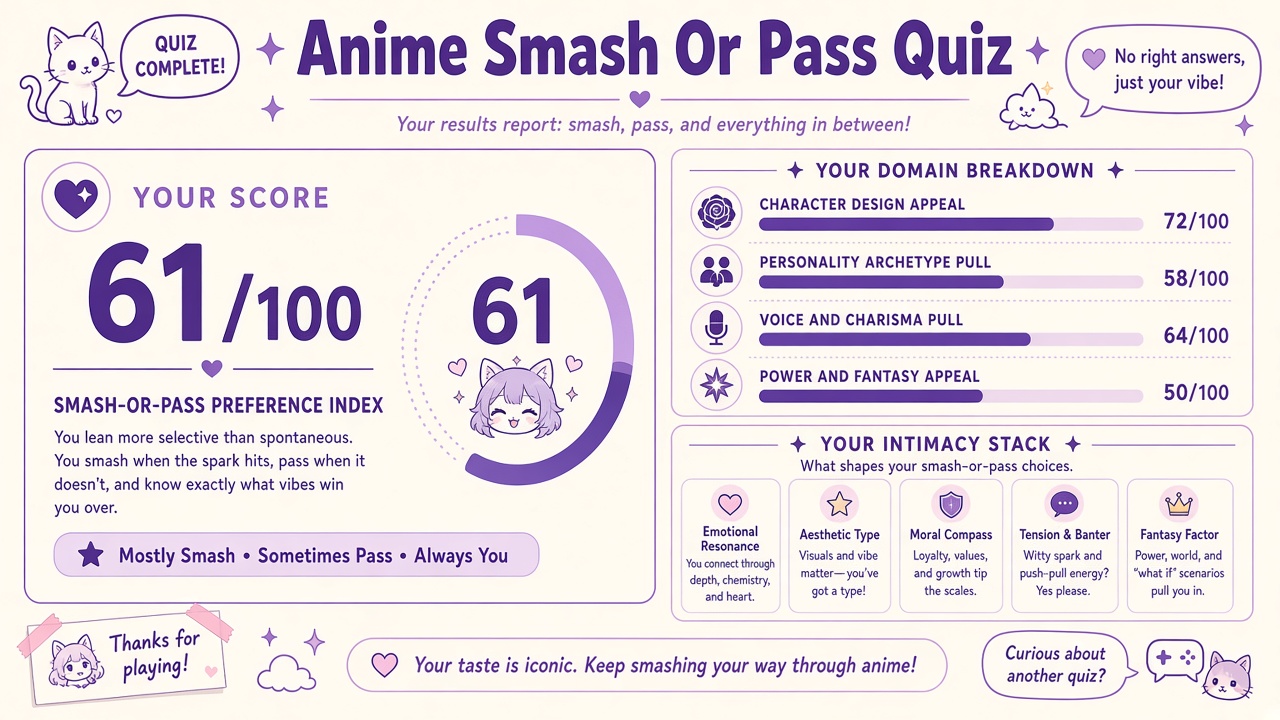
This anime smash or pass quiz maps self-reported preference habits onto four domains: character design appeal, personality archetype pull, voice and charisma pull, and power or fantasy appeal. Twenty agree-disagree items produce a smash-or-pass preference index from 0 to 100 plus a parallel fear-of-intimacy stack. Fictional characters only. Not dating advice.
Character design appeal
Hair, outfit, color palette, and silhouette pulls in smash-or-pass rounds.
Personality archetype pull
Tsundere banter, gentle healers, chaotic rivals, and loyal friend energy.
Voice and charisma pull
Seiyuu tone, laugh patterns, battle cries, and soft-spoken charm.
Power and fantasy appeal
Overpowered abilities, tragic backstories, mentor aura, and cool weapon aesthetics.
How it works
Answer 20 agreement items
Rate each statement from Strongly disagree to Strongly agree. You click Next after each answer.
Items map to domains and stack
Your answers accumulate percentages for four primary domains plus four fear-of-intimacy stack layers.
View index and dual charts
Results show your smash-or-pass preference index, band label, domain bars, and intimacy stack chart.
Take the anime smash or pass quiz
Answer 20 original items about design, personality, voice, and power fantasy pulls in smash-or-pass rounds. Your responses produce an index from 0 to 100, four domain scores, and a fear-of-intimacy stack chart.
What your result means
Your smash-or-pass preference index is the normalized total across all items on a 0 to 100 scale. Higher scores mean more agreement on this fan screener. Domain bars show whether design, personality, voice, or power fantasy drives your result most.
| Band | Index range | Typical reading |
|---|---|---|
| Lower Smash-or-Pass Preference Signals | 0 to 35 | Fewer endorsed smash-or-pass preference patterns on this screener |
| Mixed Smash-or-Pass Preference Signals | 36 to 65 | Blend of strong and moderate domain pulls |
| Higher Smash-or-Pass Preference Signals | 66 to 100 | Strong self-reported alignment on this screener |
What your report looks like
What this quiz can and cannot tell you
Can tell you
- Which preference domains feel strongest when you play fictional smash-or-pass rounds
- An index from 0 to 100 plus fear-of-intimacy stack index with domain bars
- A playful starting point for fandom discussion with friends
Cannot tell you
- Who you should date in real life or any person consent boundaries
- Official character popularity rankings from Japan or streaming charts
- Whether your tastes are morally good or bad beyond personal preference
Why fans search anime smash or pass quizzes
Fans search anime smash or pass quiz when group chats turn into design versus personality debates during seasonal rewatches. The Quiz Hub built this as an original agree-disagree screener with domain bars rather than copied character image grids.
Sample items ask whether hair design, tsundere banter, seiyuu charisma, or overpowered abilities drive your smash votes. Compare with our general anime quiz, anime trap quiz, or the fandom hub. Read our editorial policy for review standards.
Anime Smash Or Pass Quiz FAQ
Does this quiz use real people?
No. All items refer to fictional anime character preference patterns in fan games. This is not dating advice for real people.
What does the smash-or-pass preference index mean?
It is a 0 to 100 score from twenty agree-disagree items across design, personality, voice, and power fantasy domains. Higher scores mean more agreement on this fan screener.
How is this different from character match quizzes?
Character match quizzes assign you a fictional persona. This quiz measures which preference domains drive your self-reported smash-or-pass habits.
What is the fear-of-intimacy stack?
The stack chart shows vulnerability pull-back, trust hesitation, self-disclosure limits, and closeness anxiety layers that may pair with hiding crush-tier fandom tastes from partners.
Who reviewed this content?
Rachel Kim reviewed the fan framing and fictional-only disclaimers. See our editorial policy for review standards.
Reviewed by