
What this ancient history quiz measures
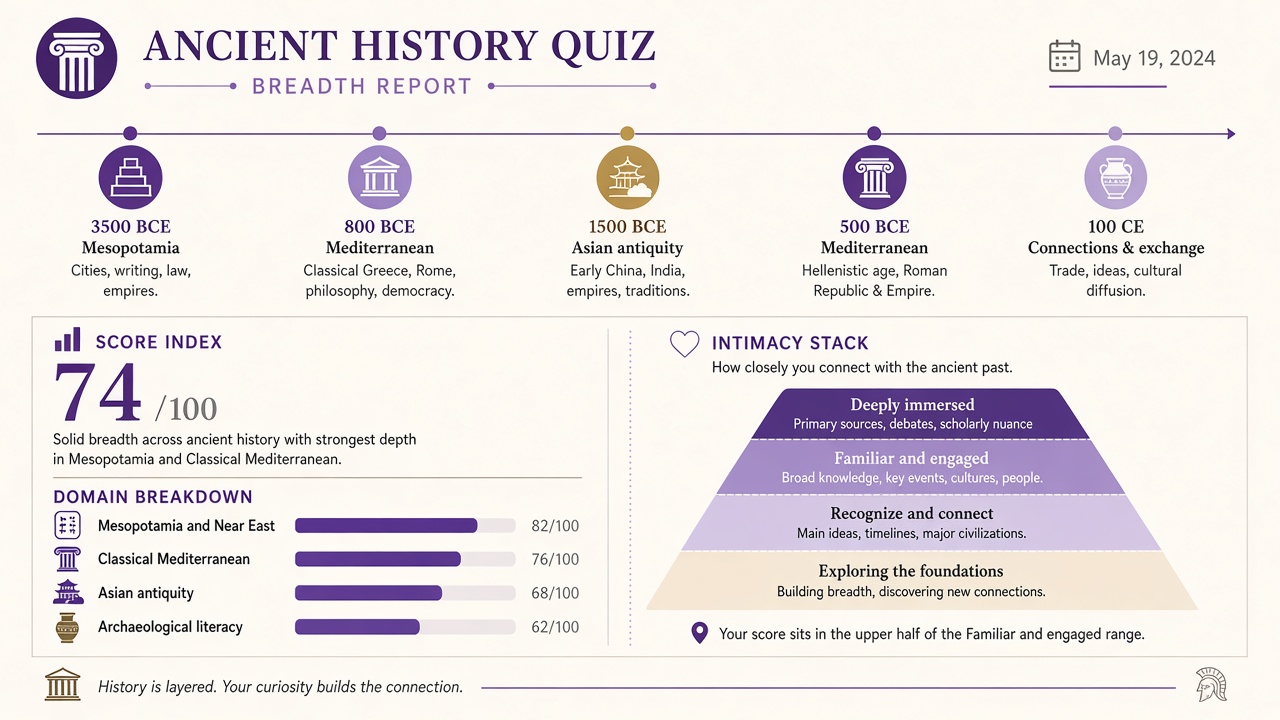
This ancient history quiz estimates cross-civilization breadth patterns in your self-report. Twenty original agree-disagree items group into Mesopotamia and the Near East, classical Mediterranean, Asian antiquity, and archaeological literacy. Each item maps to a fear-of-intimacy stack layer. Your ancient history breadth index averages these into a 0 to 100 score.
Mesopotamia and Near East
Sumerian cities, Hammurabi code, Assyrian expansion, and Persian satrap governance
Classical Mediterranean
Roman republic evolution, Punic wars, Hellenistic kingdoms, and Etruscan roots
Asian antiquity
Shang bronze rituals, Mauryan Ashoka, Indus planning, and Han Silk Road exchange
Archaeological literacy
Stratigraphy, carbon dating limits, primary sources, and repatriation debates
How it works
Three steps from first question to your ancient history breadth report.
Answer 20 agree-disagree items
Rate each statement from Strongly disagree to Strongly agree. You click Next after each answer; nothing auto-advances.
Items map to domains and intimacy stack
Your answers accumulate percentages for four primary domains plus four fear-of-intimacy stack layers.
View index, band, and dual charts
Results show Lower, Mixed, or Higher bands with domain bars and a fear-of-intimacy stack chart.
Take the ancient history quiz
Rate 20 agree-disagree statements about antiquity across regions. Your answers produce a breadth index from 0 to 100 plus domain bars and intimacy stack chart.
Opens in a focused modal. No account required. Results stay on screen.
What your ancient history breadth result means
Your ancient history breadth index is the normalized total across all 20 items on a 0 to 100 scale.
| Band | Index range | Typical reading |
|---|---|---|
| Lower Ancient History Breadth | 0 to 35 | Fewer ancient history breadth signals across domains |
| Mixed Ancient History Breadth | 36 to 65 | Blend of strong and weak domain signals |
| Higher Ancient History Breadth | 66 to 100 | Frequent strong signals across domains |
What your ancient history report looks like
After all 20 items, you get a breadth index, band label, four domain bars, and a fear-of-intimacy stack chart.
What this quiz can and cannot tell you
Can tell you
- How often Mesopotamian, Mediterranean, Asian, and archaeology literacy patterns showed up
- An ancient history breadth index with domain bars and intimacy stack
- Which civilization domain feels strongest in your current recall
- A baseline before AP World or museum-heavy study
Cannot tell you
- Deep expertise in every ancient civilization from one screener
- Graded exam results or college credit
- What archaeologists would conclude from field experience alone
- Replacement for primary source coursework
Breadth versus depth in antiquity screeners
World history teachers at UCLA report that students often strong in Rome week still stumble on Shang bronze rituals or Assyrian siege narratives. Breadth screeners like this one weight four regions equally so one strong cluster cannot hide global gaps.
Compare with our ancient Greece quiz for classical depth or map siblings for geography-only banks. The ancestor quiz covers personal heritage connection, not civilization timelines.
| The Quiz Hub test | What it adds |
|---|---|
| Ancient Greece quiz | Classical Greece history depth with distinct question bank |
| Ancient Egypt map quiz | Nile geography screener, not global breadth stems |
| Ancestor quiz | Personal heritage connection, not civilization timelines |
| This quiz | 20-item cross-civilization breadth index spanning Mesopotamia through archaeological literacy |
Sample items ask whether Persian satraps feel like governance layers over older empires or whether stratigraphy helps guess artifact age. Greece map placement stems stay in the map sibling only.
Ancient History Quiz FAQ
What does the ancient history breadth index measure?
Twenty agree-disagree items ask about Mesopotamia, classical Mediterranean, Asian antiquity, and archaeological literacy. Higher scores mean more frequent breadth endorsement on this screener.
Is this the same as the ancient Greece quiz?
No. The Greece quiz uses twenty Greece-only history stems. This quiz spans multiple civilizations with zero shared question text.
Does this quiz include map placement items?
No. Map geography lives in the ancient Egypt and ancient Greece map quizzes with separate banks.
How long does this quiz take?
About 4 minutes for 20 items with session autosave.
Who reviewed this content?
Dr. James Whitfield, reviewed the test framing and result explanations. See our editorial policy for review standards.
Reviewed by
