Generalized Anxiety Disorder (GAD): Signs, Duration, and Help
Last updated:
Educational only: This article explains generalized anxiety disorder signs and treatment paths in plain language. It is not medical advice or a diagnosis. If you are in crisis, call or text 988 in the U.S., contact Samaritans at 116 123 (UK), or use local emergency services. See our disclaimer.
Generalized anxiety disorder (GAD) means persistent, hard-to-control worry across several life areas, most days, for at least six months, plus physical or mental strain such as restlessness, poor sleep, irritability, or muscle tension. It is more than being "a worrier." The pattern interferes with focus, relationships, or daily tasks. Many people benefit from cognitive behavioral therapy with a licensed CBT therapist, and some add medication after a medical evaluation. Online screeners can organize symptoms to discuss with a clinician; they cannot replace diagnosis or safety planning.
Tips at a glance
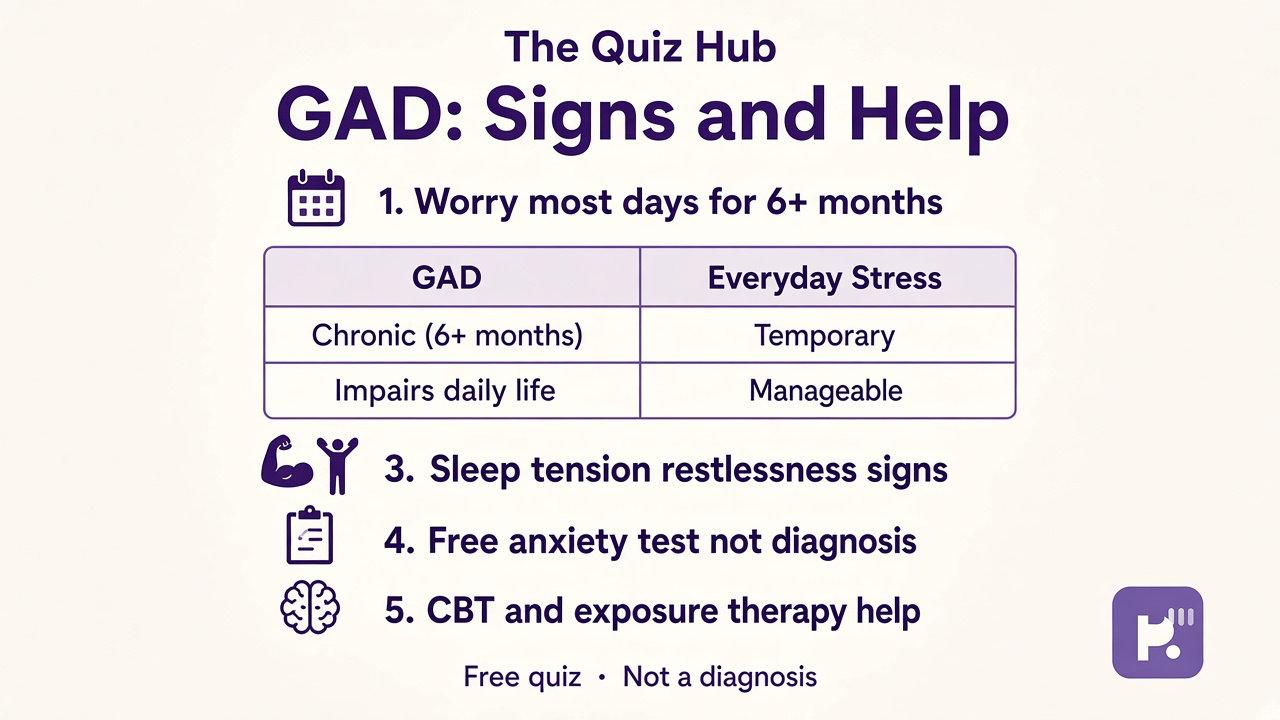
Key takeaways
- GAD requires excessive worry more days than not for at least six months (DSM-5-TR, APA, 2022).
- Physical signs often include tension, fatigue, sleep trouble, and difficulty concentrating.
- Everyday stress and GAD overlap in wording but differ in duration, breadth, and impairment.
- CBT and, when indicated, medication are common evidence-informed paths (NIMH, 2024).
- Screeners flag topics for clinical review; they do not diagnose or measure medical causes.
- Urgent risk or unexplained chest pain needs emergency evaluation, not self-help alone.
Core signs clinicians look for
The DSM-5-TR lists generalized anxiety disorder when a person shows three or more of six associated symptoms for most days over six months: restlessness or feeling on edge, tiring easily, trouble concentrating or mind going blank, irritability, muscle tension, and sleep disturbance. Worry must be excessive and difficult to control, focused on multiple domains (health, work, family, finances, world events), and linked to clear distress or functional problems.
GAD often arrives with stomach upset, headaches, or jaw clenching that people treat as purely physical until a clinician connects the timeline. Panic attacks can co-occur but are not required for GAD. Depression frequently overlaps; a combined mood screener helps you notice both tracks before an intake appointment.
Generalized anxiety disorder vs everyday worry
Normal worry protects you: it prompts planning before a job interview or checking locks at night. GAD worry keeps running after the event passes and spreads to new topics. The table below compares typical patterns. Your experience may mix columns during grief or major life change; a clinician interprets the full picture, including medical history.
| Dimension | Everyday worry | Possible GAD pattern |
|---|---|---|
| Duration | Days to a few weeks around a known stressor | More days than not for 6+ months |
| Focus | Specific problem with a plausible plan | Multiple domains; "what if" chains jump topics |
| Control | Can set worry aside to eat, sleep, or socialize | Worry feels automatic; reassurance helps briefly |
| Body | Mild tension that eases after the event | Ongoing restlessness, fatigue, sleep loss, irritability |
| Function | Performance dips slightly then rebounds | Work, parenting, or friendships shrink to manage anxiety |
| Aftermath | Relief when the stressor resolves | New worries replace old ones without full calm |
If your worry lasted only two months after a layoff, adjustment stress may fit better than chronic GAD, though you still deserve support. Substance withdrawal, hyperthyroidism, and sleep disorders can mimic anxiety; clinicians rule those out before confirming GAD.
Why the six-month rule exists
The six-month duration criterion separates long-running generalized worry from acute reactions. Short bursts of anxiety are common after medical scares, relationship ruptures, or global news cycles. When worry persists beyond half a year with associated symptoms, clinicians weigh GAD alongside social anxiety disorder, panic disorder, obsessive-compulsive disorder, and trauma-related conditions that need different tools.
Tracking helps your appointment: note daily worry intensity (0 to 10), sleep hours, and whether caffeine, alcohol, or late-night scrolling spikes symptoms. Bring a medication list. If six months have not passed yet but impairment is severe, seek care anyway; you do not need to wait for a calendar milestone to ask for help.
What fuels chronic worry
Genetics and temperament play a role, as do childhood experiences of unpredictability or over-responsibility. Adults with GAD often describe early roles as the family planner or peacekeeper. Perfectionism, intolerance of uncertainty, and habitual reassurance seeking maintain the loop: brief relief after checking or asking a partner, then doubt returns.
Life stressors such as caregiving, financial strain, or discrimination can worsen baseline worry without being the sole cause. Medical contributors include asthma, heart arrhythmias, and stimulant use. Treating the anxiety layer while ignoring sleep apnea or unchecked blood pressure leaves part of the problem active.
Evidence-informed treatment paths
CBT for GAD targets worry cycles with cognitive restructuring, worry postponement, problem-solving for solvable issues, and relaxation skills when muscle tension is prominent. A skilled CBT therapist assigns between-session practice; gains depend on repetition, not insight alone. Some protocols add acceptance and commitment therapy elements when control strategies backfire.
When avoidance shapes daily life (skipping meetings, refusing travel, endless online research), behavioral exposure inside CBT helps you approach feared outcomes in graded steps. Our exposure therapy article explains hierarchies and why escaping short-term discomfort often prolongs fear. Exposure for GAD is usually less dramatic than phobia work but still requires pacing.
Medications such as SSRIs or SNRIs are options some prescribers discuss for moderate to severe GAD. Benzodiazepines may appear short term in crisis plans but carry dependence risk; decisions belong with a medical clinician who knows your history. Therapy and medication can combine when each addresses different barriers.
Self-help that supports professional care
Sleep regularity, reduced caffeine after noon, and brief daily movement lower baseline arousal. Mindfulness apps can teach attention anchoring, though they rarely replace structured CBT for entrenched worry. Limit "worry research" spirals: set a timer for news or health forums, then switch to a concrete task.
Tell trusted friends you are working on tolerating uncertainty instead of asking for repeated reassurance about the same fear. Partners can empathize without guaranteeing outcomes. If worry centers on a child's health or school refusal, family therapy or child therapy may run parallel to your individual GAD work.
When to seek professional evaluation
Book an evaluation when worry disrupts sleep most nights, you avoid important roles, or physical symptoms persist after a primary care workup. Sudden onset after age 40 warrants medical screening. If low mood, loss of interest, or suicidal thoughts appear, mention them openly; depression treatment may run alongside GAD care.
Crisis lines are for imminent risk, not routine intake delays. Use 988 when safety feels uncertain tonight. For non-urgent but persistent anxiety, primary care physicians often refer to psychology or psychiatry networks; telehealth expands access in many regions.
Related quizzes on The Quiz Hub
Screeners organize symptoms to discuss with a licensed clinician. They do not diagnose generalized anxiety disorder or replace medical tests.
- Anxiety test: explores worry frequency, tension, and avoidance themes in plain language. Useful before an intake to prioritize talking points. Not a diagnostic instrument.
- Anxiety and depression screening (PHQ-4): brief combined mood check when anxiety and low mood overlap. Scores prompt clinical follow-up, not labels.
- Browse the Mental Health & Clinical category for additional screeners with stated limits.
Frequently asked questions
What is generalized anxiety disorder (GAD)?
Generalized anxiety disorder is a clinical anxiety condition marked by excessive worry about many topics, most days, for at least six months, with restlessness, fatigue, concentration problems, irritability, muscle tension, or sleep disruption. The worry feels hard to control and causes distress or impairment at work, school, or home. Only a licensed clinician can diagnose GAD after a full evaluation.
How is GAD different from normal worry?
Everyday worry is usually tied to a specific stressor, lasts days to a few weeks, and eases when the situation resolves. GAD worry is broader, persists for months, and often continues when life looks stable on paper. People with GAD may report feeling keyed up without a clear trigger. Our comparison table below outlines typical differences; it is educational, not a self-diagnosis tool.
Why does the six-month duration matter?
DSM-5-TR criteria require that anxiety and worry occur more days than not for at least six months for a GAD diagnosis. Shorter intense worry may reflect adjustment stress, medical issues, substance effects, or another anxiety disorder. Duration helps clinicians separate chronic GAD from acute reactions. Track patterns in a journal to discuss with a provider.
What treatments help generalized anxiety disorder?
Cognitive behavioral therapy (CBT) is a first-line psychotherapy for GAD in many practice guidelines. Some people also benefit from acceptance-based or mindfulness approaches, or medication evaluation with a prescriber. When avoidance drives symptoms, graded exposure work may appear inside CBT. Our CBT therapist overview and exposure therapy article explain how those methods differ.
Can online anxiety quizzes diagnose GAD?
No. Screeners such as our anxiety test and PHQ-4 mood screener highlight symptom frequency worth discussing with a clinician. They cannot rule out thyroid disease, sleep apnea, trauma disorders, or medication side effects. Use results as conversation prep, not as a label.
When should I seek urgent help for anxiety?
Call or text 988 in the U.S. if you have thoughts of suicide with intent, a plan, or means, or if you cannot promise your safety tonight. Seek emergency care for chest pain you cannot attribute to a known panic pattern, sudden confusion, or substance withdrawal. Anxiety treatment is important but not a substitute for acute medical or psychiatric emergencies.
Sources
- American Psychiatric Association. (2022). Diagnostic and statistical manual of mental disorders (5th ed., text rev.). DSM-5-TR generalized anxiety disorder criteria.
- National Institute of Mental Health. (2024). Anxiety disorders overview.
- American Psychological Association. (2017). Cognitive behavioral therapy for anxiety.
- Bandelow, B., Michaelis, S., & Wedekind, D. (2017). Treatment of anxiety disorders. Dialogues in Clinical Neuroscience, 19(2), 93-107.
- Stein, M. B., & Sareen, J. (2015). Generalized anxiety disorder. New England Journal of Medicine, 373(21), 2059-2068.