Feeling Worthless: Why It Happens and What Helps
Last updated:
Educational only: This article explains why people feel worthless and when to seek care. It is not therapy, medical advice, or a diagnostic tool. If hopelessness includes self-harm thoughts, call or text 988 (U.S.), contact Samaritans at 116 123 (UK), or use local emergency services. See our editorial policy for YMYL review standards.
Feeling worthless is the sense that you have no inherent value, that praise is mistaken, and that mistakes prove you are fundamentally flawed. That state is painful and common after rejection, bullying, trauma, burnout, or depression. It is not the same as healthy humility or realistic self-critique after a specific error. When worthlessness stays loud for weeks, pairs with sleep or appetite shifts, or drives withdrawal, your nervous system may be carrying shame loops, mood disorder chemistry, or unprocessed injury. Understanding those layers helps you choose support instead of attacking yourself harder.
Key takeaways
- Worth is not earned solely by productivity; persistent self-hate often signals shame or clinical mood symptoms.
- Shame loops punish the whole self; guilt can guide repair after a single behavior.
- Trauma, enmeshment, and core wounds can install "I am unlovable" stories that outlast the original event.
- Depression frequently adds worthlessness, fatigue, and anhedonia that no pep talk alone fixes.
- Self-talk audits and behavioral activation help some people; licensed care matters when function drops.
- Online quizzes flag topics for intake; they do not replace diagnosis or crisis services.
Tips at a glance
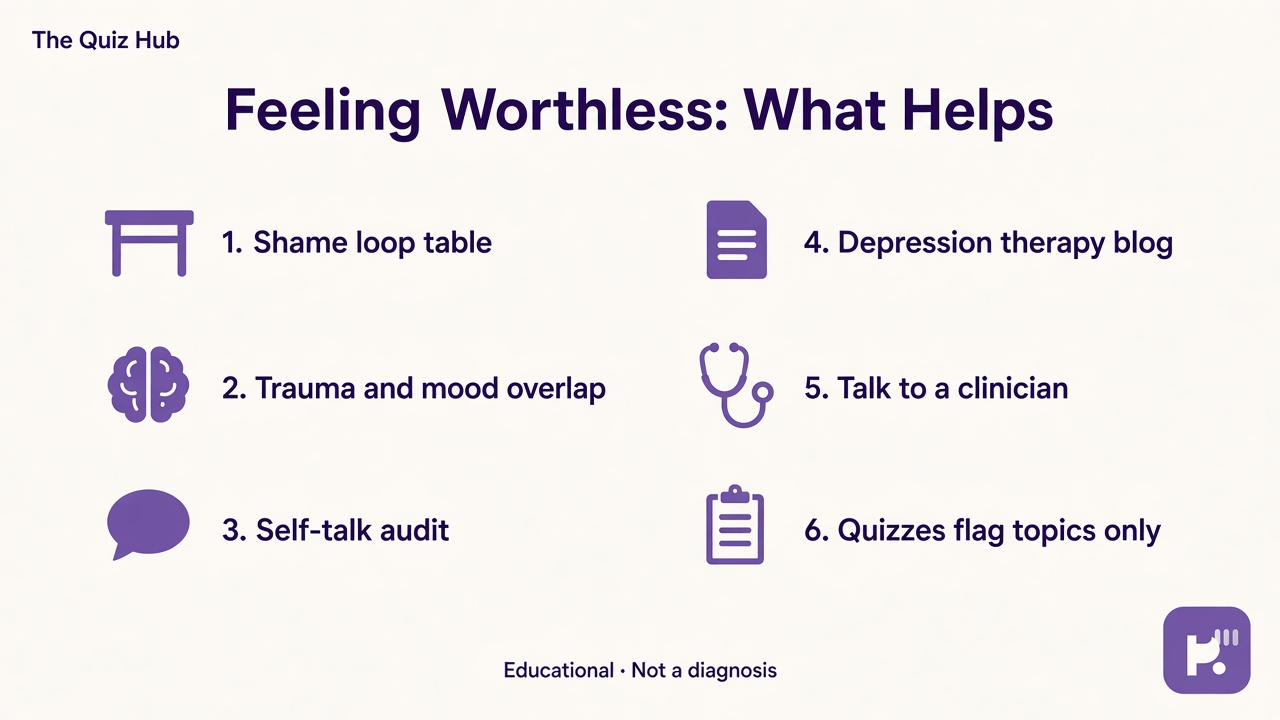
Feeling worthless versus guilt after a mistake
Guilt says, "I did something that hurt someone; I want to repair it." Worthlessness says, "I am the problem." Guilt can motivate apology, restitution, or changed habits. Worthlessness tends to shrink your world: you hide, procrastinate, or sabotage opportunities because success feels undeserved. Researchers distinguish shame (global self-attack) from guilt (behavior-focused regret). Chronic shame correlates with depression, substance use, and relationship withdrawal in many clinical samples. Naming which voice is speaking gives you a first lever: you can address a behavior without sentencing your entire identity.
If you only feel worthless after one conflict, context matters. A harsh comment, social media comparison, or performance review can spike shame that fades in days. When the inner monologue stays hostile across settings (work, friendships, alone time), look for patterns below rather than treating willpower as the only tool.
The shame loop: how worthlessness feeds itself
Shame loops are predictable even when they feel chaotic inside. Something activates an old wound: a tone of voice like a parent, a memory, a perceived failure, or rejection sensitivity. The mind produces a global label ("fraud," "burden," "disgusting"). You respond by hiding, overworking to prove value, snapping at people who care, or numbing with screens or substances. Relief is brief; isolation and rumination return, which confirms the story that you are unworthy of connection. Breaking the cycle usually needs both cognitive skills (catching the label) and behavioral steps (staying in contact, eating, sleeping, moving) so the body is not starving the prefrontal cortex that could challenge the narrative.
| Stage | What you might notice | What the nervous system is doing | Gentler pivot |
|---|---|---|---|
| Trigger | Criticism, comparison, memory, conflict, idle time | Threat detection; old template activates | Name the cue aloud: "This is a shame spike, not a verdict." |
| Global label | "I am worthless," "everyone would be better off without me" | Shame compresses complexity into one identity attack | Ask: "What specific behavior happened? What would I tell a friend?" |
| Withdrawal or punishment | Cancel plans, binge work, self-harm urges, harsh self-talk | Escape from imagined rejection; short-term relief | One connection bid: text one safe person a factual update. |
| Rumination | Replay loops, scroll for evidence you fail | Brain seeks certainty; shame feels like truth | Time-box worry (10 minutes), then shift to a body task. |
| Aftermath | Flat mood, fatigue, more avoidance | Depression-like shutdown reinforces isolation | Schedule clinician check if cycles repeat most days. |
Cognitive behavioral therapy and compassion-focused approaches often map loops like this in session. You do not need to memorize jargon; you need repeatable exits when the label arrives.
Trauma, attachment, and mood overlap
Worthlessness rarely appears from a single cause. Trauma can teach that your needs were dangerous or that abuse was your fault. Enmeshment or emotional neglect can blur boundaries so you feel responsible for everyone else's feelings while yours go unnamed. Our guide on enmeshment trauma and emotional boundaries explains how fused family roles fuel guilt that looks like worthlessness. Core wound work (abandonment, defectiveness, unlovability) often sits underneath chronic shame; see core wounds types and healing for how schema-style beliefs show up in adult relationships and self-talk.
Depression adds another layer. Low mood, anhedonia, sleep disruption, and concentration problems can make every task feel like evidence you are broken. Worthlessness in that context is a symptom cluster, not a personality sentence. Medical and psychological care (therapy, medication evaluation when appropriate, sleep treatment) targets biology and learning history together. Read how depression therapy approaches combine behavioral activation, cognitive work, and medication consults when indicated.
| Contributor | Typical inner story | Common body or behavior signs | Care direction (not self-diagnosis) |
|---|---|---|---|
| Acute shame after event | "I humiliated myself; I cannot show my face." | Flushing, avoidance for days, normal sleep | Supportive friend, apology if owed, time |
| Trauma or complex PTSD themes | "I deserved harm; I am contaminated." | Flashbacks, hypervigilance, startle, trust issues | Trauma-informed therapist; safety planning if abuse ongoing |
| Depressive episode features | "I am a burden; nothing will improve." | Weeks of low mood, fatigue, appetite or sleep shift | Primary care or psychiatrist; therapy plus activation |
| Chronic stress or burnout | "I only matter when I produce." | Irritability, cynicism, collapse after deadlines | Boundaries, rest, workplace or financial counseling |
| Social rejection or bullying residue | "Groups always exclude me." | Social anxiety, rehearsal loops before events | Social skills coaching, CBT, gradual exposure |
Overlap is normal. Trauma history plus current depression can amplify worthlessness until both are treated. A clinician sorts timelines and safety; online articles organize questions for that conversation.
Self-talk audit: catch the prosecutor
A self-talk audit is a structured listen to your default sentences. For three days, jot the harshest thought that appears after setbacks (not every thought, just the peak insult). Note the situation, the exact words, and what you did next. Patterns often reveal all-or-nothing labels, mind reading ("they think I am pathetic"), and discounting positives ("that compliment was pity"). Once visible, thoughts become hypotheses instead of facts.
Try a courtroom frame: what evidence supports the thought? What evidence is missing? What would a fair judge say about one mistake versus a lifetime? Replacement lines work best when specific: "I missed the deadline; I can email a plan" beats "I am worthless." If the prosecutor voice sounds like a caregiver or bully from childhood, therapy may need imaginal dialogue or trauma processing, not only logic.
Practices that support steadier self-worth
- Separate identity from output: track three non-productive qualities you appreciate in others and in yourself.
- Behavioral activation: schedule one small valued action daily even when mood says you do not deserve it.
- Limit comparison windows: mute feeds that trigger rank-and-shame for a trial week.
- Ask for witness: tell one trusted person the shame story; secrecy feeds loops.
- Move before you argue with thoughts: a ten-minute walk lowers arousal enough to edit the script.
- Bring audit notes to intake so sessions start with data, not fog.
When to talk to a clinician
Book an evaluation when worthlessness lasts most days for two weeks or more, sleep or appetite change, you stop enjoying hobbies, work or parenting slips, or you use alcohol or drugs to mute the inner voice. Same-day or crisis care is appropriate when self-harm feels likely. Primary care can screen for depression and thyroid issues; therapists add trauma and schema work; psychiatrists discuss medication when symptoms are moderate to severe. Waiting for rock bottom wastes years; early treatment often shortens episodes.
If you already have a therapist, share the shame loop table entries that repeat. If you are on a waitlist, use behavioral activation and crisis lines rather than isolating. Improvement is uneven; a bad day does not erase biochemical or trauma recovery progress.
Related quizzes on The Quiz Hub
Screeners highlight patterns to discuss with a licensed clinician. They do not diagnose disorders or measure your worth as a person.
- Anxiety and depression screening (PHQ-4): brief mood and worry items useful as a intake conversation starter. Not a substitute for full evaluation or emergency care.
- Anxiety test: notes frequency of worry and physical tension. High worry can ride alongside shame; bring results to therapy rather than self-labeling.
- Browse the Mental Health Clinical category for additional screeners with stated limits and crisis reminders.
Frequently asked questions
Why do I feel worthless even when people praise me?
Praise can bounce off when shame runs deeper than achievement. Early messages that love was conditional on performance, bullying that targeted identity, or depression chemistry that flattens reward can all leave compliments feeling hollow. A shame loop may treat any success as luck and any mistake as proof you are defective. Therapy often targets the inner critic and the beliefs underneath it, not just positive thinking.
Is feeling worthless a symptom of depression?
Persistent worthlessness or excessive guilt is a common depression symptom in DSM-5-TR major depressive episode criteria, especially when it lasts most of the day for two weeks or more alongside low mood, sleep or appetite changes, fatigue, or concentration problems. Not every bad week is clinical depression. A primary care visit or licensed clinician can separate situational shame from a mood disorder and discuss treatment options.
Can trauma make you feel worthless?
Yes. Abuse, neglect, chronic humiliation, or betrayal can install beliefs like "I deserved it" or "I am unlovable." Complex trauma and attachment injuries often show up as self-blame long after the event. Trauma-focused therapy (such as CPT or EMDR when appropriate) addresses those stored meanings. Feeling worthless after trauma is a nervous system story, not a moral truth about your value.
What is a shame loop?
A shame loop is a repeating cycle: a trigger (criticism, memory, comparison), a harsh self-judgment ("I am garbage"), withdrawal or self-punishment, then temporary relief followed by more isolation and rumination. Unlike healthy guilt, which targets a specific behavior, shame attacks the whole self. Breaking the loop usually requires naming the trigger, slowing the story, and practicing self-compassion or behavioral activation with support.
Should I take a mental health quiz if I feel worthless?
Screeners can highlight worry, low mood, or stress patterns worth discussing at intake. They cannot diagnose depression, PTSD, or personality disorders. Use results as conversation starters with a clinician, not as labels to punish yourself. If scores suggest clinical range symptoms, book professional care rather than trying to fix biochemistry with willpower alone.
When does feeling worthless need crisis care?
Seek emergency help when you have a suicide plan, cannot stay safe, hear commands to harm yourself, or cannot care for dependents. In the U.S., call or text 988. Go to the nearest emergency department when risk feels immediate. Therapy waitlists and self-help articles are not substitutes for crisis services.
Sources
- American Psychiatric Association. (2022). Diagnostic and Statistical Manual of Mental Disorders (5th ed., text rev.). Worthlessness and guilt criteria in major depressive episode.
- Tangney, J. P., & Dearing, R. L. (2002). Shame and Guilt. Guilford Press.
- Gilbert, P. (2010). The Compassionate Mind. New Harbinger.
- National Institute of Mental Health. (2024). Depression overview.
- Substance Abuse and Mental Health Services Administration. (2024). 988 Suicide & Crisis Lifeline.